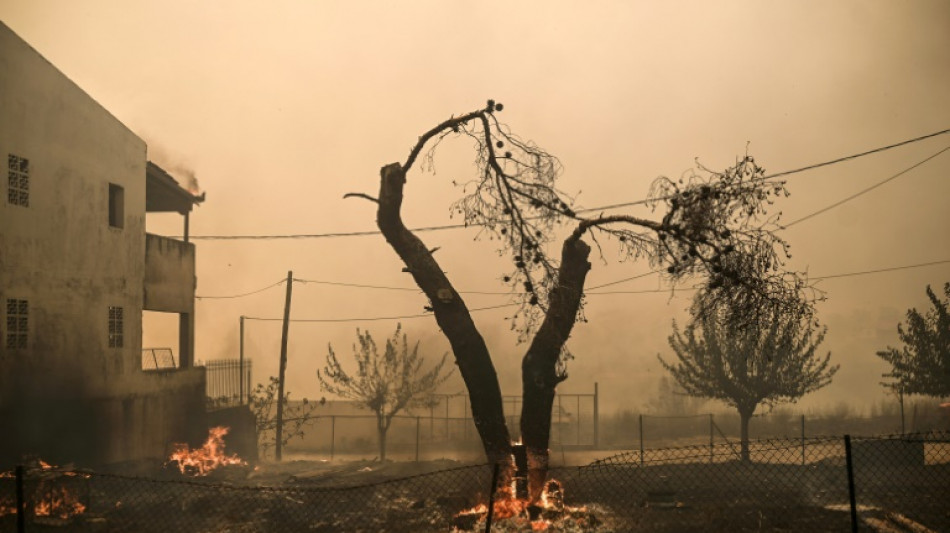
Climate change could bring year-round heatwaves: UN researcher / Photo: Angelos Tzortzinis - AFP

 Trump says 'massive' oil, gas, mineral exploration to begin in Greenland

 China heads for record trade surplus as exports surge

 Vietnam mourns 700 war dead in major push to identify missing

 Relentless Swiatek wins all-Polish battle to launch Wuhan campaign

 Seeing pivotal election, Israelis fly from around world to vote

 South Korea's Eom 'racially abused' in England's Championship: club
 Asian markets mixed as tech firms claw back some losses

 India shuts down iconic Delhi protest site after three decades

 Japan urges Russia for 'impartial treatment' of arrested journalist

 Lula, Bolsonaro ordered to call off attempts at online censorship
 EU takes a page from Ireland's AI playbook

 Global deforestation slowed in 2025 but surged in Congo basin: study

 LSEG Accelerates Tick History Analysis With NVIDIA

 Saudi employee arrested for allegedly bugging OpenAI office

 Atletico sink Man Utd as Viking deny Bayern in Champions League

 Man United's Martinez blasts board's lack of investment

 Meet A7 International, an Innovative Global Platform Designed to Reinvent the International Payments Market

 Shakhtar hope London move a reminder of Ukraine conflict

 Tresoldi hat-trick fires Brugge past Inter Milan

 Rams axe kicker Mevis after misses cost victory over Bills: reports

 Yamal stays cool at boiling Galatasaray to lift Barcelona to victory

 Arsenal cruise past Lille into share of Champions League lead

 Trump ousts Greece ambassador over ethics scandal

 Reese Witherspoon, France's Mediawan to buy Hello Sunshine

 Bipartisan US senators urge Trump to scrap Russian diesel deal

As Europe and other regions swelter, a UN researcher cautioned that climate change was enabling increasingly intense and long-lasting heatwaves, which in some areas could soon begin to hit year-round.
Extreme heat has dominated the headlines in recent weeks, from the current "heat dome" cooking much of Europe, to heat-fuelled wildfires raging in Greece, Spain, Canada and Hawaii, and soaring temperatures in the middle of the South American winter.
Heatwaves are beginning earlier, lasting longer and becoming more intense, John Nairn, a senior extreme heat advisor at the UN's World Meteorological Organization (WMO), told AFP in an interview.
"It's the most rapidly emerging consequence of global warming that we are seeing in the weather systems," he said, stressing that this was in line with scientific predictions.
"People are far too relaxed about the signs," he lamented.
"The science has been saying this is coming your way. And this is not where it stops."
"It will only get more intense and more frequent."
- 'Parked' heat -
One reason, he explained, was that global warming appears to be leading to a weakening of the global jet streams -- air that flows high in the Earth's atmosphere.
As the jet stream waves grow slower and wavier, they allow weather systems to "become parked" in one spot for longer.
"You can get a summertime situation where you get persistent heatwaves, and the heat just builds and builds and builds, because the wave is not moving on," Nairn said.
If you look at the planet as a whole, he said you could see that "these heatwaves are appearing in each of those same wavelengths around the globe".
"The slowing down and parking of the weather patterns is setting us up so that North America, parts of the Atlantic ocean, Europe and Asia are simultaneously sitting in the (wave) ridges, getting caught."
Heatwaves are among the deadliest natural hazards, with hundreds of thousands of people dying from preventable heat-related causes each year.
- 'More dangerous' -
Nairn called for the conversation around heat to become "smarter".
Among other things, he said, there should be far more focus on rising overnight minimum temperatures than on the maximum day temperatures that grab headlines.
Repeated high nighttime temperatures are particularly dangerous for human health, since the body is unable to recover from the heat it suffers through during the day.
Higher overnight temperatures also mean that the energy accumulated during the day has nowhere to go, pushing temperatures even higher the next day.
The fact that minimum temperatures are rising faster than maximums is thus pushing excess energy "into longer periods of higher temperatures", Nairn said.
"It's cumulative... So heatwaves are becoming much more dangerous."
And as the climate continues to change, the situation is due to get worse, Nairn said.
He voiced particular concern over the situation in the tropics and subtropics, pointing to the record heat seen in South America, with temperatures up towards 40 degrees Celsius in the middle of what is supposed to be their winter.
Looking forward, he cautioned that "we're going to see a lot more heatwaves across a much longer period of the year".
In the tropics and subtropics, "unfortunately, the indications are that severe and extreme heatwaves are likely to be able to occur anytime (of year) before the end of the century".
Less sunlight means year-round extreme heatwaves are not expected at other latitudes, but Nairn stressed that there too we will be seeing more "unseasonably warm periods" even in winter.
Asked what could be done to rein in the rampant heat, Nairn stressed that "all of us have the capabilities to actually turn this around".
"We need to electrify everything... and stop burning fossil fuels. It's not harder than that."
Y.Baker--AT