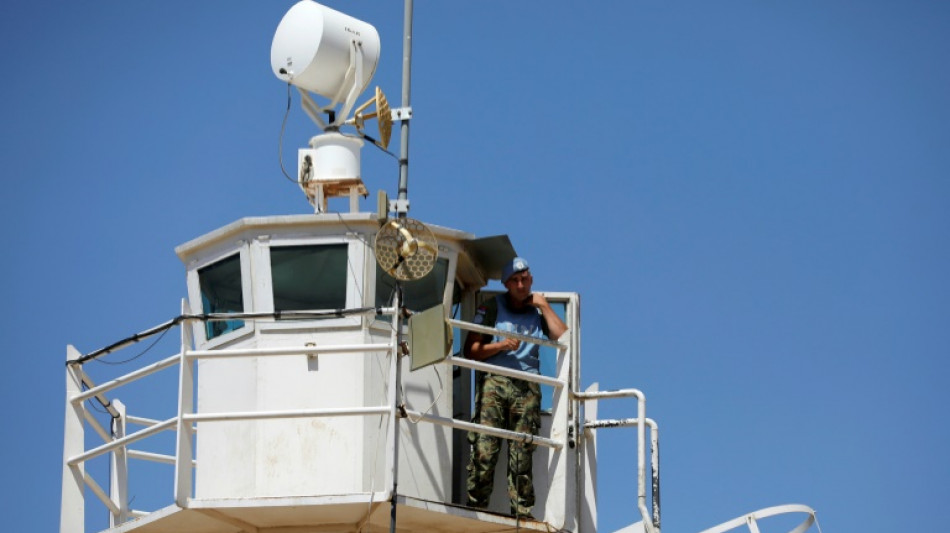
Divided border village at heart of Israel-Lebanon tensions / Photo: JALAA MAREY - AFP

 Iran hits back at Trump after insists truce over
 Scaloni wants 'never-say-die' legacy for Argentina
 Scaloni wants Argentina's legacy to be 'never say die'
 Spain into World Cup semi-final with France after late strike against Belgium
 Boeing unveils new 737 MAX production line as aviation giant charts comeback

 Wemby inks Spurs extension, tells fans 'I'm here to stay'

 Courtois backs Lammens to bounce back after World Cup blunder

 NBA T-Wolves add Ball and Green as James eyes options

 England's Rice, Guehi and James train ahead of Norway World Cup clash

 Merino strikes late as Spain beat Belgium to set up France World Cup semi

 Ohtani to miss All-Star Game for treatment on knee
 Hundreds of Peruvian newborns named after Norway striker Haaland

 Wall Street gets small boost from SK hynix debut

 Deschamps leads France to familiar territory in final World Cup
 Alfred goes third in 200m all-time list, Wanyonyi smashes 1km mark

 Trump agrees to more Iran talks but insists truce is over
 'No secret' that Kane v Haaland the key to England clash, says Norway coach Solbakken

 Prince Harry and family meet King Charles: UK media
 Sinner salutes 'true inspiration' Djokovic after ending rival's Wimbledon bid

 US senators announce Trump deal on Russia sanctions bill

 Foreigners among 12 killed in ferocious Spain wildfire

 Vinicius apologizes to Brazilians for World Cup 'frustration'

 Slick Sinner scuppers Djokovic record bid to make Wimbledon final

 India's Mandhana stars in inaugural women's Test at Lord's

 Xhaka tells Swiss fans to 'keep dreaming' ahead of Argentina World Cup clash
Straddling the frontier between Lebanon and the Israeli-annexed Golan Heights, the picturesque village of Ghajar has become a lightning rod for tensions between the hostile forces on either side.
The latest tit-for-tat exchange saw Israeli Defence Minister Yoav Gallant and the chief of Lebanon's powerful Hezbollah movement, Hassan Nasrallah, vow to send the other's country "back to the Stone Age" if the other escalates violence.
On the sleepy streets of Ghajar, home to manicured flower beds and ice cream trucks, an invisible boundary is intended to keep the two sides apart.
"The Blue Line is in the air," resident Abu Youssef Hussein Tawfiq Khatib told AFP, referring to the United Nations demarcation line drawn when Israeli troops withdrew from south Lebanon in 2000.
"You see that the town is open, there are no borders or anything," added the 79-year-old, wearing a traditional white headdress near the village mosque.
But weeks earlier, Israelis erected a controversial fence topped with barbed wire on the Lebanese side of the Blue Line.
The move followed cross-border fire in April that was the heaviest since a devastating war between Israel and Hezbollah in 2006. That and other incidents have sparked fears of renewed conflict.
Any miscalculation could have devastating consequences. The month-long 2006 war killed 1,200 people in Lebanon -- mostly civilians -- and 160 Israelis, mostly soldiers.
With the neighbouring countries still technically at war, Lebanon condemned the Ghajar fence as a unilateral Israeli "annexation" of the northern part of the village.
On July 6, an anti-tank missile was launched from Lebanese territory towards the new barrier, prompting retaliatory strikes by Israeli forces.
- 'Atmosphere of alert' -
Despite the cross-border exchanges, Ghajar resident Nahlah Saeed insisted that right now "here's safe -- Israel's safe".
"In the future, I don't know. I know that I live well, happily," said Saeed, 63, sitting in the shade outside a house.
According to municipal figures, the village is home to around 3,000 people, who took Israeli citizenship after Israel seized the Golan Heights from Syria in the Six-Day War of 1967 and then annexed it in 1981 in a move never recognised by the international community.
Village spokesman Bilal Khatib said residents had the "right to build a fence around our own homes".
"The council built the barrier and stopped the soil being swept away, protecting these homes. A second reason was that we had, more than once, wild animals entering the village," he told AFP in his office.
Under the scorching sun, UN peacekeepers patrol the northern side of the new fence, which is metres high and looks over Lebanese homes in the village of Wazzani.
On both sides of the Blue Line, local officials told AFP about title deeds and pointed to maps which they said prove their ownership of the disputed land.
Wazzani mayor Ahmad al-Mohammed said he has "adapted to the atmosphere of alert".
"In recent years, there was Israeli bombardment, which took a human, material and livestock toll. But people don't leave the village, because they must be tied to their source of livelihood," he told an AFP journalist in south Lebanon.
Lebanese authorities consider the expansion of Ghajar, with its pastel-coloured homes spreading to the north in recent decades, as an infringement on their land.
On the outskirts of Wazzani, shepherd Imad al-Mohammed rode a horse as he took his flock out to pasture.
"When the Lebanese lands in the vicinity of Ghajar are recovered, the pasture lands will increase and I'll take the sheep there," he told the AFP correspondent, pointing across to homes now behind the Israeli fence.
- 'Peace before everything' -
The UN is mediating the fence affair and acts as an intermediary in talks over the Blue Line, at which refreshments must be served separately to the opposing sides by the Italian contingent.
"Despite all the tensions in the area, there is still a commitment from the parties, or no appetite for a conflict," said Andrea Tenenti, spokesman for the United Nations Interim Force in Lebanon (UNIFIL).
Under international agreements backed by the two governments, "Israel is obliged to withdraw from the northern part of the village of Ghajar," Tenenti said.
Lebanon, meanwhile, is obliged to remove a tent that was erected across the Blue Line northeast of Ghajar earlier this year.
An Israeli security official, speaking on condition of anonymity as he was not authorised to speak publicly, said the "rogue terrorist army" Hezbollah was behind the tent and UN mediation on the matter was underway.
"Nobody wants this to escalate, right, so he (Nasrallah) is also trying to keep it under the threshold. We're keeping it under the threshold," the official said.
He cited Israeli forces using non-lethal weapons to push back Hezbollah members who approached the border around 40 kilometres (25 miles) southwest of Ghajar, wounding three militants.
Standing within view of the valley, Khatib, the elderly Ghajar resident, underlined the importance of "peace before everything".
"That's it, and everyone has the rights that belong to them. I take the land that belongs to me, and he takes the land that belongs to him," he said.
N.Mitchell--AT