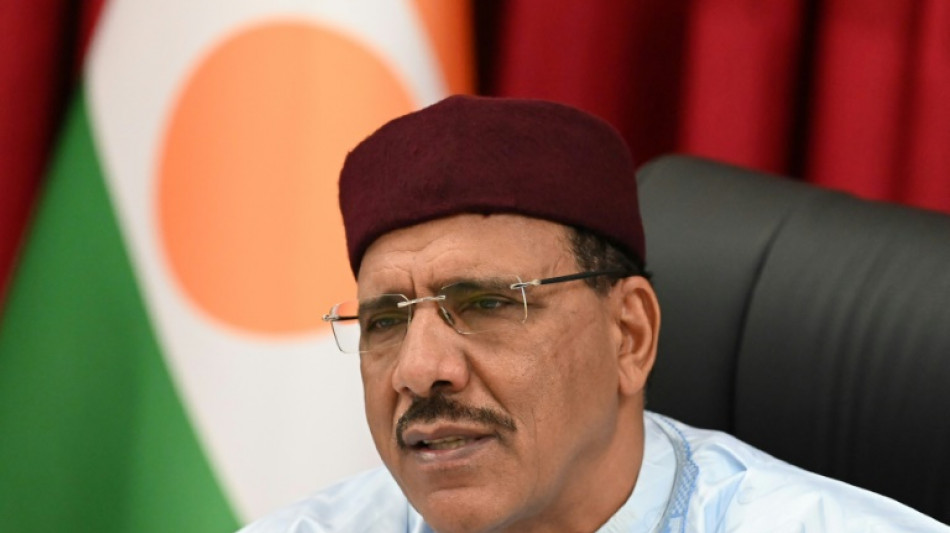
Military intervention in Niger laden with risks: experts / Photo: Issouf SANOGO - AFP/File

 NBA T-Wolves add Ball and Green as James eyes options

 England's Rice, Guehi and James train ahead of Norway World Cup clash

 Merino strikes late as Spain beat Belgium to set up France World Cup semi

 Ohtani to miss All-Star Game for treatment on knee

 Hundreds of Peruvian newborns named after Norway striker Haaland

 Wall Street gets small boost from SK hynix debut

 Deschamps leads France to familiar territory in final World Cup
 Alfred goes third in 200m all-time list, Wanyonyi smashes 1km mark

 Trump agrees to more Iran talks but insists truce is over
 'No secret' that Kane v Haaland the key to England clash, says Norway coach Solbakken

 Prince Harry and family meet King Charles: UK media
 Sinner salutes 'true inspiration' Djokovic after ending rival's Wimbledon bid
 US senators announce Trump deal on Russia sanctions bill

 Foreigners among 12 killed in ferocious Spain wildfire

 Vinicius apologizes to Brazilians for World Cup 'frustration'
 Slick Sinner scuppers Djokovic record bid to make Wimbledon final

 India's Mandhana stars in inaugural women's Test at Lord's
 Xhaka tells Swiss fans to 'keep dreaming' ahead of Argentina World Cup clash
 Drought threatens irrigation in northern Italy

 Fery expects to thrive in spotlight after Wimbledon fairytale

 Pressure off for 'scared' Merlier after Tour de France stage win
 Indian cricket board to review T20 team's 'bad phase'
 Nasdaq gets no boost from SK hynix debut in NY
 People 'disdain' AI, says director Christopher Nolan
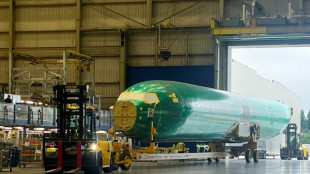 Boeing to expand 737 MAX output as aviation giant charts comeback

The West African bloc ECOWAS is mulling military intervention to restore Niger's elected president, Mohamed Bazoum, after he was detained by members of his guard on July 26.
But experts say any such move is freighted with operational and political hazards -- from mustering an intervention force to inflicting civilian casualties.
These, they say, are the main issues:
- Mobilising the force -
The Economic Community of West African States (ECOWAS) last Thursday mandated the deployment of a "standby force to restore constitutional order" in Niger.
The force has intervened six times among ECOWAS members since 1990, in such events as civil war or political chaos.
But, today as in the past, there is no clear agreement among ECOWAS members on the force's parameters, said Marc-Andre Boisvert, a Sahel specialist affiliated to the Centre FrancoPaix think tank in Montreal.
"Basically, the African standby force wasn't conceived to restore constitutional order in a country where there has been a coup," said Elie Tenenbaum of the French Institute of International Relations (IFRI).
Gathering the force "depends on the will of the contributors," said Boisvert -- an effort that requires lengthy negotiations and overcoming "enormous suspicion".
Out of 15 ECOWAS members, three -- Mali, Guinea and Burkina Faso -- have been suspended from the organisation's ranks because of military coups.
Of the others, West Africa's superpower Nigeria as well as Benin, Ivory Coast and Senegal say they are willing to send troops, although they also face strong opposition at home for this.
- Force numbers -
"An operation of this kind needs to mobilise between 3,000 and 4,000 soldiers," said a Senegalese general, Mansour Seck.
So far, only Ivory Coast has publicly named how many troops it would commit -- around a thousand.
"African states generally keep a jealous grip on their sovereignty when it comes to security and defence," Tenenbaum said.
Also, "it's hard to muster troops in armies which are already fragile and under-equipped."
Niger's own armed forces number around 30,000, of whom 11,000 are deployed fighting jihadists, according to figures given by Bazoum last year.
The military regimes in Mali and Burkina Faso have also said that any intervention in Niger would be considered a "declaration of war" against them.
On the other hand, their armed forces are weak and already embroiled with fighting jihadist insurgents.
- Operational risk -
Ousting the regime in Niger, a vast arid nation, means focussing on its capital Niamey.
A land offensive would mean having to cross several hundred kilometres (a couple of hundred miles) of hostile terrain.
In this light, specialists say a key lies in air mobility, possibly using Niamey's airport as a staging point for targeting the presidential palace where Bazoum is being held.
ECOWAS military chiefs "want to take Niamey airport and bombard the presidential palace, but we have modern anti-aircraft defence which is able to shoot down their aircraft," said Amadou Bounty Diallo, a Nigerien analyst and former soldier.
Seck said: "The landing strip is easy for the putschists to occupy -- all you need to do is put thousands of young people on it" to discourage pilots from opening fire to seize it.
"It won't be a simple military operation... one of the risks is that it could get bogged down, and that depends on the determination of the people on the spot," he warned.
Resistance to intervention will be based on the Presidential Guard, an elite force of 700 men, although the willingness of other army units to fight is a matter of debate.
Other components of the army outwardly endorsed the coup "in order to avoid bloodshed -- they don't want to be in a war," a Bazoum advisor said.
"As soon as things start getting serious, you will see many units break away."
In contrast, a Nigerien security source predicted that foreign intervention would cause the armed forces "to close ranks".
- Civilian casualties -
High civilian casualties is one of the big risks, said Tenenbaum.
Pro-coup supporters have rallied several times in the capital, many of them declaring they are willing to come to the help of their army if it were attacked.
"All this to free a president that putschists have said they will execute in the event of ECOWAS intervention," Tenenbaum said.
burx-str/stb/ri/kjm
M.Robinson--AT