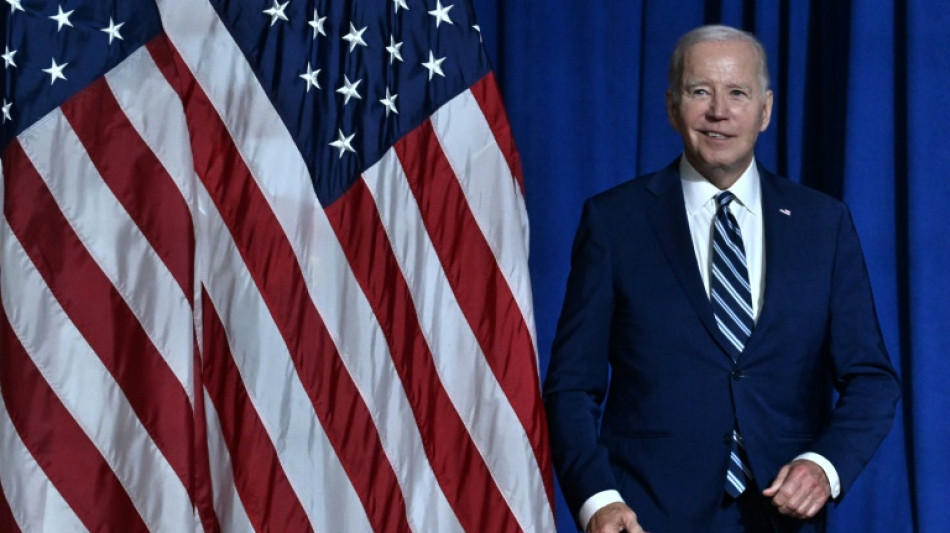
One year on: How has US climate plan affected trade ties? / Photo: Jim WATSON - AFP/File

 Hungary cuts anti-LGBTQ legislation from Orban-era law
 'Our future is being robbed': Greta Thunberg joins France student protests

 Late superstar Anita Mui's ashes missing in Hong Kong

 'No choice': IMF says developing countries must cut spending despite war shock

 Boasting South Korea footballers spark rethink of military service exemptions

 Five dead as Hurricane Simon, Rachel pummel Mexico's Pacific coast

 Seoul, Tokyo stocks plunge as Asia suffers fresh tech rout
 Damaged and drained, Indonesia's peatlands go up in smoke

 Dominant Australia wary of Pacific threat at Rugby League World Cup

 Pope to be admitted to hospital for lung operation

 Samoa's McFarland welcomes 'massive' arrival of ex-All Blacks for World Cup run-in

 Brewers beat Dodgers 7-4 to extend MLB playoff lead

 Teenager shoots headmaster, teacher at French school

 InterContinental Hotels Group PLC Announces Transaction in Own Shares - October 13

 Akkodis Brings Multilingual Intelligence to Mercedes-AMG PETRONAS Formula One Team races

 'Breaking Bad' actor RJ Mitte dead: representatives

 Former DR Congo president Kabila forms new force with M23 armed group
 Tom Cruise's 'Digger' tanks, leaving studio with $250 mn hole

 US actress Selma Blair arrested after flight altercation
 One dead as Hurricane Simon creeps along Mexico's Pacific coast
 Carrick's Man United 'hungry and eager' to fix worst start in decades

 Fury as US federal agents search anti-Trump lawmaker's home

 One goal enough for Flick as Barca enter Galatasaray cauldron

 A7 to unveil a service that will re-invent the international payments market
 'Status quo' with EU 'not good enough', UK PM says as summit date set

US President Joe Biden's landmark climate action plan may have been trailed by billions of dollars in clean energy investment, but its potential to reshape trade lines has strained ties with allies.
The Inflation Reduction Act (IRA), signed into law on August 16 last year, directs some $370 billion in subsidies toward America's energy transition, including tax breaks for US-made electric vehicles and batteries.
But the incentives, which boost American manufacturing after years of offshoring, have triggered fears that they could draw businesses out of other countries.
"This was really the United States coming into the game in a big way," said Joshua Meltzer, senior fellow at the Brookings Institution.
Europe had been subsidizing the development of clean technologies since before the IRA, as had China and others, Meltzer noted.
But Washington's entry "meant that for these subsidies to remain competitive they had to be continued or raised," he told AFP.
- 'Unintended consequences' -
The legislation had some "unintended consequences" in constraining trade with key US allies, said Jeffrey Schott, senior fellow at the Peterson Institute for International Economics.
A sticking point was a consumer tax credit of up to $7,500 for the purchase of electric vehicles (EVs) assembled in North America.
To qualify for the full credit, vehicle batteries should also have a percentage of critical minerals sourced from America or countries with which it has free-trade pacts, leaving the European Union and, initially, Japan in the cold.
This drew ire from those countries, and US officials eventually expanded access to the clean vehicle subsidies, noting in March that the free trade agreement requirement could also include newly negotiated critical minerals deals.
This includes one that Japan had inked with the United States just shortly earlier -- opening doors to benefits from some subsidies.
"Part of the initial friction was because... the last revisions of the IRA were done in haste and in secret," said Schott.
There appeared to be a "lack of understanding that US allies were not all US free-trade partners," he added, leading to some "creative accounting" by the Treasury Department in defining how the law would be implemented.
Meltzer said that the United States "quite quickly tried to respond to these concerns by negotiating these kind of bilateral deals," referring to Japan's pact and the EU's efforts toward a similar accord.
This alleviated many concerns, he said.
- Partnerships and relocations -
Canada, which warned about the risks of a subsidy war, has since responded by matching certain IRA incentives with those of its own.
In April, it announced up to 13.2 billion Canadian dollars ($9.8 billion) in subsidies over 10 years for Volkswagen's first overseas battery plant in Ontario.
Elsewhere, South Korea's largest automaker Hyundai is hoping to produce US-assembled electric cars eligible for subsidies at a site under construction in Georgia.
Other South Korean companies have forged partnerships with US ones to build assembly lines meeting IRA requirements, such as battery maker Samsung SDI's joint venture with General Motors to build an EV battery plant in the US.
"The IRA would benefit the US through additional output and lower strategic dependence vis-a-vis China," said an analysis by three European Central Bank economists in July.
"The US would gain from positive relocation effects, increasing production by six percent to 30 percent in electrical and optical equipment," the economists said in a column on the Centre for Economic Policy Research's policy portal.
This comes mainly at China's expense, and to a smaller degree the EU's, the economists said.
While the relocation involves a relatively small share of total output, losses in specific sectors can be more substantial.
Since the climate law was signed, at least $75 billion in new manufacturing investments has been announced, according to policy analyst Jack Conness of think tank Energy Innovation: Policy and Technology.
IRA green subsidies may be "of similar size" to those available in the EU, but the US clean-tech subsidies are "simpler and less fragmented," said European think tank Bruegel in a report this year.
Such factors could make the US subsidies more attractive to businesses, at a time when Europe also faces rising energy costs following Russia's invasion of Ukraine.
"If you're in an energy-intensive sector such as chemicals... the US looks increasingly attractive," Meltzer said.
"It's a broader set of factors, I think, that are creating competitive challenges in Europe," he said. "The IRA is a part of that... but it's not everything."
A.Moore--AT