Sudanese start small businesses to survive war / Photo: - - AFP

 Hungary cuts anti-LGBTQ legislation from Orban-era law
 'Our future is being robbed': Greta Thunberg joins France student protests

 Late superstar Anita Mui's ashes missing in Hong Kong

 'No choice': IMF says developing countries must cut spending despite war shock

 Boasting South Korea footballers spark rethink of military service exemptions
 Five dead as Hurricane Simon, Rachel pummel Mexico's Pacific coast
 Seoul, Tokyo stocks plunge as Asia suffers fresh tech rout
 Damaged and drained, Indonesia's peatlands go up in smoke

 Dominant Australia wary of Pacific threat at Rugby League World Cup
 Pope to be admitted to hospital for lung operation
 Samoa's McFarland welcomes 'massive' arrival of ex-All Blacks for World Cup run-in
 Brewers beat Dodgers 7-4 to extend MLB playoff lead

 Teenager shoots headmaster, teacher at French school

 InterContinental Hotels Group PLC Announces Transaction in Own Shares - October 13
 Akkodis Brings Multilingual Intelligence to Mercedes-AMG PETRONAS Formula One Team races
 'Breaking Bad' actor RJ Mitte dead: representatives

 Former DR Congo president Kabila forms new force with M23 armed group
 Tom Cruise's 'Digger' tanks, leaving studio with $250 mn hole
 US actress Selma Blair arrested after flight altercation

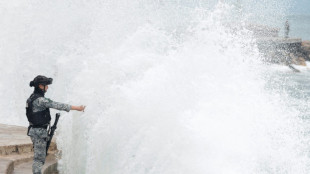 One dead as Hurricane Simon creeps along Mexico's Pacific coast

 Carrick's Man United 'hungry and eager' to fix worst start in decades
 Fury as US federal agents search anti-Trump lawmaker's home

 One goal enough for Flick as Barca enter Galatasaray cauldron
 A7 to unveil a service that will re-invent the international payments market

 'Status quo' with EU 'not good enough', UK PM says as summit date set
Sudan's war has left university lecturer Ali Seif without pay for months. To make ends meet, he has turned to making soap in his room at a makeshift displacement camp.
Out of work as fighting rages between the forces of rival generals, many Sudanese have been forced to find creative ways to support themselves and their families.
Until April 15, when the conflict erupted between the army headed by General Abdel Fattah al-Burhan and Mohamed Hamdan Daglo's paramilitary Rapid Support Forces, Seif had worked at a Khartoum university.
Now the engineering lecturer and his family live in Wad Madani, a city where most of the nearly three million people displaced from the capital fled for safety with the few belongings they could bring.
Wad Madani has been spared the violence so far, but air strikes and fighting are taking place around 150 kilometres (95 miles) to the north.
Like many others, Seif said his house was "robbed" by paramilitaries, and he told AFP he has not received a salary since March with banks closed.
In order to survive, he has started selling soap.
"Misfortune makes you creative," said Seif.
"I noticed there was no soap left on the market even though everyone wanted some, so I decided to make soap bars," he recalled, surrounded by plastic pots he uses to mix soap paste before pouring it into ice cube trays to mould the bars.
- 'No choice' -
Like Seif, Michelle Elia Moussa used to stand in front of a classroom full of students.
But since the war turned her life and country upside down, she has spent her days standing in front of a stall at Al-Hasaheisa market, halfway between Khartoum and Wad Madani.
"I've given up hope and shelved my ambitions of being a brilliant teacher," she said, glasses on her nose and apron around her waist, as she looks over her cakes.
"Without a job, I can't support myself," she said, in a poverty-stricken country where the spectres of famine, epidemics and widespread war crimes now loom large.
"It's the first time I've worked in a market," she told AFP.
"I'm not comfortable, I'm ashamed, but it's a war. I have no choice," she added, expertly spreading a light dough on cast-iron plates to make thin wafers with holes.
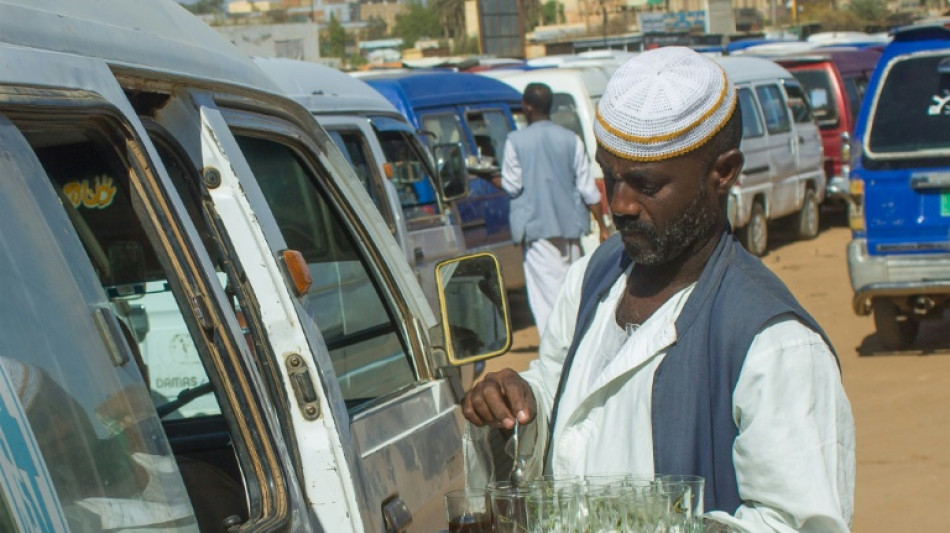
Eshraqa Mousa, another woman who fled Khartoum, has opened a small stall to sell tea. Without it, she said, she could "only provide one meal a day" for her children.
- Leaving 'everything behind' -
Her family's hasty departure from the capital at the start of a war that has killed at least 3,900 people and displaced four million is still fresh in Mousa's memory.
"We left everything behind... so I came here and bought this little stall to sell tea," she said, draped in her long, multicoloured veil.
In a conservative society where tea sellers, though numerous, are often stigmatised and harassed, the move was an act of bravery she had never imagined she would achieve.
But with the war, such taboos were shattered, and survival and resourcefulness took over.
"We were forced to find alternatives," said Mohammed Ali.
A former civil servant in the capital, he "teamed up with some colleagues to open a small mobile food stall", he said.
Made of white sheet metal and powered by a generator, it's "in the style of those you find in Khartoum, which don't exist in Wad Madani."
Every day, he now sells mashed beans, falafel and other snacks loved by his compatriots, and he makes enough to feed his family.
That is, until the next storm: the streets of Wad Madani are buzzing with speculation that the war could soon come to this city.
Ch.Campbell--AT