Pentagon eyes missile testing role for Australia / Photo: ANDREW LEESON - AFP/File

 'Breaking Bad' actor RJ Mitte dead: representatives

 Former DR Congo president Kabila forms new force with M23 armed group

 Tom Cruise's 'Digger' tanks, leaving studio with $250 mn hole

 US actress Selma Blair arrested after flight altercation

 One dead as Hurricane Simon creeps along Mexico's Pacific coast

 Carrick's Man United 'hungry and eager' to fix worst start in decades

 Fury as US federal agents search anti-Trump lawmaker's home

 One goal enough for Flick as Barca enter Galatasaray cauldron

 A7 to unveil a service that will re-invent the international payments market

 'Status quo' with EU 'not good enough', UK PM says as summit date set
 Stolen Renoir paintings found behind wall in France

 French supermarkets suffer refrigerator shutdown after 'unprecedented' cyberattack

 Arsenal lose Hincapie and Zubimendi in freak double blow
 Saudi says resilience tested, vows response after deadly airport attacks
 Alcaraz exits Shanghai Masters in straight-sets loss
 Pope to enter hospital on Tuesday for lung operation
 Renshaw shines again before Australia declaration

 Atletico's Simeone encourages goalless Alvarez improvement

 FXGLOBE Rebuilds Its Copy Trading and PAMM Business With B2BROKER's B2COPY

 Nepal rescuers search for missing after flash flood

 Oil rises as Trump comments roil energy markets
 Premier League in limbo as Manchester City soar

 Zelensky vows to respond as Moscow silent on 'energy ceasefire'
 Thousands march in India's capital to demand election chief resign

 African players in Europe: Mbeumo ends goal drought as United draw

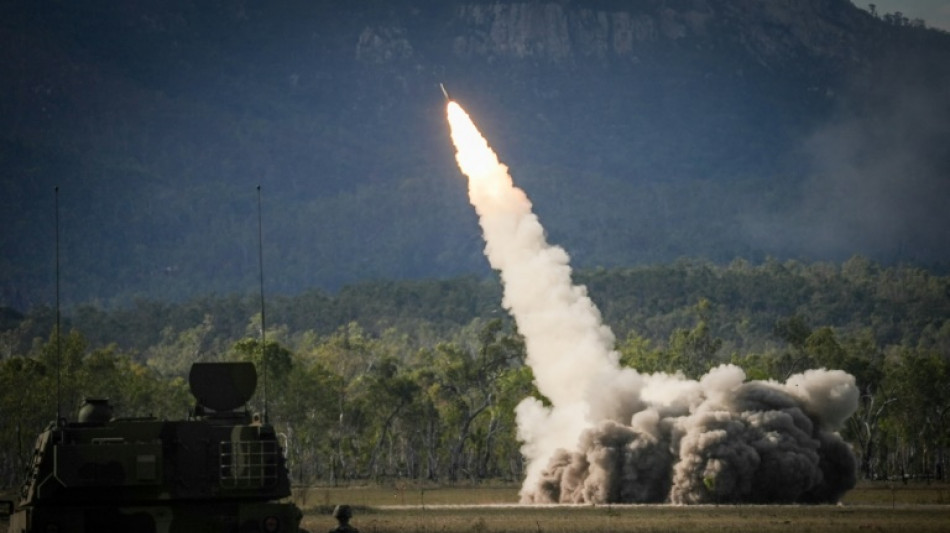
Australia could be a testing ground for US hypersonic and other long-range precision weapons under the AUKUS pact, a top Pentagon official told AFP on Wednesday.
US Secretary of the Army Christine Wormuth said Australia's contribution to the three-way AUKUS agreement, which includes Britain, "doesn't always have to be dollars".
The pact was signed in late 2021 and is seen as a way of countering China's growing clout in the Asia-Pacific region.
Work under AUKUS has so far focused on supplying Australia with nuclear-powered submarines, a fleet capable of travelling stealthily over vast distances and striking foes at long range.
But the pact is increasingly focused on developing advanced capabilities such as long-range precision firing, artificial intelligence and hypersonic weapons.
Wormuth said Australia could be a proving ground for these weapons.
"One thing Australia has in spades is long distances and relatively unpopulated land," she told AFP in a telephone interview from Washington.
"A challenge for us in the United States when it comes to hypersonics or even some of our things like the precision strike missile -- which is not a hypersonic weapon but has very long ranges in some of its increments -- for us to find open spaces in the United States where we can actually test these weapons, it's a challenge.
"Australia obviously has a tremendous amount of territory where that testing is a little bit more doable -- so I think that's a unique thing, as an example, that the Australians bring to the table."
China has denounced the AUKUS pact as undermining peace in the region -- a charge that Washington, Canberra and London reject.
But critics have also asked whether it is truly cooperative, or whether the United States, because of its size and overwhelming military power, will dominate.
Wormuth said she expected the two smaller partners to pitch in and "have skin in this game -- and they do".
"The sense I got certainly from talking to senior Australian officials is they're not doing this to make us happy, they're not doing this just for fun," said the Pentagon official, who visited Australia last week for the Talisman Sabre multinational military exercise.
"They're doing this because they see it as in their own national interest in terms of being able to meet the different challenges that they see in the theatre."
- 'Prohibitively expensive' -
Facing Russia's war in Europe, threats from North Korea and a more bellicose China, the United States has sought to bolster its defence alliances and put more advanced capabilities into the hands of allies like Australia, Ukraine and Taiwan.
For much of the Cold War, it was Washington's policy to be able to fight two major wars at once.
Wormuth admitted that today, budget constraints, US public opinion and the relative strength of Russia and China make such a doctrine impossible.
"I think there is a recognition that when you look at the size of our military, when you look at the size of the defence budget that the American taxpayer is willing to pay for, we... don't plan to fight more than one major war at a time," she said.
Instead, the United States hopes its alliance and nuclear arsenal will "discourage opportunistic aggression".
"Given the sophistication of the Russian military and the Chinese military today, to try to size our military to hypothetically handle two wars at a time would be prohibitively expensive".
R.Lee--AT