Five things to know about LNG as EU looks beyond Russia

 PSG outgun embattled Man City in six-goal Champions League thriller

 In Chicago, pope's hometown, Catholics express shock and support

 Musk suggests US govt behind any slowdown in Ukraine's Starshield system
 Chiclayo prays for recovery and return of the 'Peruvian pope'
 Barcola scores hat-trick as Liverpool hit LASK for six

 Healthy corals help bleached neighbors regain color: study

 Hope ton helps West Indies level T20 series at 2-2 in India

 Ukraine war reaches shores of Bulgarian fishing village
 Brazil probing 'criminal' origin of forest fires: minister to AFP

 Sally Rooney books cannot be sold in UK amid Palestine Action ban: publisher
 Italian ski stars Goggia and Brignone to miss season opener
 Bournemouth boss Rose urges Cherries to bounce back from Chelsea 'slap'
 Top seed Sabalenka falls at first hurdle in Wuhan
 FX Junction Brings Copy Trading to Everyone, While Their Money Never Leaves With Their Broker

 Brighton defender Struijk's red card overturned

 Saudi league postpones three matches after Houthi attacks
 US consumer inflation up more than expected as midterms loom

 Canadian publisher supports novelist Orelien after AI denial
 Medvedev sees off Tsitsipas to reach Shanghai Masters quarters
 Louvre boss warns of closure risk without major renovations
 Lawes and Genge urge England to end ban on overseas-based players

 Metrika Selected by OCC to Support Stablecoin Supervisory Framework Under the GENIUS Act

 Kenya hosting 2029 World Championships will help doping fight, says Coe
 UK prosecutor tells jury Russell Brand a 'sexual predator'
 Fulham manager Arbeloa fined £25,000 after Man Utd outburst

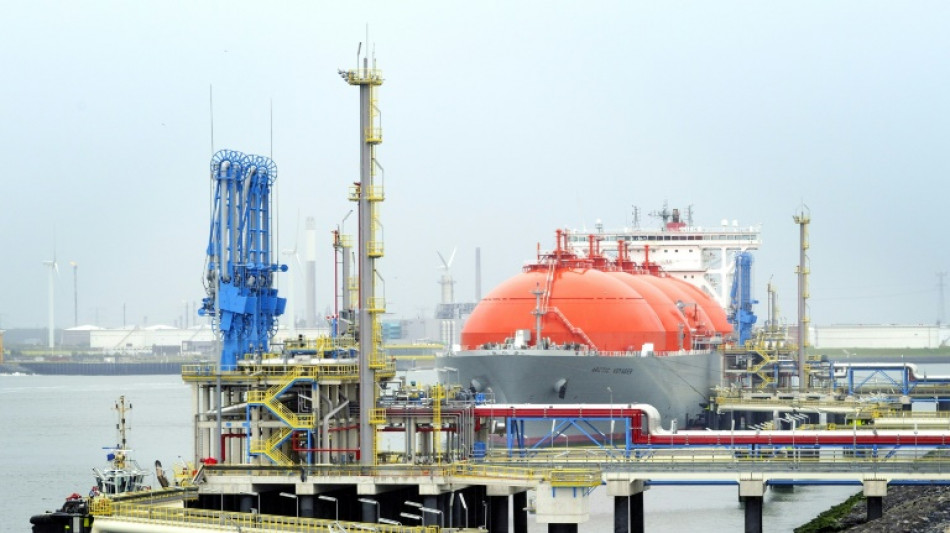
Europe is counting on liquefied natural gas (LNG) to help reduce its heavy dependence on Russian energy in the wake of Moscow's invasion of Ukraine.
The European Commission this week set a target of slashing Russian gas imports by two thirds by the end of the year.
Russia supplies 40 percent of the EU's gas needs, with Italy and Germany especially dependent.
Here are five things to know about LNG:
- Tanker transport -
After its extraction, natural gas is cooled down to minus 162 degrees Celsius (minus 260 degrees Fahrenheit) to turn it into its liquefied form.
Natural gas takes up 600 times less room as a liquid than in its gaseous state, making it easier to transport it in tanker ships.
On arrival at port, LNG is converted back into gas in terminals before it goes into national energy grids.
It can also be transported by tanker trucks in its liquefied form to be taken to industrial zones.
- From Papua New Guinea to Trinidad -
LNG offers more options in terms of suppliers as it can be imported by sea from countries that are not connected to pipelines.
Some of the alternatives invoked for Europe include the United States, Australia and Qatar.
They are among some 20 countries that export LNG, a group that includes countries as far afield as the Pacific island of Papua New Guinea as well as Trinidad and Tobago in the Caribbean.
Russia also ships LNG.
Trade in LNG increased by six percent last year, pushed up by higher demand from China and South Korea, according to Shell's annual LNG outlook.
- Tight market -
In a 10-point plan to reduce the EU's reliance on Russian gas, the International Energy Agency said the bloc could "theoretically" increase its near-term imports of LNG by some 60 billion cubic metres.
The European Commission sees potential for 50 billion cubic metres.
But the IEA warned that all importers "are fishing in the same pool for supply, so (in the absence of weather-related or other factors that limit import demand in other regions) this would mean exceptionally tight LNG markets and very high prices".
A maximum of 35 billion cubic metres of LNG is expected to be added to the market this year, said Vincent Demoury, secretary general of the International Group of Liquefied Natural Gas Importers.
"It's possible that China will get around half of it, which would leave less than 20 billion cubic metres for the European market," Demoury said.
"Unfortunately you cannot ask (LNG) to perform miracles in the short term," he said.
- New terminals -
Poland and Lithuania have built LNG terminals.
Germany, which lacks terminals, said this month it would build one on its North Sea coast to reduce it dependence on Russian gas.
Before the outbreak of war, Germany imported 55 percent of its gas from Russia, via pipelines running through Ukraine, Poland and under the Baltic Sea.
But building terminals can take two to three years.
One option is to use ships known as a Floating Storage Regasification Unit (FSRU) to convert LNG into gas.
But it can still take 12 to 18 months to put them into service, said Demoury.
Europe also needs to improve its land connectivity to transport regasified LNG.
Spain, for instance, has six terminals for regasifying and storing LNG, Europe's largest network.
But there are only two pipelines between Spain and neighbouring France which have little capacity.
- Environmental impact -
The industry boasts that LNG offers a cleaner alternative to coal for electricity production and oil for the propulsion of ships.
But environmental groups are not fans of LNG.
"Replacing one fossil fuel and Russian dependency with another would prove a dead end for Europe in the medium term," said the Climate Action Network on the sidelines of an EU summit that ends Friday.
Lorette Philippot, private finance campaigner at Friends of the Earth, said the LNG sector impacts climate because it is energy-intensive, increases upstream production and emits harmful methane gases.
B.Torres--AT