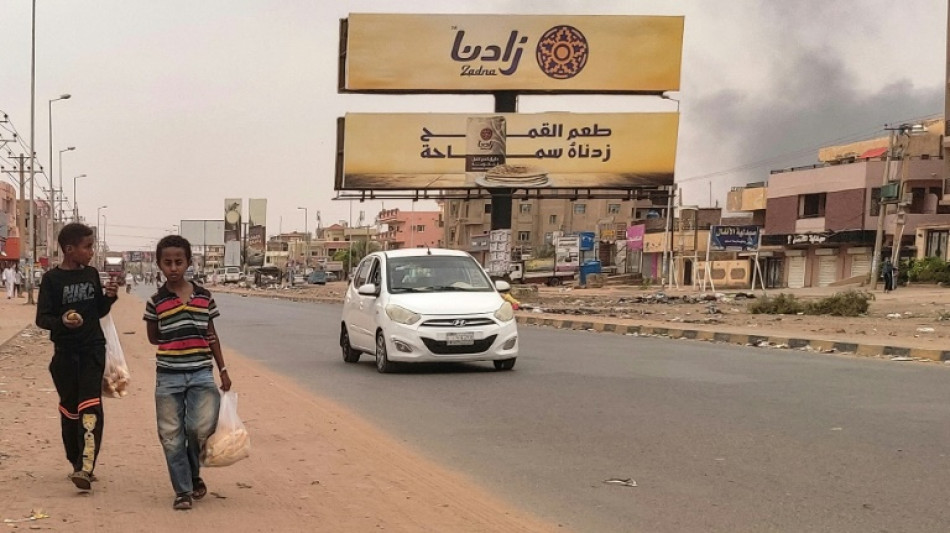
Sudan army returns to talks in Saudi as war enters fourth month / Photo: - - AFP

 Madrid mourns evicted retiree, 'icon' of Spain housing protests

 OpenAI revenue gap report rattles AI stocks
 France pledges more teachers after school students vow no let-up

 Bordeaux confirmed in sixth tier of French football
 Trump gives 'national treasure' Musk top US medal after rift

 MLB proposes shortening season, reforming playoffs

 Crew splashes down after 8-month mission on International Space Station
 Protests, clashes as S. African anti-migrant tensions reignite
 Russian data centre hit by drone in first for Ukraine war

 'Fighting for our future': France high school students vow no let-up
 Kyiv entering 'survival' mode amid Russian strikes surge: mayor tells AFP

 Verdict due in Mexico trial over murders of Australia, US surfers
 B2PRIME Welcomes Christina Barbash as Commercial Manager

 Russia forcing Kyiv into 'survival' mode before winter, mayor tells AFP
 Closing arguments begin in Maradona death trial
 UEFA president Ceferin to stand for re-election in 2027

 Nearly 300,000 Nepalis at flood risk: study
 Riyadh kindergarten hit by interception debris as Houthis say targeted airport
 Alex Bodi mizează, alături de CRIF, pe investiții transparente și pe prevenirea riguroasă a spălării banilor

 Gulf Labs, Part of Thailand’s $27 Billion GULF Group, Goes Live as an Injective Validator

 EU okay for winter despite 'historically low' gas stocks: operators

 Rwanda to host F1 Grand Prix: sources close to both sides

 EU top diplomat says bloc in favour of UN Lebanon peacekeepers' extension

 Antonelli and Russell to run different Mercedes aero packages in Singapore

 WTO hikes 2026 trade growth forecast on AI boom

Sudanese army representatives have returned to Jeddah in Saudi Arabia for talks with their paramilitary foes, a government source said Saturday as the war between rival generals entered its fourth month.
"A delegation of the armed forces has returned to Jeddah to resume negotiations with Rapid Support Forces (RSF) rebels," the source told AFP on condition of anonymity because they were not authorised to speak to media.
The RSF has made no comment on returning to the talks in Jeddah, which Saudi and US mediators adjourned last month after a series of repeatedly violated ceasefires.
On April 15, a power struggle between army chief Abdel Fattah al-Burhan and his former deputy, RSF commander Mohamed Hamdan Daglo, burst into all-out war, claiming at least 3,000 lives and displacing more than three million people.
The delegation in Saudi Arabia signals a return to diplomatic efforts by the army, after it boycotted talks last week in Ethiopia hosted by east African regional bloc IGAD.
Khartoum's foreign ministry had objected to Kenyan President William Ruto's leadership of the IGAD quartet, accusing Nairobi of siding with the RSF.
Before the Jeddah talks were suspended, US mediators had grown increasingly frustrated with both sides' reluctance to work towards a sustained truce.
Experts believe that both Burhan and Daglo have opted for a war of attrition instead, hoping to extract greater concessions at the negotiating table later.
- No respite -
For three months, barely a day has passed for residents of the capital Khartoum without their homes shaking from constant air strikes, artillery blasts and gun battles.
To escape the brutal urban warfare and rampant looting, 1.7 million people have fled the capital, according to the United Nations.
Millions remain in the city, sheltering at home as the violence shows no signs of abating.
Witnesses again reported "clashes using various types of weapons" in the capital's northwest on Saturday as well as air strikes from army fighter jets in the south.
Others said RSF drones had targeted Khartoum's largest military hospital, in an attack the army said killed "five patients" and injured 22 others, "mostly civilians".
The UN has said that most hospitals in combat zones were out of service.
Outside Khartoum, the worst fighting has taken place in the western region of Darfur, where a quarter of Sudan's 48 million people live.
Entire villages and neighbourhoods there have been destroyed, with reports of mass civilian deaths and assassinations of officials for their ethnic background, blamed on the RSF and allied Arab militias.
The International Criminal Court has launched a probe into suspected war crimes, including sexual violence and civilians being targeted for their ethnicity, its chief prosecutor announced Thursday.
Though most of the fighting has been concentrated in Khartoum and Darfur, new fronts have sporadically opened up, particularly in the south where witnesses said a rebel group took an army base in South Kordofan state on Friday.
- Compounding disasters -
Those who successfully flee combat zones are not out of harm's way.
More than 2.4 million people have been displaced to other parts of Sudan, where roadblocks, the breakdown of the banking system and fragile health services mean responders are ill-equipped to meet soaring demand.
Three months in, "the battle lines are hardening, making it ever more difficult to reach the millions of people who need urgent humanitarian assistance," UN humanitarian affairs chief Martin Griffiths said on Saturday.
Aid groups and health workers repeatedly warn that without humanitarian corridors -- which the army and RSF both had pledged but which failed to materialise -- disease outbreaks and overwhelmed care facilities could spell disaster.
Griffiths, the UN under-secretary-general for humanitarian affairs, renewed appeals for safe passage of aid Saturday, after fighters have repeatedly confiscated relief supplies and prevented convoys from passing through checkpoints.
"We cannot replenish stores of food, water and medicine if brazen looting of these stocks continues. We cannot deliver if our staff are prevented from reaching people in need," he said.
The UN says 740,000 people have fled across borders to Sudan's neighbours, some of which face economic crises or political instability themselves.
In impoverished South Sudan, the closure of trade with its northern neighbour, combined with the influx of returnees and refugees, is jeopardising an already fragile humanitarian situation, according to the International Committee of the Red Cross.
And in the Central African Republic, "small arms smuggling" across the border is booming, while "severe shortages in food and fuel" threaten livelihoods, President Faustin Archange Touadera warned at a summit of Sudan's neighbours in Cairo on Thursday.
At that meeting, Egyptian President Abdel Fattah al-Sisi urged international donors "to honour their commitments", referring to $1.5 billion in aid pledged at a Geneva conference in June -- less than half the estimated needs of Sudan and its immediate neighbours.
L.Adams--AT