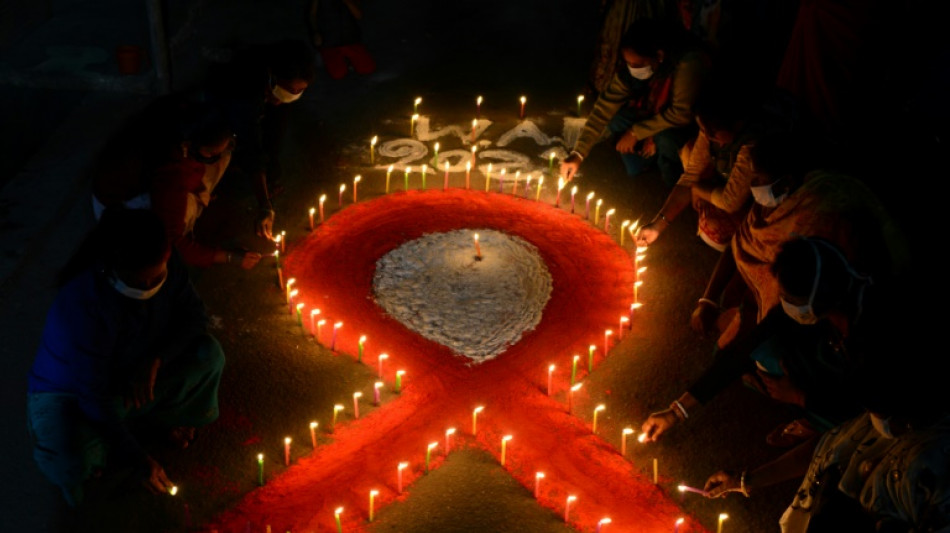
'End of AIDS' still possible by 2030: UN / Photo: Diptendu DUTTA - AFP

 Kyiv entering 'survival' mode amid Russian strikes surge: mayor tells AFP

 Verdict due in Mexico trial over murders of Australia, US surfers

 B2PRIME Welcomes Christina Barbash as Commercial Manager

 Russia forcing Kyiv into 'survival' mode before winter, mayor tells AFP

 Closing arguments begin in Maradona death trial

 UEFA president Ceferin to stand for re-election in 2027

 Nearly 300,000 Nepalis at flood risk: study

 Riyadh kindergarten hit by interception debris as Houthis say targeted airport

 Alex Bodi mizează, alături de CRIF, pe investiții transparente și pe prevenirea riguroasă a spălării banilor

 Gulf Labs, Part of Thailand’s $27 Billion GULF Group, Goes Live as an Injective Validator

 EU okay for winter despite 'historically low' gas stocks: operators

 Rwanda to host F1 Grand Prix: sources close to both sides

 EU top diplomat says bloc in favour of UN Lebanon peacekeepers' extension

 Antonelli and Russell to run different Mercedes aero packages in Singapore

 WTO hikes 2026 trade growth forecast on AI boom

 'I love that challenge': Hamilton prays for rain in Singapore

 G.Bissau moves towards postponement of December general election
 Verstappen out to settle 'unfinished business' at Singapore Grand Prix

 WhiteBIT Launches Bitcoin Lightning Network Support, Powered by Voltage

 Oil surges, stocks sink as US reportedly eyes fresh Iran strikes

 Anne Carson: modern takes on Greek classics

 Canada's Anne Carson wins Nobel literature prize

 Ethiopia drones hit Eritrean troops in Tigray

 Russian strike on buses kills 30 in frontline Ukrainian city

 Thailand begins extradition process against Chinese journalist

"The end of AIDS" is still possible by 2030, the United Nations insisted Thursday, but cautioned that the world's deadliest pandemic could only be halted if leaders grasped the opportunity.
"AIDS can be ended" as a public health threat, the UNAIDS agency said, as it outlined a roadmap of investment, evidence-based prevention and treatment, empowering civil society and tackling the inequalities holding back progress.
UNAIDS said ending the pandemic was, above all, a political and financial choice.
"We are not yet on the path that ends AIDS," the agency's executive director Winnie Byanyima said, but "we can choose to get on that path".
The UN first set out in 2015 the target of ending AIDS as a public health threat by 2030.
Byanyima said the greatest progress on HIV -- the virus that causes AIDS -- was being made in the countries and regions that have invested strongly.
She cited eastern and southern Africa, where new HIV infections have dropped by 57 percent since 2010.
Botswana, Eswatini, Rwanda, Tanzania and Zimbabwe have already achieved what are called the 95-95-95 targets.
This means that 95 percent of those living with HIV know their status; 95 percent of those who know they have HIV are on life-saving anti-retroviral treatment; and 95 percent of people on treatment to achieve viral suppression -- and therefore highly unlikely to infect others.
At least 16 other countries are close to achieving the target.
They include eight in sub-Saharan Africa -- the region where 65 percent of HIV-positive people live -- and Denmark, Kuwait and Thailand.
- 39 million living with HIV -
In a report, UNAIDS said that two decades ago the AIDS pandemic seemed unstoppable, with more than 2.5 million people acquiring HIV each year and AIDS claiming two million lives annually.
But the picture is now dramatically different.
UNAIDS said that in 2022, 39 million people globally were living with HIV, of whom 29.8 million were accessing anti-retroviral therapy. Those missing out include 660,000 children.
The numbers on anti-retroviral treatment have near-quadrupled from 7.7 million in 2010.
Furthermore, 82 percent of pregnant and breastfeeding women living with HIV had access to anti-retroviral treatment in 2022, compared to 46 percent in 2010 -- which has led to a 58 percent drop in new infections in children.
Around 1.3 million people became newly infected with HIV last year -- down 59 percent from the peak in 1995.
Meanwhile 630,000 died from AIDS-related illnesses, and it is still the "number one killer" in countries including Mozambique, said Byanyima.
"Overall, numbers of AIDS-related deaths have been reduced by 69 percent since the peak in 2004," the report said.
- 'Dependent on action' -
"The end of AIDS is an opportunity" for today's leaders to be remembered as "those who put a stop to the world's deadliest pandemic", said Byanyima.
"We are hopeful, but it is not the relaxed optimism that might come if all was heading as it should be. It is, instead, a hope rooted in seeing the opportunity."
Laws that criminalise people from key populations, or their behaviours, remain in place in many nations, UNAIDS said, giving the example that criminalisation, and stigmatisation, of drug injectors prevents them from coming forward for treatment.
HIV continues to impact key populations more than the general population, it added.
In 2022, compared with adults aged 15-49 in the general population, HIV prevalence was 11 times higher among men who have sex with men; four times higher among sex workers; seven times higher among people who inject drugs; and 14 times higher among transgender people.
P.A.Mendoza--AT