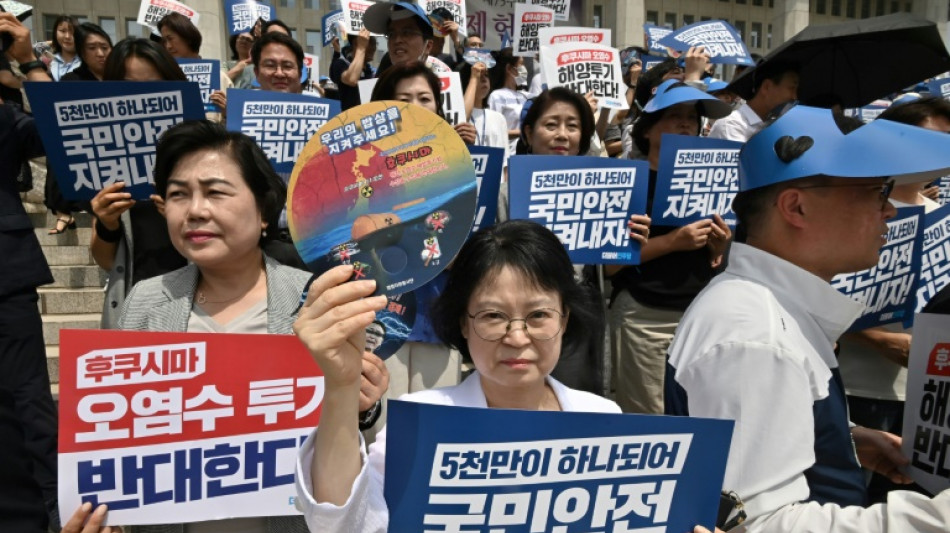
Impact of Fukushima water release on South Korea 'negligible': Seoul / Photo: Jung Yeon-je - AFP

 The British historian helping the French rediscover de Gaulle
 Dodgers beat Braves to advance, Guardians survive in MLB playoffs

 Latin American, Caribbean women top Nobel literature buzz
 US says Fiji-based Chinese official paid bribes for Beijing

 After botched US execution, Christa Pike was nearly taken off life support

 Guinea-Bissau junta urges military unit loyal to ex-president to disarm

 As species decline, green turtles offer glimmer of hope

 Brothers Scott and Beauden Barrett named to start for All Blacks

 EU trade chief seeks to dial down China tensions
 'Never again Bolsonaro': thousands march ahead of Brazil election runoff

 After botched execution, US woman was nearly taken off life support before revival
 Searing AIDS drama 'Elsinore' opens London film festival

 Evicted pensioner who sparked Spain housing protests dies: tenant union

 Golf star Rahm quitting LIV tour over 'unacceptable' terms

 Thousands march fearing return of a Bolsonaro presidency in Brazil

 French PM denies police ordered to confront student protesters

 Rubio touts US power, calls on Europe to emerge from 'slumber'

 Trump says 'we don't think' Russian plague is bio-weapon

 Five children among 26 killed in Ukraine after Russian strikes

 Man City should 'accept' punishment for rule breaches, says Lineker

 US woman who survived botched execution is awake and speaking
 From 1800s to modern pharma: a Nobel-winning chemistry quest

 Southampton boss Eckert given suspended ban over 'Spygate'

 Russia warns of 'false' information as second plague case reported

 IEA ready to release more oil reserves if necessary
Japan's plan to release treated water from the Fukushima nuclear plant would have "negligible consequences" for South Korea, Seoul said Friday, as it tried to assuage rising public concern.
The International Atomic Energy Agency (IAEA) this week gave the green light for a decades-long project to discharge accumulated water from the plant, which was devastated by an earthquake and tsunami that hit the eastern coast of Japan in 2011.
But the plan has encountered widespread public opposition and protests in South Korea, and even panic-buying of salt based on fears that the Fukushima water will pollute the ocean and the salt sourced from seawater.
South Korea conducted its own separate review of Tokyo's plan, and found Japan would meet or exceed key international standards, policy coordination minister Bang Moon-kyu told reporters at a press conference on Friday.
The study, which focused on whether the discharge would affect South Korean waters, found it would have "negligible consequences", the minister said.
It would take up to 10 years for the treated water released from Fukushima into the Pacific Ocean to circulate back into the seas around the Korean peninsula, Bang said.
By then, the radiation level "is projected... to be scientifically irrelevant", he added.
IAEA head Rafael Grossi will visit Seoul from Friday, but the agency's review has not alleviated strong resistance in South Korea to the discharge plan, with some opposition lawmakers even going on hunger strike in protest.
"Japan wants to release the wastewater into the sea because it's the easiest and cheapest way to do so," Woo Won-shik, an MP who has been on hunger strike at the parliament in Seoul since June 26, told AFP.
- Decommissioning over decades -
Several of the reactors at the Fukushima Daiichi plant went into meltdown after cooling systems were overwhelmed by the massive 2011 tsunami.
The resulting nuclear accident was the worst since Chernobyl, and the clean-up has lasted more than a decade, with most of the areas declared off-limits due to radiation now reopened.
Decommissioning the plant itself will take decades more, but the facility's operator TEPCO faces the immediate problem of more than 1.33 million cubic metres of water accumulated at the site.
The water is a mixture of groundwater, rain that seeps into the area, and water used for cooling.
TEPCO and Japan's government want to release the treated liquid, diluted with seawater, via a pipe extending a kilometre from the coast where the plant sits.
But South Korean MPs and civic groups claim there are multiple alternatives that are safer but more expensive, such as burying the treated water deep underground or vaporising it.
Hunger striking lawmaker Woo told AFP that the IAEA report had "failed to take into account long-term effects on humans via the food chain".
But at Seoul's sprawling Noryangjin Fish Market, many vendors expressed frustration over the high-profile domestic opposition to Tokyo's plan, saying it was bad for business.
Last week, ruling party lawmakers visited the market, with several drinking seawater from the fish tanks in front of cameras in a bid to reassure the public it was safe -- a move that drew widespread ridicule online.
The media coverage "is not helping us at all because it keeps people from coming", one 80-year-old vendor, who only wished to be identified by her surname Moon, told AFP.
The country needs to move on from questioning and criticising the water release, said Moon, who has run her stall for 50 years, because "many other countries are doing it as well".
Since taking power last year, South Korean President Yoon Suk Yeol has sought to bury the historical hatchet with Japan on issues including wartime forced labour as he seeks closer regional security cooperation in the face of rising nuclear threats from North Korea.
A.Williams--AT