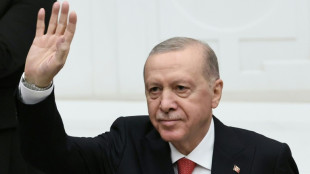
EU to take one giant leap towards digital euro / Photo: JOEL SAGET - AFP/File

 UK tax body opened probe into Man City in 2018: FT

 Yemen's Houthis claim new attacks on Saudi airports as conflict deepens

 Germany factory production at highest level for 18 months
 Thailand floods death toll rises to 60 since mid-September

 US pushes Russia for information on plague reports

 Myanmar leader lands in Malaysia for migrant return talks

 Indian central bank hikes rates for first time since 2023

 US military on Okinawa face curfew, alcohol ban after murder case

 Fierce lobbying in EU over 'forever chemicals'

 Dodgers beat Braves and Padres avoid sweep in MLB playoffs
 Mourning, war and elections as Israel marks October 7

 Messi says Argentina retirement is 'saddest day of my career'

 Oil rises and stocks fall as Hormuz worries flare

 Pacific presses world for help 'surviving' climate change at pre-COP summit

 Verstappen revival to be put to the test in steamy Singapore

 US woman who survived botched execution is conscious, speaking: lawyers

 Climate champion Australia digging more coal
 Emotion, tears as Messi retires from Argentina national team

 Dodgers push Braves to the brink of MLB playoff exit

 Crisis-stricken Haiti postpones elections

 N. Korea's Kim pledges 'invariable support' in Putin birthday letter

 OGRD Alliance Advances PLPC Multi-Asset Platform Following APHELAR Milestone, Expanding Licensing and Strategic Capital Frameworks

 VEON and Amdocs Enter 10-Year Strategic Agreement to Advance Digital Services powered by Amdocs' AI technology

 Emotion, tears as Messi prepares for Argentina farewell

 Kane eyes Ronaldo record after matching England cap mark

The EU will take the next crucial step on Wednesday towards launching a digital version of the euro, a controversial project that has come under attack from the public, politicians and banks before it even exists.
From China to the United States, Jamaica to Japan, dozens of central banks worldwide are exploring or have already put in place digital currencies as electronic payments dominate the way people spend their money and cash usage dwindles.
The move to create a digital version of the single currency began in 2020 when European Central Bank (ECB) President Christine Lagarde suggested the idea and the Frankfurt-based body launched a public consultation.
Digital euro enthusiasts say it will complement cash and ensure the ECB does not leave a gap that could be filled by private, usually non-European, players and other central banks.
Critics question the need for a digital euro and banks warn of major risks, while the ECB's own study found the public was concerned over payment privacy.
"If we are just duplicating the existing payment infrastructure with the digital euro, that is not a good enough business case. For the time being, the digital euro seems to be a solution in search of a problem," German MEP Markus Ferber told AFP.
The European Commission, the EU's executive arm, will publish a proposal on Wednesday that will be the legal foundation on which the ECB could launch a digital euro.
The final law must be backed by the EU's 27 member states and the European Parliament.
The ECB is set to give the formal green light to a digital euro in October and the expectation is that it will be available from 2027 onwards.
- Benefits 'outweigh' costs -
According to a draft proposal seen by AFP, the commission noted the digital euro's "long-term benefits... outweigh its costs" and warned "the costs of no action can potentially be very large".
The currency would be available for individuals living in the euro area and visitors.
Lagarde argued in March during a panel event that the digital currency was important for resilience and to "safeguard European payment autonomy".
Many of the means of payments are "not necessarily European", she noted, adding it was "very unhealthy to rely on one single source of payment".
US giants Visa and Mastercard currently dominate the global card payment market.
Her comments are in line with the EU's greater focus on bringing production to Europe or nearer to the bloc and moving away from relying on third countries.
Others argue, however, the EU's plans spell trouble, especially for banks.
The European Banking Federation (EBF) warned in March of the "significant risk for banks" because of the potential for bank runs as customers could hold their funds in digital euro accounts and wallets, moving them away from the banks' balance sheets.
The draft proposal includes a provision that will limit how much money people can keep in digital euros -- ECB officials have suggested a cap of 3,000 euros ($3,300).
The commission also said the digital currency would be granted "legal tender" status, meaning it must be accepted as payment.
There will be exceptions including for small businesses that do not accept any form of digital payment, according to the draft proposal.
- Privacy concerns -
The ECB has a difficult battle to win over Europeans. A public consultation showed that the number one priority when it comes to the digital euro is privacy.
To calm people's fears, the ECB has stressed it would not attempt to control how people can spend the digital currency or use it for surveillance, as critics claim is the case in China.
"The ECB would not set any limitations on where, when or to whom people can pay with a digital euro," ECB executive board member Fabio Panetta said in January.
In the draft text, the commission said the digital euro "will be designed so as to minimise the processing of personal data by payment services providers" and the ECB.
R.Garcia--AT