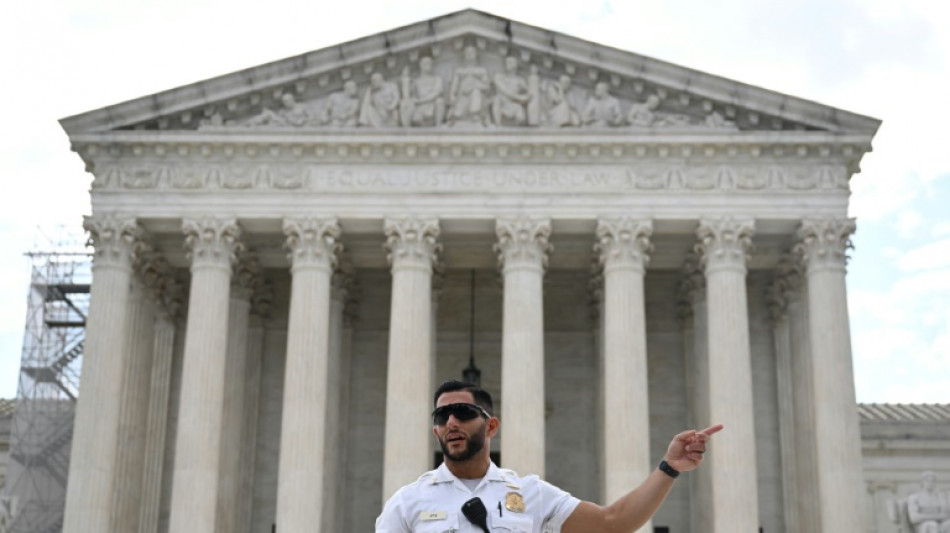
Supreme Court backs free speech rules in online stalking case / Photo: Jim WATSON - AFP

 UK tax body opened probe into Man City in 2018: FT

 Yemen's Houthis claim new attacks on Saudi airports as conflict deepens

 Germany factory production at highest level for 18 months

 Thailand floods death toll rises to 60 since mid-September

 US pushes Russia for information on plague reports

 Myanmar leader lands in Malaysia for migrant return talks

 Indian central bank hikes rates for first time since 2023

 US military on Okinawa face curfew, alcohol ban after murder case

 Fierce lobbying in EU over 'forever chemicals'

 Dodgers beat Braves and Padres avoid sweep in MLB playoffs

 Mourning, war and elections as Israel marks October 7

 Messi says Argentina retirement is 'saddest day of my career'

 Oil rises and stocks fall as Hormuz worries flare

 Pacific presses world for help 'surviving' climate change at pre-COP summit

 Verstappen revival to be put to the test in steamy Singapore

 US woman who survived botched execution is conscious, speaking: lawyers

 Climate champion Australia digging more coal
 Emotion, tears as Messi retires from Argentina national team

 Dodgers push Braves to the brink of MLB playoff exit

 Crisis-stricken Haiti postpones elections

 N. Korea's Kim pledges 'invariable support' in Putin birthday letter

 OGRD Alliance Advances PLPC Multi-Asset Platform Following APHELAR Milestone, Expanding Licensing and Strategic Capital Frameworks

 VEON and Amdocs Enter 10-Year Strategic Agreement to Advance Digital Services powered by Amdocs' AI technology

 Emotion, tears as Messi prepares for Argentina farewell

 Kane eyes Ronaldo record after matching England cap mark

The US Supreme Court sided with free speech advocates Tuesday in ruling that a man's online harassment of a country singer could only be deemed illegally threatening if he knew it could be understood as such.
The high court overruled the Colorado conviction of Billy Counterman for making what the western US state deemed threats among the thousands of unwelcome Facebook messages he sent to country singer Coles Whalen from 2014 to 2016.
True threats are not protected by the US Constitution's guarantee of free speech rights.
The Colorado court found based on state laws that Counterman's messages to Whalen -- such as writing "die, don't need you" and "staying in cyber life is going to kill you" -- could be objectively considered threats.
Counterman's attorney turned to the Supreme Court arguing that the only way of determining whether a message is a threat should be subjective: what was the sender's intent?
The case drew the interest of free speech advocates who worried that upholding Counterman's conviction would chill free speech protections by permitting the prosecution of anyone whose speech is perceived as threatening by another person, without proof of intent.
But Colorado had argued that requiring a subjective determination of the sender's intent would enable abuse of free speech rights, and specifically immunize stalkers "who are untethered from reality."
"Ninety percent of actual or attempted domestic violence murder cases begin with stalking," Colorado Attorney General Phil Weiser had told the court.
But in their 7-2 opinion, the justices rejected Colorado's arguments.
They said it needed to prove Counterman had at least some awareness that his messages could be perceived as threats.
Writing for the majority, Justice Elena Kagan did not completely bow to Counterman's argument that Colorado needed to prove he made a conscious threat against Whalen.
Instead, she said, the state only needed to prove that Counterman was being reckless.
"The state must show that the defendant consciously disregarded a substantial risk that his communications would be viewed as threatening violence," she wrote.
Based on legal precedents, according to Kagan, "we hold that a recklessness standard is enough" to convict.
The recklessness standard offers enough "breathing space" for protected speech without sacrificing the ability to enforce laws against true threats, she wrote.
In dissent, Justice Amy Coney Barret, backed by Clarence Thomas, said objective standards of what is threatening are supported by established law and enforced in many states.
She said the majority decision would make it harder to prosecute real threats, and that "recklessness" was a flimsy standard.
"The reality is that recklessness is not grounded in law, but in a Goldilocks judgement: Recklessness is not too much, not too little, but instead 'just right.'"
In response, Kagan wrote: "In law, as in life, there are worse things than being 'just right.'"
M.O.Allen--AT