Troubled Guatemala headed for runoff after inconclusive election / Photo: Johan Ordóñez - AFP

 Myanmar leader lands in Malaysia for migrant return talks
 Indian central bank hikes rates for first time since 2023
 US military on Okinawa face curfew, alcohol ban after murder case
 Fierce lobbying in EU over 'forever chemicals'
 Dodgers beat Braves and Padres avoid sweep in MLB playoffs
 Mourning, war and elections as Israel marks October 7

 Messi says Argentina retirement is 'saddest day of my career'
 Oil rises and stocks fall as Hormuz worries flare

 Pacific presses world for help 'surviving' climate change at pre-COP summit
 Verstappen revival to be put to the test in steamy Singapore
 US woman who survived botched execution is conscious, speaking: lawyers

 Climate champion Australia digging more coal
 Emotion, tears as Messi retires from Argentina national team
 Dodgers push Braves to the brink of MLB playoff exit
 Crisis-stricken Haiti postpones elections
 N. Korea's Kim pledges 'invariable support' in Putin birthday letter
 OGRD Alliance Advances PLPC Multi-Asset Platform Following APHELAR Milestone, Expanding Licensing and Strategic Capital Frameworks

 VEON and Amdocs Enter 10-Year Strategic Agreement to Advance Digital Services powered by Amdocs' AI technology

 Emotion, tears as Messi prepares for Argentina farewell

 Kane eyes Ronaldo record after matching England cap mark
 Spain fight back to beat Croatia, Kane adds to record for England

 Merino double helps Spain beat Croatia, reach Nations League quarters

 US stocks hit fresh records as oil stabilizes on rising supplies

 As Messi bows out, Argentines say 'thank you'

 Ronaldo opens door for Portugal return, apologises for walkout

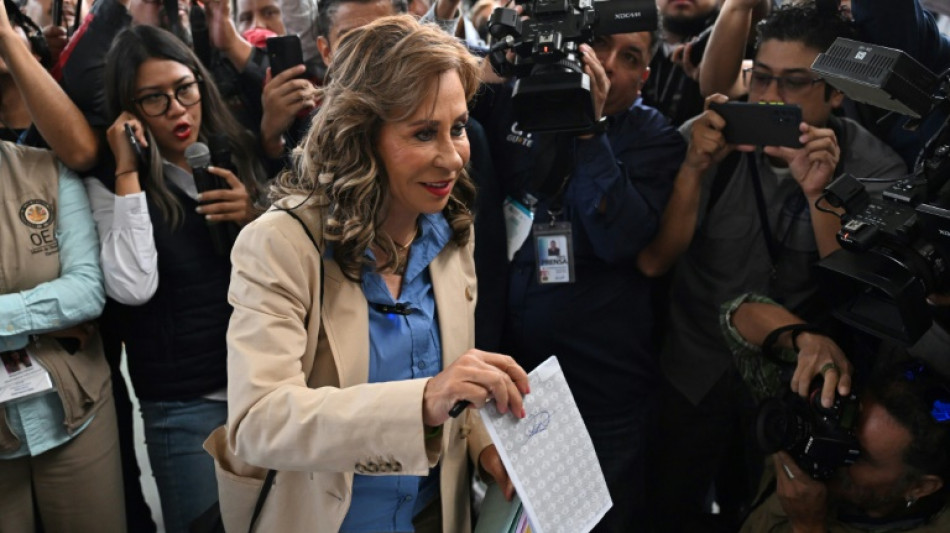
A former first lady and the son of an ex-president -- both social democrats -- will go head-to-head in Guatemala's August runoff after no candidate secured enough votes to win Sunday's first round of presidential elections.
The battle between Sandra Torres and Bernardo Arevalo -- who unexpectedly ended in second place having polled at number eight -- means Guatemala will have its first leftist leader in more than a decade.
Torres, the ex-wife of deceased former president Alvaro Colom, came in first Sunday with about 15.8 percent of votes cast, followed by Arevalo with just under 12 percent, according to the near-complete count early Monday.
Both oppose the legalization of same-sex marriage and elective abortion in this staunchly Catholic Central American country.
Career diplomat Edmond Mulet and rightwinger Zury Rios, daughter of a former dictator, placed fifth and sixth respectively, having polled in the top three with Torres ahead of the vote.
The candidate from outgoing President Alejandro Giammattei's Vamos party, Manuel Conde, came in third out of a crowded field of 22 candidates.
"We are very pleased with the results," said Arevalo, son of Juan Jose Arevalo who in 1945 became Guatemala's first democratically-elected president after decades of dictatorship.
"We did not feature in the polls, but we always said that we didn’t come to win polls, we came to win at the ballot box," the 64-year-old sociologist added.
For her part, Torres, 67, declared: "We are ready, ready and willing to win."
Representing the same National Unity of Hope (UNE) party as her ex-husband, Torres had lost her last two races in 2015 and 2019.
- 'Always the same' -
Sunday's election saw low turnout and a high rate of invalid ballots cast, with few Guatemalans holding out hope that their next president will solve the problems of crushing poverty, violence and corruption.
"We woke up very early to vote. We vote with enthusiasm -- and afterward, the presidents, it's always the same thing," voter Maria Chajon told AFP, resigned.
"There are no options to improve the country. They are the same as always," added lawyer Manuel Morales, 58.
More than 17.3 percent of all votes were invalid, more than the percentage won by any single candidate and four times higher than in the first round election in 2019.
"The winner is definitely the null vote, (evidence of) citizen discontent... in the system," Edie Cux, director of the local chapter of the Transparency International, told Emisoras Unidas radio.
The country of 17.6 million is one of Latin America's poorest, a reality that has, along with high rates of violent crime, compelled hundreds of thousands to risk the perilous migrant journey north toward the United States in hopes of a better life.
Rights groups have furthermore expressed increasing concern over perceived efforts to crack down on prosecutors and journalists in an apparent bid by the government to protect a corrupt system benefiting those in power.
Guatemala has one of Latin America's highest rates of social inequality, according to the World Bank.
More than half its inhabitants live in poverty and half of all children under five suffer from chronic malnutrition, according to the United Nations.
Crime is another major election issue. Guatemala's homicide rate is 17.3 per 100,000 inhabitants -- about three times the world average, the UN says.
- Burning ballots -
Sunday's vote was marred by the exclusion of two popular candidates, Carlos Pineda and Thelma Cabrera, invalidated by the Supreme Electoral Tribunal decisions their supporters claim amounted to political sidelining.
On election day, Torres lobbed claims of "buying votes" against the ruling party, as Mulet also pointed to alleged irregularities.
Voters clashed with police and soldiers in San Jose del Golfo, 18 miles (30 kilometers) northeast of Guatemala City, amid allegations the mayor brought people from other districts to vote for the ruling party.
Voting in the town was suspended.
In San Martin Zapotitlan police fired tear gas at demonstrators making similar allegations as they burned ballot papers at a local voting center.
Eleven people were arrested, police chief Edgar Moran said.
Giammattei, ending his constitutionally-limited single term with high disapproval ratings, did not comment on the claims of irregularities, instead accusing opposition groups of inciting violence.
According to early estimations, Giammattei's Vamos party will become the biggest grouping in the 160-member Congress, taking about 40 seats.
Torres's UNE, currently the biggest, will have about 27 and Arevalo's Semilla (Seed) party 24.
The runoff will be held on August 20.
burs-mlr/dw
H.Thompson--AT