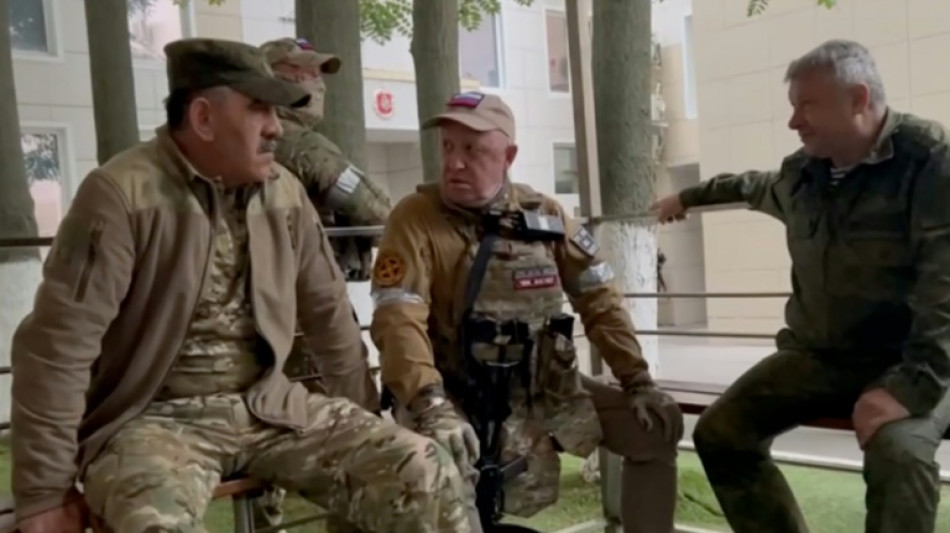
Wagner mutiny in Russia raises questions on overseas influence / Photo: Handout - TELEGRAM / @razgruzka_vagnera/AFP

 Hotel Blacklist Launches New Accommodation Industry Risk Assessment Tool
 Bangladesh nuclear plant draws hope -- and worry

 US beat Canada 1-0 to wrap up four-win international break
 Turkey, Australia's joint COP31 leadership raises doubts
 For Turkish NGOs, COP31 offers rare space for action

 Sleep, appetite, gene-editing experts contend for Nobel chemistry prize

 Nobel Peace Prize haunted by the 'spectre' of Trump

 Africa launches own credit agency in bid for cheaper borrowing

 US, China, EU: three paths to regulating AI
 Australia's High Court rules against coal mine in landmark climate case
 Australia touts new funds for Pacific infrastructure at Fiji 'pre-COP'

 Eva Marie Saint, Oscar winner of Hollywood classics, dies at 102

 Australia probes app used in cheap smart glasses over privacy fears
 England needed to 'move on' from World Cup pain, says Tuchel
 O'Neill to stay at Celtic after period of "reflection"

 Kane marks 125th England cap with Wembley Nations League double

 Quebec's incoming separatist leader wants to block Crown from swearing-in
 Emmys gala will now stream its premier television awards
 Paramount completes Warner Bros takeover, creating Skydance
 Trump blames France unrest on Islam, migration
 Apple's Cook praises EU over efforts to protect children online
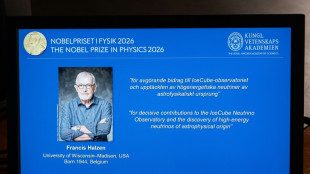 Nobel winner Halzen says years of October 'misery' finally over
 Quebec separatist win rattles Carney's unity push

 'Itching' for change: Shiffrin cuts back slaloms this season
 'Gen Z has risen up': Tens of thousands mass for tense France school protests
Russian mercenary group Wagner has been seen for years as an armed extension of Moscow's influence in Syria and Africa -- a status now called into question by its leader's aborted revolt.
After calling off his troops' advance toward Moscow, Wagner head Yevgeny Prigozhin was expected to go into exile in Belarus.
But now questions hover over the future of the group's operations in more far-flung places, where it is said to profit greatly from exploiting natural resources and propping up regimes sceptical of, or hostile towards, the West.
"Given Wagner's presence overseas, the greatest effects from this event may be felt in MENA (Middle East and North Africa)/Africa," Rob Lee, of the Foreign Policy Research Institute, wrote on Twitter.
"Wagner has a large presence across Africa, which benefits and depends on the Russian government/military.
"Would the Kremlin allow the same dynamic to continue if Prigozhin and Wagner are based in Belarus?" he added.
It is a question no-one can answer with certainty.
"It's a mystery, and it depends on how (the Russian authorities) want to compartmentalise what's going on in Africa and what's going on everywhere else," Michael Shurkin, director of programmes for the Africa-focused consulting firm 14 North, told AFP.
"Russia might think that what they (Wagner) are doing in Africa is worth continuing because it serves Russians interests as well," he continued.
"It's bad news for sure for the Malian and Centrafrican governments. No doubt about that. But we still don't know what is going to happen."
- Codependent -
What is likely, however, is that Prigozhin and Putin would have raised the subject before agreeing that the mercenary boss would go into exile rather than face charges over the mutiny.
Wagner depends heavily on the Russian defence ministry for deliveries of troops, equipment and weapons to its theatres of activity.
And Moscow, for its part, needs Wagner to help keep a grip on the troubled areas where it operates -- and where Russia is keen to undermine Western influence.
In Syria, according to the Syrian Observatory for Human Rights (SOHR), Wagner's mercenaries -- from Russia, former Soviet republics and Syria itself -- acted as "special forces" on the ground alongside Moscow's regular army after it intervened in the country's civil war in 2015.
They are allegedly still present today, in smaller numbers, near oil wells and in the provinces of Hama and Latakia.
In Africa, Wagner fighters have been identified in Libya, Mozambique and Sudan.
They are also on the front lines in insurgency-hit Mali -- whose junta insists it employs only "Russian instructors" -- as well as in the Central African Republic, where a Wagner executive manages the security of President Faustin Archange Touadera.
The group brings back "gold and minerals from Sudan, the Central African Republic and Mali, which Putin needs to keep his economy on life support", said a European military source.
The United Nations' independent expert on human rights in the Central African Republic has accused the army and its Russian allies of atrocities.
The European Union subsequently imposed fresh sanctions on Wagner, targeting several of its senior representatives in the African country.
On Friday, French President Emmanuel Macron accused Russia of being "a destabilising force in Africa through private militias who come to prey on and commit abuses on civilian populations."
- 'Uncertainty and hesitation' -
What happens next depends on the negotiations between Putin and Prigozhin via Belarus President Alexander Lukashenko.
"Visibly, in Bangui and Bamako, there's uncertainty and hesitation about what's happening," said Maxime Audinet, of the Strategic Research Institute at the Paris Military School (IRSEM), in reference to the authorities in the Central African Republic and Mali.
He noted that websites linked to Prigozhin and his wider network had been blocked, but only in Russia.
"Delegating huge swathes of power to Wagner so it could act where the Russian state didn't want to get involved has given the group much more room for manoeuvre than planned," he told AFP.
"I imagine that in the (Putin-Prigozhin) discussions, the question of all its (Wagner's) external activities has been put on the table.
"The Prigozhin network has become the dominant element of Russia's presence in sub-Saharan Africa in recent years," Audinet said.
"We can expect the fragile balance between Russian state and non-state actors on the continent to be shaken up."
It could take time for the dust to settle.
"Wagner had a certain amount of freedom in its projects in Africa," said Pauline Bax, deputy director of the Africa programme at the International Crisis Group.
But Putin "can't send Russian soldiers in Wagner's place. I can't see the group pulling out of the continent straight away."
A.Anderson--AT