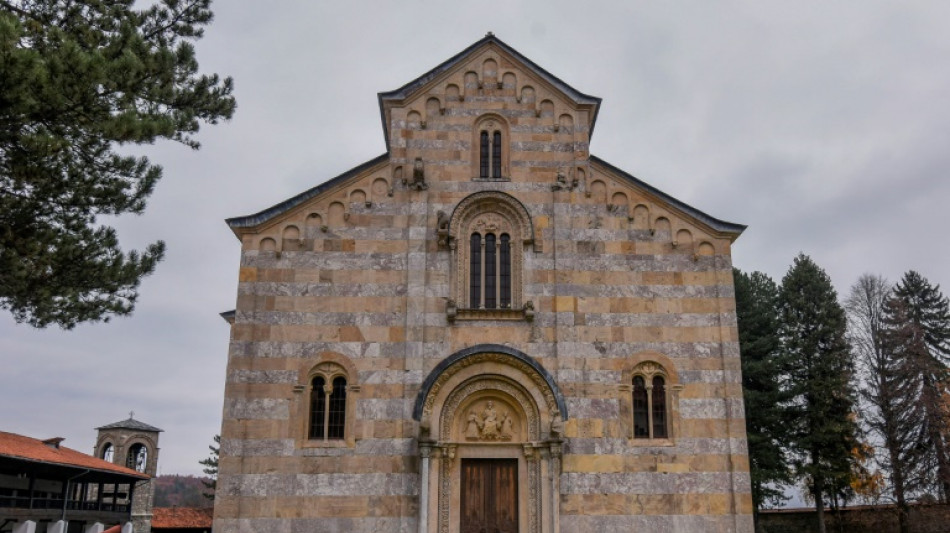
NATO-led peacekeepers guard medieval monastery in Kosovo / Photo: Armend NIMANI - AFP/File

 Hotel Blacklist Launches New Accommodation Industry Risk Assessment Tool
 Bangladesh nuclear plant draws hope -- and worry

 US beat Canada 1-0 to wrap up four-win international break
 Turkey, Australia's joint COP31 leadership raises doubts

 For Turkish NGOs, COP31 offers rare space for action
 Sleep, appetite, gene-editing experts contend for Nobel chemistry prize
 Nobel Peace Prize haunted by the 'spectre' of Trump

 Africa launches own credit agency in bid for cheaper borrowing

 US, China, EU: three paths to regulating AI
 Australia's High Court rules against coal mine in landmark climate case
 Australia touts new funds for Pacific infrastructure at Fiji 'pre-COP'

 Eva Marie Saint, Oscar winner of Hollywood classics, dies at 102

 Australia probes app used in cheap smart glasses over privacy fears
 England needed to 'move on' from World Cup pain, says Tuchel

 O'Neill to stay at Celtic after period of "reflection"

 Kane marks 125th England cap with Wembley Nations League double
 Quebec's incoming separatist leader wants to block Crown from swearing-in
 Emmys gala will now stream its premier television awards

 Paramount completes Warner Bros takeover, creating Skydance
 Trump blames France unrest on Islam, migration
 Apple's Cook praises EU over efforts to protect children online
 Nobel winner Halzen says years of October 'misery' finally over
 Quebec separatist win rattles Carney's unity push

 'Itching' for change: Shiffrin cuts back slaloms this season
 'Gen Z has risen up': Tens of thousands mass for tense France school protests
Located at the foot of the Balkans' Accursed Mountains, the Decani Monastery is seen as a symbol of Serbia's religious heritage in Kosovo -- and a "miracle" of survival through many conflicts.
The 14th century domed building, a World Heritage site which still boasts its original frescoes, is under 24-hour guard by NATO-led peacekeepers.
They are stationed at the approach to the monastery, their armoured vehicle topped with a big gun and sandbagged sentry post anomalous in the bucolic valley.
Inside the monastery compound, the soldiers' camouflage uniforms mingle with the black robes of the 20 Eastern Orthodox monks who live there.
Since the ethnic Albanian majority of Kosovo rose up in 1998-1999 against Belgrade, sites linked to Serbian heritage such as the monastery have become targets.
Although the situation in Kosovo has largely calmed in the two and a half decades since the 1999 Kosovo war, in which NATO intervened, simmering tensions require continued vigilance by the NATO-led KFOR peacekeeping force.
Tensions are currently at their highest since 2004, KFOR commanders say, with ethnic Albanians claiming municipal administrations in Serb-majority flashpoint towns in Kosovo's north, and Serbia holding three Kosovo policemen that were arrested mid-June.
- A haven -
The peace that reigns in Decani Monastery makes those troubles seem a world away, but its monks are aware that conflict has often lapped at its walls.
"Two Balkans wars, two world wars, Communism... the church suffered a lot. So it is kind of a miracle the church survived in such conditions," one of them, Father Petar, told journalists including AFP who visited under KFOR escort in late June.
The monk did not dwell on what threats the site confronts today, emphasising instead its mix of Gothic, Byzantine and Eastern architecture.
"It is a combination of the most beautiful elements of Christian art, from east and west," Father Petar said, observing that the church has "never changed" over its 700-year history.
During the Kosovo war and its aftermath, the monastery was a refuge for people of several religious beliefs, a haven from ethnic rivalries.
Built between 1327 and 1335, its founder was Serbian King Stefan Decanski, after whom it and the nearby village was named -- though Serbs refer to the village as Decani while ethnic Albanians call it Decan.
Orthodox faithful come from far to worship the remains of King Stefan, who was anointed Saint Stefan of Decani, which are kept in the altar under the cupola inside the monastery.
KFOR soldiers keep a respectful watch inside and outside the monastery as monks carry out the rituals.
"Our job is to maintain good relations with all the municipality elements, disparate ethnics (ethnicities) of course," said the KFOR team leader for the site, Sergeant Manuel Cetrullo.
A.O.Scott--AT