How US might help Ukraine -- without broadening the war

 Govt takes control of Turkey's most-watched news channel

 FIFA to offer members $6.35-billion development fund windfall

 US consumer inflation hotter than expected as midterms loom

 INmune Bio Inc. and Quantum Computing Inc. Partner to Apply Quantum Optimization and AI to Advance Alzheimer’s Drug Research and Explore New Applications for XPro

 Hot US inflation data dents Wall Street stocks

 India sends 'cockroach' leaders to jail after protest

 'Sinners' director Ryan Coogler to reboot 'X-Files' for Disney

 Lufthansa wins contest for TAP Air Portugal stake

 AI worms, 'major' incident fears spur safety calls at industry summit

 Fuel shortage triggers queues on Indonesia's Bali island

 Evolution Metals & Technologies Corp. Reaffirms $400 Million to $460 Million FY2027 Revenue Guidance, Unveils Eight Sintered Magnet Grades Covering an Estimated 75% of Global NdFeB Revenue, and Moves to Answer U.S. Army Call for Rare Earth Magnets

 Trial defence says Russia used Nord Stream pipelines as 'weapon'

 Israeli settlers set fire to mosque in occupied West Bank

 Macron says French student protesters 'exploited' by political forces: spokeswoman

 Stocks diverge ahead of key US inflation data

 Japan summons Russian ambassador to protest journalist's arrest

 Workers to strike at world's largest copper mine in Chile

 Ukraine accuses US of helping Russia as missiles hit Kyiv

 Drone hits data centre of Russia's largest bank

 Bivial AG Brings Its Complete Dashboard to Mobile

 Mont Blanc nearly two metres taller than in 2023: French surveyors

 Pope recovering after lung cancer operation that rattles Church

 Indonesia haze spikes Singapore pollution, shuts East Timor schools

 Higher borrowing costs an 'alarm signal' for France: finance minister

 Zelensky accuses Putin of disrespecting Trump after latest attacks

The United States believes Russia is digging in for a protracted war, and Washington wants to help Kyiv resist, but an overarching goal remains -- limiting the conflict to Ukraine to avoid spillover that could provoke "World War III."
The US military establishment is walking a tightrope as it seeks to balance such demands and avoid nuclear escalation, according to public statements by American leaders and AFP interviews with several officials who spoke on condition of anonymity to discuss the sensitive issue.
The conflict "may not be over soon," warned Secretary of State Antony Blinken during his latest visit to Europe.
US intelligence sources initially feared a lightning attack that would see Kyiv fall within days. But the Pentagon soon realized Russia's army was "behind" in its battle plan, due to logistical problems and Ukraine's fierce resistance.
The US military assumes, however pessimistically for Washington, that Russia's massive and superior military capacity could eventually overwhelm Kyiv.
As one senior US defense official put it: "I just don't think we should underestimate" Moscow's "firepower."
- Putin 'destined to lose' -
The suffering, Blinken cautioned, "is likely to get worse before it gets better."
But Russian President Vladimir Putin "is destined to lose," he insisted.
In private, US officials go further, not hesitating to assert the Russian leader has already lost. And they are adapting their strategy accordingly.
Their first priority is to keep providing major assistance to Ukraine's resistance so it can hold on, even if some cities begin to fall.
The Americans have put in place "robust information and intelligence sharing with Ukraine," one diplomat explained, in particular to enable anti-aircraft defenses to thwart some of Russia's attacks.
An unprecedented $350 million in emergency military aid announced in late February has already been delivered to Ukrainian forces in the form of Stinger anti-aircraft missiles and portable Javelin anti-tank missiles.
Washington plans to release a massive $10-billion package including economic and humanitarian assistance, along with more weaponry and ammunition.
There is "no limit" to military assistance, one senior US official stressed, so long as it does not involve offensive heavy weapons.
Americans' great fear is that Putin, should he feel provoked, will extend the conflict beyond Ukraine, risking a direct -- and potentially nuclear -- confrontation with the United States and its NATO allies.
Therefore, the need to "contain the president of Russia" becomes a prime directive, said one US official.
- Red line -
Preventing a broadening of the war is a red line that was bluntly summarized by another official: "We don't want World War III."
Even before Russia's invasion, President Joe Biden -- acutely mindful of the threat of a nuclear face-off -- warned that any direct US involvement in Ukraine would provoke a "world war." He has given directives to avoid such a spiral, by limiting the capacity of American intervention.
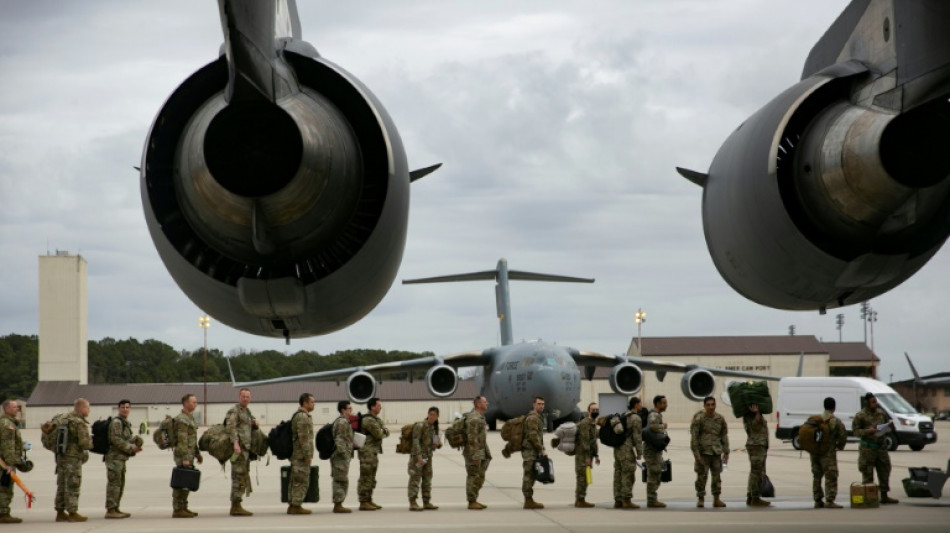
Washington is therefore emphasizing the preventive and deterrent deployments of soldiers in allied countries that are on Russia's doorstep, which have been visited by Blinken and US Chief of Staff General Mark Milley.
But any option that could be interpreted by Putin as a major escalation has been ruled out, to avoid Moscow branding any NATO country a "co-belligerent" of Ukraine.
Should the Russians attack forces of a single NATO country, all other members of the transatlantic alliance, including the United States, would be obligated to come to its aid militarily under Article 5 of the treaty that unites them, and which Biden has pledged to respect.
Establishing a no-fly zone over Ukraine, sought by its President Volodymyr Zelensky, has been rejected by Washington and NATO.
The reason: NATO planes would have to be prepared to shoot down Russian fighters, and "that could lead to a full-fledged war," Blinken said.
Putin, for his part, has threatened "colossal and catastrophic consequences" for Europe and the wider world if a no-fly zone is implemented.
Given such tensions, Washington has blown hot and cold on the possible delivery to Kyiv, via countries like Poland, of Soviet-made fighter jets on which Ukrainian pilots have trained.
- 'Off-ramps' -
Biden's administration, at first reluctant to mention the prospect, eventually admitted it was "actively" studying the plan. But it has offered no firm commitment, or a timetable.
Some in Washington worry such a gesture would be enough to bring US confrontation with Moscow to a head, without even significantly changing the balance of power in Ukraine's skies.
While calls for more forceful Western intervention grow as images of dead civilians shock the public, US leaders remain committed to the delicate balancing act.
They hope ramping up pressure on the Kremlin with sanctions will eventually cause Putin to conclude that prosecuting his war is more costly than withdrawing.
But this would require keeping diplomatic channels open to offer him "off-ramps."
Having ceased all high-level contact with the Russians since February 24, the Americans are encouraging others to talk to Putin.
A weekend mediation attempted by Israel was seen in this light.
Similarly, Blinken's phone call to Chinese Foreign Minister Wang Yi, at a time when Beijing boasts of its "rock-solid" friendship with Moscow, did not exclude the possibility of China playing an intermediary role.
Y.Baker--AT