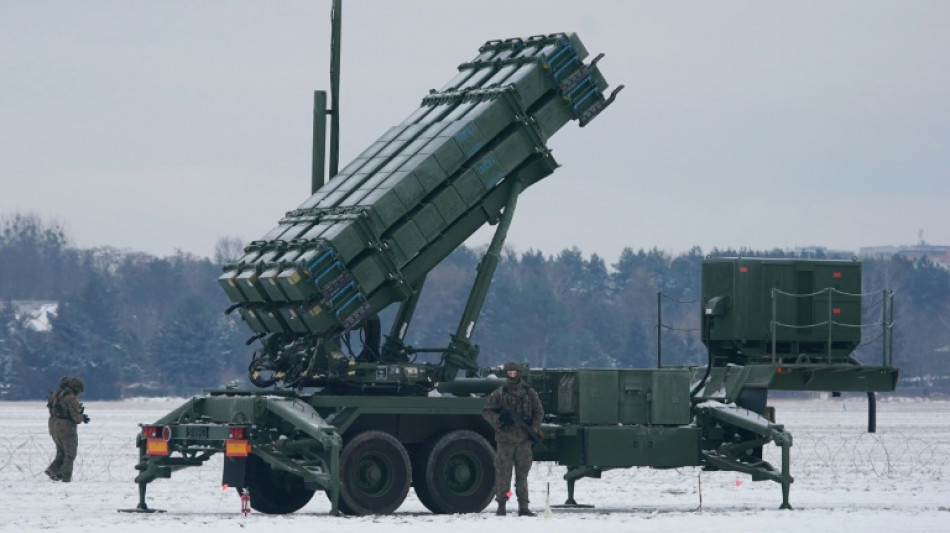
Europeans scramble on air defence after decades of complacency / Photo: JANEK SKARZYNSKI - AFP/File

 Australian sprint star Gout out of U20 worlds with hamstring tear

 Unions to protest as Volkswagen thrashes out job cut plans
 Teeth bared in Greece's bear-human showdown
 Alpacas, mini pigs on the loose after floods hit south China zoo
 All Blacks make five changes for Italy Nations Championship clash

 Western Europe records its hottest June as heatwaves surge: EU monitor
 Fashion's mystery man Margiela sells off his archives
 Nuclear test-scarred Marshall Islands criticises China missile
 Chip titan SK hynix to set price for mega US listing

 Crude extends rally as US-Iran flare-up rocks peace hopes

 Democrat accused of rape exits key US Senate race

 Japan student Ito keeps place against Ireland as Jones returns

 InterContinental Hotels Group PLC Announces Transaction in Own Shares - July 09

 Belgium bid to crack Spain's ironclad defence in World Cup quarter-final
 US man sentenced after swapping 17th century manuscript
 US launches new strikes on Iran after Trump vows to hit 'hard'
 Taylor Swift fans pay $25 for garbage from outside wedding
 After quakes, Venezuelans fear losing damaged homes

 PSG's Lee set to join Athletico

 Erdogan gave pistols to NATO leaders, Starmer says
 Nocera Expands Diversified Technology Strategy With Binding Agreement to Acquire an Equity Interest in INERGX, an Integrated Energy Storage and Power Platform for AI, Defense and Mission-Critical Demand
 China sends nuclear missile message as US looks elsewhere
 Justin Bieber added to 11-minute World Cup final halftime show

 Fery targets Wimbledon final birthday present after royal seal of approval
 Egypt file complaint against referee after World Cup exit

The intensity of the drone and missile war in Ukraine has laid bare gaps in European states' air defences that experts say will be difficult, time-consuming and costly to plug.
Anti-air systems will likely have a starring role at the Paris Air Show starting on Monday, predicts Richard Aboulafia, managing director of AeroDynamic Advisory.
"You're going to see a lot of talk about production capacity for missiles. The market for missiles is easily the fastest growing segment of the industry and yet the manufacturers simply can't keep up," Aboulafia told AFP.
Western countries had enjoyed total mastery of the skies since the end of the Cold War and largely dropped the powerful defences once designed to protect NATO forces from Soviet aircraft.
France got rid of eight of its nine anti-aircraft artillery regiments, MPs flagged up in a recent report.
But NATO countries have been turning to air defence again in recent years as more states have acquired cruise missiles, short-range ballistic missiles and drones, said Mark Cancian, a retired US marine colonel who is a senior adviser at the US-based Center for Strategic and International Studies (CSIS).
"They started it, but basically didn't get too far," Cancian told AFP.
"In another five years, I think there'll be a lot more out there, but that doesn't help Ukraine right now," he added.
With anti-air systems and the missiles they fire lacking, the West is struggling to respond to Ukraine's pleas for supply -- whether for short- or long-range defences.
Berlin plans to spend five billion euros on anti-air from a 100-billion-euro ($110 billion) fund for rebuilding its armed forces in the coming years, with the same amount budgeted in Paris for the period to 2030.
On the industry side, European missile maker MBDA has in recent months signed contracts worth two billion euros with France and Italy to supply 700 Aster missiles, used especially in the SAMP/T system.
And Poland will spend 2.2 billion euros on 44 launchers and hundreds of CAMM missiles.
- 'Euro Sky Shield' -
Led by Germany, 17 European nations last year banded together on air defence with the "Euro Sky Shield" project -- although France, Italy and Poland have all stayed out.
The scheme would involve joint procurement for short-, medium- and long-range systems, including the German-made Iris-T, the American Patriot and the US-Israeli Arrow-3.
"It makes enormous sense" to harmonise across allied countries, Aboulafia said.
Nevertheless, "whenever NATO tries to standardise, obviously big decisions have to be made in terms of who takes lead on production and design", he added.
"We've seen this movie before and the big problem is always France," which is reluctant to cede industrial leadership, Aboulafia said.
"Germany's proposal does not take European security interests sufficiently into account, has failed to convince partners, and leaves many questions unanswered on the strategic, military, industrial, and economic levels," Berlin-based think-tank SWP wrote in a recent report.
By choosing US and Israeli technology rather than European, the German-led plan is also "at odds with the goal of strengthening Europe's industrial and technological defence base", SWP added.
The recent French MPs' report directly criticised the Sky Shield, lamenting "the total lack of European solutions... versus promotion of American and Israeli products".
Yet another Israeli offering, a new hypersonic missile interceptor from Rafael Defense Systems, could tempt European governments when displayed in Paris next week, after Russia fired its much-hyped Kinzhal nuclear-capable weapons into Ukraine.
Alongside the Paris Air Show, the French government has invited ministers to a conference on air defence to try and smooth over differences.
"The Germans have proposed an industrial agreement, we offer a strategic initiative: having the capacity for European air defence that is sovereign, with European equipment," a French diplomatic source said.
A.O.Scott--AT