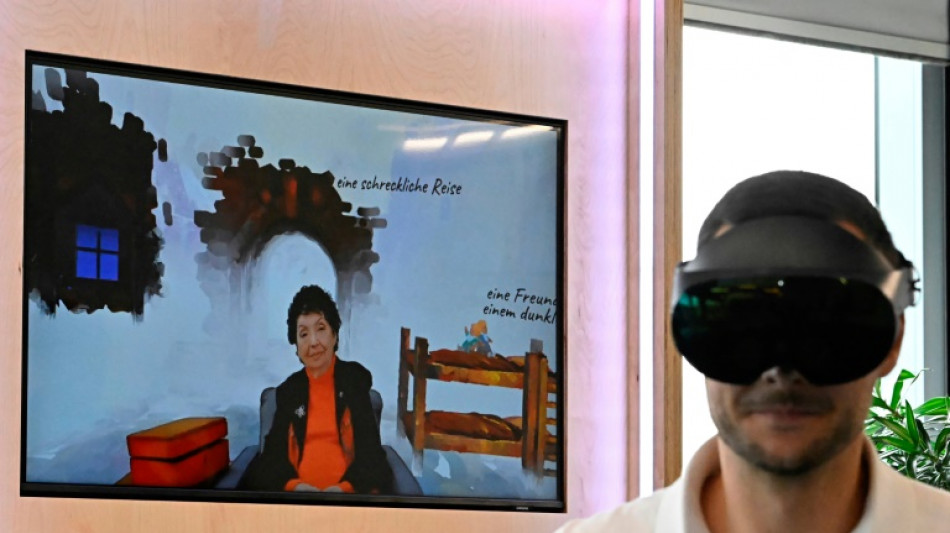
AI meets VR to keep Holocaust memory alive / Photo: Tobias SCHWARZ - AFP

 Trump orders new strikes on Iran over attacks on shipping in Hormuz

 PSG's Lee set to join Atletico Madrid

 Iran plays with fire, but calculates Trump will hold back

 Oil surges, stocks slide as Trump says Iran ceasefire over

 Meta to build $9 billion data center in western Canada

 Rogers backs Kane to outshine Haaland in World Cup showdown

 Some US Fed officials considered June rate hike on war fallout

 UN launches appeal for nearly $300 mn in Venezuela quake relief

 US to remove Syria from terror blacklist, in new boost to Sharaa

 Court rejects Trump request to restore his name to Kennedy Center

 MLB pitching great Verlander to retire after 2026 season

 Artificial cloud brightening could tame El Nino, but with risks: study

 Shocked and shaken, Venezuela quake survivors get psychological help

 France, Morocco kick off blockbuster World Cup quarter-finals

 Amorim hails 'ambitious' AC Milan, promises to learn Italian

 Cancer survivor Traeen takes the long road to Tour yellow

 Easing Russian Olympic restrictions 'terrible', says Wimbledon star Kostyuk
 'Unbelievable' Kooij wins Tour de France 5th stage in chaotic sprint finish

 Britain's Fery to face Zverev in Wimbledon semi-finals

 Zverev sees off Fritz to make first Wimbledon semi-final

 Barcelona sets new heat record at 40.7C: weather agencies

 'The Pitt,' 'Hacks' lead Emmy nominations

 France lose appeal against Olise booking at World Cup

 Putellas joins star cast at London City Lionesses

 Oil back at $80, stocks slide as Trump says Iran ceasefire over

Inge Auerbacher fears for a future when Holocaust survivors like her can no longer bear witness. But advances in virtual reality and AI give her hope their stories will live on.
Auerbacher, 88, is the star of a new interactive VR experience called "Tell Me, Inge" in which she recounts her horrific experiences as a small Jewish child in a Nazi concentration camp and what it took for her to not give up.
"I've been involved in many (Holocaust education) projects but I find this one is made for today," Auerbacher, who travelled from her home in New York for the launch in Berlin on Tuesday, told AFP.
"I wanted it to be able to be used for all ages, and particularly young people. With a book, you have to create your own images in your head but with this technology, you see it with your own eyes."
Through artificial intelligence, users of the VR headset can have a "conversation" with Auerbacher, asking about her encounters with heartbreaking loss and occasional heroism.
The project is a collaboration between Los Angeles-based company StoryFile, the World Jewish Congress and Facebook-owner Meta, which billed it as the first AI and metaverse Holocaust education experience in Germany.
Auerbacher, a trained chemist, sat for two days of interviews, answering around 60 questions in fluent German and English to create a database of video files.
When a user asks a question based on prompts on the screen, the system spools to that section of the interview using key words and Inge "answers", creating the effect of an immersive, one-on-one exchange.
On screen, Auerbacher wears a butterfly scarf and brooch -- for her, a symbol of the 1.5 million children killed by the Nazis. In the backdrop, 3D animated graphics and archival footage illustrate her story.
Asked how it was seeing her own image via the headset, the sprightly Auerbacher said with a laugh, "It was great, I look so young!"
- 'Resilience and tenacity' -
StoryFile co-founder Stephen Smith, who has worked in Holocaust education for three decades, said the technology allows users to "talk to history through the people who went through it".
"I spent much of my life with Holocaust survivors and in spite of all of the hate that they experienced, they have made amazing contributions to society," he told AFP.
"There's a great deal to take from the human spirit, from resilience and tenacity. So this project is giving young people the opportunity to open their eyes very early."
Meta, which two years ago changed its name from Facebook to reflect a metaverse priority, has invested heavily in VR headgear for a range of purposes from gaming to conferencing and education.
Julia Reuss, Meta's director of public policy for central Europe, declined to discuss its financial contribution to the project but said the company hoped to keep expanding it with other survivors.
"We've long had a focus on fighting anti-Semitism in our team here in Germany and we're happy we found the right partner to help us address Holocaust remembrance culture and education using VR," she told AFP.
In addition to the programme for headsets, smartphone and computer versions are available. Reuss said museums and schools would be ideal settings to use them.
- 'Cancer' of hatred -
Auerbacher was the last Jewish child born in her hometown of Kippenheim, southwestern Germany in 1934 before the Nazis' genocidal campaign.
While her grandmother was deported to Riga and murdered, Auerbacher and her parents were sent to the Theresienstadt concentration camp when she was just seven years old. She would be 10 before she gained her freedom.
Now travelling the globe as a book author and educator, Auerbacher told the German parliament last year on International Holocaust Remembrance Day that it was essential to fight the spreading "cancer" of hatred.
In 2017, Germany passed a controversial law requiring social network giants to remove Holocaust denial and other illegal content and report it to the police following years of rampant abuse.
While they have deleted many offending accounts, much of the content has migrated to other platforms, creating constant challenges for law enforcement.
Auerbacher said she wanted the new VR and AI technology to be one more weapon in the war against disinformation and hate speech.
"When you're dead, you're gone -- not everyone believes in heaven. And it's important to me that this history does not die," Auerbacher said.
"When I'm gone, perhaps someone will remember me. This technology is there and we should use it."
W.Nelson--AT