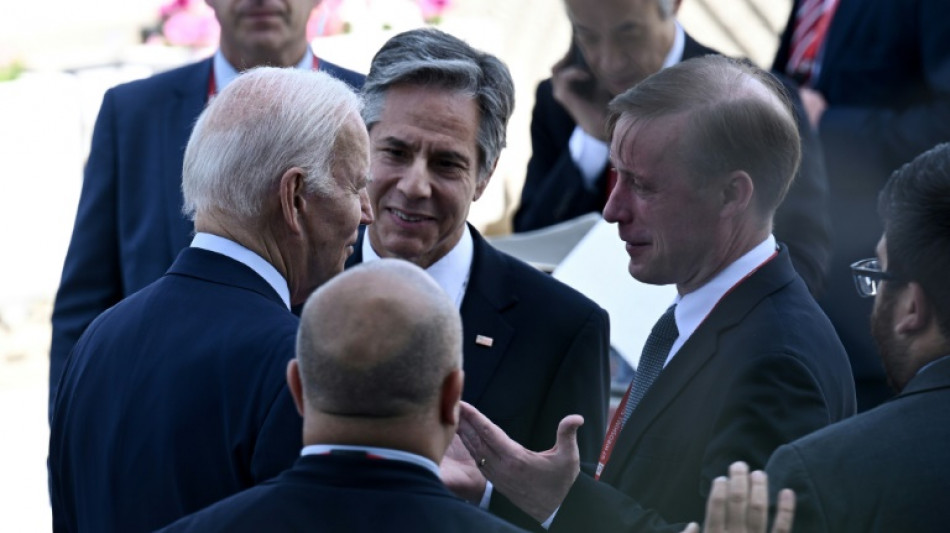
US urges keeping Russia nuclear arms limits, eyes China / Photo: Brendan SMIALOWSKI - AFP/File

 Asian Games set to close after records, rancour and rain

 Cry for help as French-Swiss lake dries up

 Sabalenka swept out of China Open in third round

 US urges 'restraint' as Ethiopia's Tigray crisis rocks region
 Teens on target again as USA down Mexico 3-0

 World records prove Asian Games were a hit, says top official

 US prison chief who oversaw botched execution resigns

 'Chaotic' Asian Games threaten Japan hopes of hosting Olympics again

 Finnish town braces for change from Google data centres

 What is fuelling French school protests?

 Without lawyers, migrant children face deportation from the US

 Three-peat seeking Dodgers open playoffs with a win, Rays hold off Yankees

 Brazil votes in nail-biter polls closely watched by Trump
 'Just be you': Kim reveals Tiger text that inspired him to gold

 Myanmar migrants returned to war-torn nation from Malaysia

 ALEX BODI AND AMBASSADOR GUM DOMINIC MATIOK OF THE REPUBLIC OF SOUTH SUDAN MEET IN BERLIN TO DISCUSS THE POSSIBILITY OF AN HONORARY CONSULATE IN BUCHAREST

 Lula, Bolsonaro wrap up campaigns ahead of Brazil's knife-edge vote

 Toulouse edge Castres in Top 14 derby

 Murakami homer propels White Sox to MLB playoff win over Guardians

 Israel targets top Hamas leader in deadly Gaza strike on anniversary

 Houthis say struck oil facility near Riyadh, as Saudis hit Sanaa

 AI needs safety layers like nuclear plants: ex-OpenAI engineer

 MVP Judge will miss Yankees' MLB playoff series against Rays

 New lizard species discovered in Peru

 Fernandes hails Portugal's 'greatest symbol' Ronaldo, calls for unity

A top White House official on Friday offered to maintain current nuclear warhead limits with Russia, while making the case for putting rising power China at the center of future arms control efforts.
National Security Advisor Jake Sullivan made the comments in a speech at the annual National Arms Control Association meeting in Washington, as he outlined the attempt by Joe Biden administration to confront what he called "substantial" and "deep" cracks in the post-Cold War nuclear landscape.
With the last US-Russia arms control treaty -- New START -- largely moribund and due to expire in 2026, Sullivan said the United States is keen to forge a new treaty.
In the meantime, however, Washington wants the world's two leading nuclear powers to preserve the core of that treaty -- a limit for each of 1,550 warheads.
"We're prepared to stick to the central limits as long as Russia does," Sullivan said.
He also called on Moscow to start new talks for a post-2026 framework, saying "rather than waiting to resolve all of our bilateral differences, the United States is ready to engage Russia now to manage nuclear risks."
Unlike during the Cold War, when there were only two global nuclear powers, the future of arms control will revolve around China's rapidly expanding arsenal and global presence, Sullivan said.
"By 2035, (China) is on track to have as many as 1,500 nuclear warheads -- one of the largest peacetime nuclear buildups in history," Sullivan said, meaning that "the United States will need to deter two near-peer nuclear powers for the first time in its history."
"We're also ready to engage China without preconditions," he said.
A senior US official told reporters that the China factor not only involves the need for Washington to manage the threat directly but to consider the ripple effects created for US nuclear allies Britain and France, whose own smaller arsenals are largely directed at countering Russia.
Agreements with China "of course will affect our ability to come to some sort of accord with the Russians," the official said.
- Difficult path -
With relations at rock bottom with President Vladimir Putin's Russia and currently at a near standstill with Beijing, a difficult path lies ahead.
China "has thus far opted not to come to the table for substantive dialogue on arms control. It has declined to share the size and scope of its nuclear forces or to provide launch notifications. And it has not shown much interest in discussions regarding the changes to its nuclear forces," Sullivan said.
In February this year, Putin announced that Russia was suspending participation in New START, a Cold War-era treaty which limits warheads and allows verification by both sides.
The State Department said Thursday that it has made reciprocal "countermeasures" by suspending various aspects of the treaty, including on-site inspections and exchange of data.
While offering to rebuild arms control treaties, Sullivan stressed that the United States will simultaneously improve its nuclear forces.
"Responsibly enhancing our deterrent capabilities allows us to negotiate arms control from a position of strength," he said.
P.Hernandez--AT