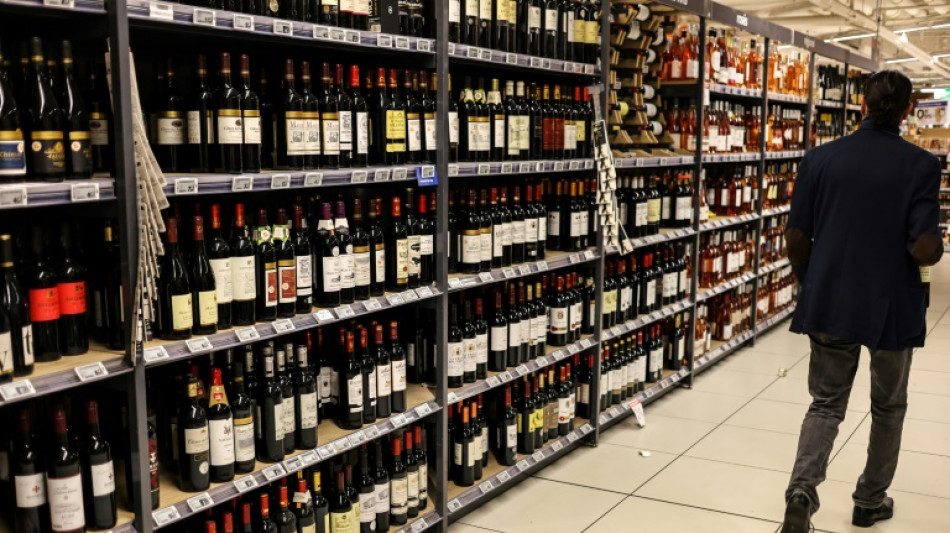
What's in wine? Campaigners want ingredients on the bottle / Photo: Charly TRIBALLEAU - AFP

 Kooij wins Tour de France 5th stage in chaotic sprint finish

 Trump says Ukraine can make Patriot missiles

 Teenager arrested after two girls wounded in Germany school attack
 Farage vs Count Binface: hard-right leader's UK poll gambit

 Hong Kong's Robert Wun: the bold Millennial conquering Haute Couture

 IMF cuts 2026 world growth forecast, flags risks from new Mideast fighting
 Kostyuk sets up Wimbledon semi-final against Noskova

 Noskova reaches first Wimbledon semi-final

 Air Canada taps new CEO to replace chief who couldn't speak French

 Istanbul mayor ejected from court in corruption case

 Landslide kills eight at refugee school in Bangladesh

 Cleary leads NSW past Queensland to regain State of Origin crown

 MEXC Adds Nine Ondo Tokenized Stock and ETF Trading Pairs Tied to AI Infrastructure Demand

 Oil prices surge, stocks slide as Trump says Iran ceasefire over
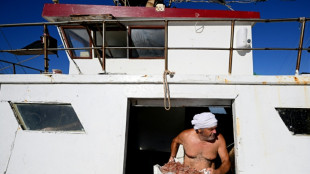 Sunken wrecks, hot seas threaten fishermen on Italian isle

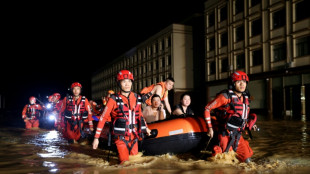 Rescuers search for survivors of China storms as super typhoon nears

 Egypt file complaint against referee after controversial World Cup exit

 Apple loses challenge against EU digital competition rules

 Trump says Iran ceasefire 'is over'

 Rescuers search for missing in China storms after 100,000 flee

 OpenAI to launch new model after US freeze

 UK museums at 'sharp end' of climate change challenge

 In Mauritania, Imraguen people's desert-ocean paradise under threat

 Iraq's holy cities host funeral processions for Khamenei

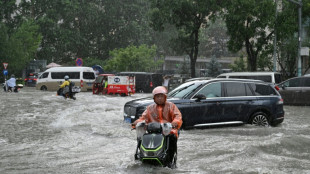 Rescuers search for missing in China storms after 100,000 evacuated

European wines are finally being forced to reveal their ingredients to customers, but only on a website -- not on the bottle. Environmental campaigners are unimpressed.
Wine can contain a wide array of additives to control taste, strength and appearance: sulfur, sugar, egg white, dried fish bladders, enzymes from a pig or cow pancreas, and a range of chemical compounds.
While most of the food and drink sector has been forced to print ingredients and nutritional information on packaging for decades, the alcohol sector has long had a special exemption.
In 2017, the European Commission concluded there was no "objective grounds" for this exception, and new rules -- which come into force on December 8 -- require wines to reveal their contents.
But there is a twist. The wine industry was allowed to come up with their own method of doing so -- and it decided to give vineyards the option of using QR codes that link to a website, thus keeping the ingredients off the bottles.
An activist group, the Transparency for Organic World Association (TOWA), said this is unworkable.
"Can you really imagine getting out your smartphone in the supermarket and scanning several QR codes to compare the additives in wines, and remembering them all to make your choice?" said Olivier Paul-Morandini of TOWA.
The wine industry claims that it cannot be treated like other foodstuffs.
"Wine does not follow a recipe. The grape evolves in function of the sun, of climatic conditions... the ingredients are not the same from one harvest to another," said Ignacio Sanchez Recarte, of the Comite Europeen des Entreprises Vins (CEEV) , which represents the industry in Brussels.
The CEEV said digital labelling is the only realistic way to get all the EU's winemakers onboard (there were 2.2 million in 2020, according to Eurostat). It also means the ingredients are automatically translated into all EU languages.
"The Commission understood the need to provide a level of flexibility that will allow companies to communicate this information in a way that will not disrupt the way we trade," said Recarte.
The CEEV also filed a complaint this month to the European Commission over Irish plans to put health warnings on alcoholic drinks.
- 'List the consequences' -
For TOWA, e-labels show a lack of commitment to the greening of agriculture which the EU claims is a priority.
Organic and natural winemakers say that if a wine needs a QR code rather than a label, it is probably best avoided.
"An organic winemaker who puts very few additional things into their wine can make a label for the bottle, while a conventional winemaker would need a dictionary, so clearly that's why a QR code is necessary," said Julien Guillot, a well-known natural winemaker in Burgundy.
QR codes and e-labels are typical of a system that still greatly benefits conventional farmers using pesticides and chemical fertilisers, who receive the overwhelming majority of the EU Common Agricultural Policy subsidies, according to TOWA.
"We don't need just a list of ingredients. We should have a list of all the consequences of conventional farming and how much they cost," said Paul-Morandini.
"The pollution of soil, water, health and environment all has a price that is paid by consumers and society."
D.Lopez--AT