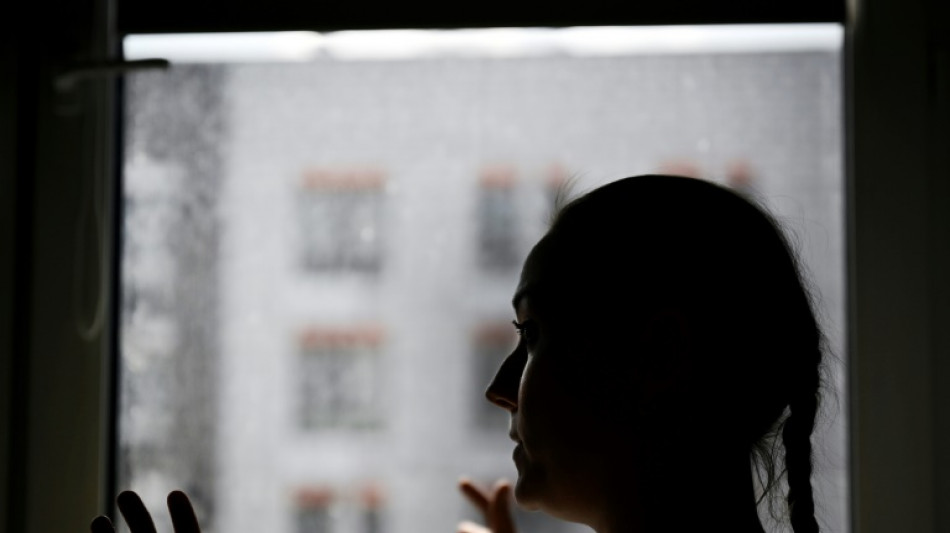
'You never forget': Mariupol refugee in Moscow haunted by horrors / Photo: Alexander NEMENOV - AFP

 'He's here with me': Japan cycle queen dedicates gold to late brother
 Japan Olympic chief says 'lot more' athletes at Games than expected
 Asian carmakers besting US rivals at home, China poised to strike

 Widgets & Web Offers All-Inclusive Investor Relations Websites for Public Companies, IPOs and SPACs

 Adams named new US captain to 2030 World Cup
 China a better influence in Latin America than US: poll

 Judge pauses construction of border project in Texas national park

 Belgium's De Bruyne fires double to sink Turkey, France held by Italy
 US jobs data boosts stocks as oil prices dip

 US Supreme Court to hear high-stakes climate case
 Trump expected to name intel chief Clayton as AI czar: reports
 Argentina unveils passports-for-investment scheme

 Brazil election debate chaos sparks censorship row
 England's Carse charged by cricket body over nightclub incident

 Amazon vows $1 bn for data center towns, decries 'myths'
 Oil prices drop on G7 fuel release, US jobs data boosts stocks

 G7 agrees deal to ease global energy supply concerns

 Spain's government dealt blow as lawmakers reject housing bills
 Food, medicine shortages deepen in Russian-occupied Oleshky

 Man City whistleblower Rui Pinto facing 'dire consequences' - lawyers
 Russia 'tearing Kyiv apart', mayor says, as strikes paralyse traffic

 Taiwan boxer Lin wins Games gold as Japan edge North Korea on penalties

 Japan tame North Korea to win Games gold after shootout drama

 US posts weak job growth data in September
 Ethiopia's conflict: the regional dimension

Alyona and her family survived one hundred days of hell during Russia's siege of Mariupol, which ended a year ago on Saturday, when the last Ukrainian troops in the city surrendered.
A year later, she, her husband and their two children have begun to rebuild their lives in Russia but are still haunted by the horrors of the battle for the Ukrainian port city.
The 35-year-old speaks in the present tense as she describes the dozens of bodies hastily buried in the courtyards of the city's apartment blocks or along its pavements.
"The stench, the scenes, the bloated stomachs (of decomposing bodies) -- you never forget that," Alyona said in the family's new apartment in the outskirts of Moscow.
She recounted to AFP how her daughter saw a dog eating a body.
"She asks me: 'Mum, what's happening? Why is a dog eating a man?' And I still don't know what to tell her," she said, crying.
Alyona preferred to withhold her last name fearing repercussions if Ukrainian authorities learn that she moved to Russia.
Alyona and her family were living in the northern part of Mariupol when hundreds of thousands of residents found themselves trapped by the offensive ordered by President Vladimir Putin on February 24, 2022.
For two months, the city was surrounded and subjected to intense bombardment.
Residents who were not killed hid in basements without water, electricity, heating or phone signal, cut off from the world in freezing temperatures.
Alyona said she could hear the cries of the wounded.
"But we couldn't do anything. We couldn't come out of the basements. We would have been torn to pieces."
She said she never cried in front of her children.
"I was a she-wolf, an iron lady. But during the night, I screamed my heart out on my hands and knees. I screamed so much. It was terrible. We wanted to stay alive."
- 'We are alive!' -
Between the beginning of March and the end of April 2022, she lived a "cave life" in a basement with around 60 children.
From time to time, residents emerged to find food. Some never came back.
In May, while the last Ukrainian troops were holed up in Mariupol's Azovstal steelworks, she managed to contact her mother Viktoria.
Her mother was living in Bakhmut -- a town in eastern Ukraine that is now the epicentre of fighting between Ukrainian and Russian troops.
"They told me: 'We are alive! We are alive!" said Viktoria, who now lives in Moscow.
"It was as if a weight was lifted from my shoulders."
With her phone, Alyona filmed the first bombings and the gutted apartment blocks from her window.
She filmed her children playing not far from small crosses marking makeshift graves.
On June 4, 2022, exactly 100 days after the start of the Russian offensive, Alyona and her family left for Russia.
They went through several checkpoints and "filtration" centres during which she said she and her husband were searched by Russian soldiers.
She said her family was not on anyone's side in the conflict and they passed through the screenings without problems.
Ukraine has accused Russia of using violence during these checks and even of executing civilians. Russia has denied these allegations.
- 'Abandoned' -
Asked who was responsible for the destruction in Mariupol, Alyona was cautious.
"We don't have the information our leaders have," she said.
But she blames the Ukrainian government for not evacuating her family.
"My army didn't save me. My country abandoned me," she said.
The family is planning to stay in Moscow.
Her husband has found a job as an electrician and Alyona, whose first language is Russian, said she shares the mentality, religion and language of Russian people.
According to a UN tally from October 2022, more than 2.8 million Ukrainian refugees have moved to Russia. Many have since travelled to the European Union but many have also chosen to stay.
Natalya Mityusheva, 41, from the non-governmental organisation Mayak.fund, said many Ukrainian refugees -- particularly families -- stay in Russia because "it is easier for them to adapt" despite the "minimal assistance" provided by the state.
Mariupol survivors are often the most traumatised, she said.
The fighting started "when they were going to work, to school, they could not believe what was happening."
"For them, it was a terrible shock," said Mityusheva, whose organisation provides humanitarian, legal and psychological assistance to Alyona and her family.
One year on, Alyona is still afraid.
When firecrackers went off in her area in Moscow over the New Year, she found herself plunged back into the nightmare of Mariupol.
"I started packing my bag with my children. I wanted to leave," she said.
"I couldn't believe it was only firecrackers".
W.Moreno--AT