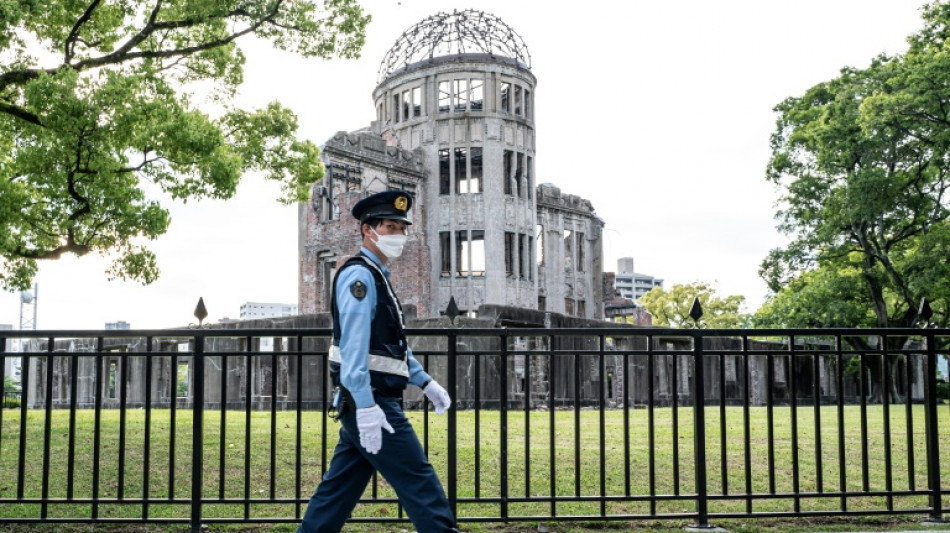
Japan ramps up G7 security after PM attacks / Photo: Richard A. Brooks - AFP/File

 Botched US execution leaves murderer unconscious on ventilator: lawyers
 Cornell rape case exposes sexual violence at US colleges
 France held by Italy in Zidane's homecoming after Olise stunner

 Ethiopian pro-government militia claims Tigray airport as regional tensions spike
 Ohtani shaking off injuries as Dodgers launch MLB post-season
 Sea levels to rise in California as coastal wave surges up west coast
 New rallies urged in France as protests disrupt over 730 schools
 Djokovic survives China Open scare, Sabalenka starts strong
 King Charles to evoke colonial 'darkest days' on Caribbean tour
 Tesla shares jump after global car sales top estimates
 DR Congo Ebola outbreak killed more than 4,000: official figures
 Djokovic survives China Open scare against wildcard world no. 104
 Lula, Bolsonaro trade blows in final scramble for votes in Brazil
 New clashes erupt as protests disrupt over 560 French schools
 NY governor vows to close loophole after alleged Cornell gang rape
 Ethiopia Tigray rebels pushed back as regional tensions spike
 Stocks rise, yields fall as US job numbers disappoint
 Man City verdict a 'big topic' for England players, says Tuchel
 NY attorney general tasked with investigating alleged Cornell gang rape
 China widens military footprint with Laos air base
 G7 talks as US pressures Europe over diesel stocks
 Man City launch appeal against explosive financial ruling
 Swiss president to quit government
 Europe rejects US threats over diesel stocks, urges joint G7 action
 Philippines tennis star Eala says 'I get overwhelmed sometimes'
Security is tight at every G7 summit, but this year's host Japan has more to prove than most, after an attack last month on the prime minister and the 2022 assassination of ex-premier Shinzo Abe.
Some 24,000 security personnel are reportedly being deployed to Hiroshima during the summit, most dispatched from other parts of the country.
Well ahead of the May 19-21 talks, patrolling police have been weaving between tour groups in the western city's famed Peace Park.
Security personnel were also motoring up and down the river that runs alongside sites like the Atomic Bomb Dome, with helicopters regularly buzzing overhead.
The measures have extended far beyond the city, including to the capital Tokyo, where messages on the train system warn of heightened security for the summit.
Major cities in Japan do not generally have rubbish bins in public places, but security personnel have been sealing off other places considered to pose a potential threat.
Coin lockers, which are common in many stations, have been put out of operation at major stations as far afield as Tokyo.
Vending machines on subway platforms have also been unplugged and sealed with tape, along with apologetic signs warning they will be unavailable during the summit for security reasons.
In Hiroshima, signs across the city and in hotels remind locals and tourists alike that the summit will cause disruption, including the closure of streets and access to the island of Miyajima, which leaders are expected to visit.
Dozens of schools and other institutions have simply opted to close during the summit, according to local media.
The measures are likely to be closely scrutinised less than a year after a gunman assassinated former prime minister Abe as he campaigned in the city of Nara.
Then in April, a man hurled an explosive device towards Prime Minister Fumio Kishida shortly before he was due to deliver a campaign speech in the city of Wakayama.
He escaped unharmed, but the fact that an assailant was able to throw the device at such close range so soon after the Abe murder prompted renewed criticism of security arrangements in Japan.
The head of Japan's National Police Agency, and the local police chief, resigned in the wake of Abe's assassination after an investigation confirmed "shortcomings" in the security for the former leader.
The investigation slammed a system under which local police were given responsibility for the security of visiting senior officials and argued that with better measures, it was "highly probable" the attack could have been prevented.
Kishida has instructed police to step up security around the G7 "so that guests can visit Japan with peace of mind".
Leaders from G7 members Japan, the United States, Canada, Britain, France, Germany, Italy and the European Union will be joined by invitees including Brazilian President Luiz Inacio Lula da Silva and Indian Prime Minister Narendra Modi.
G.P.Martin--AT