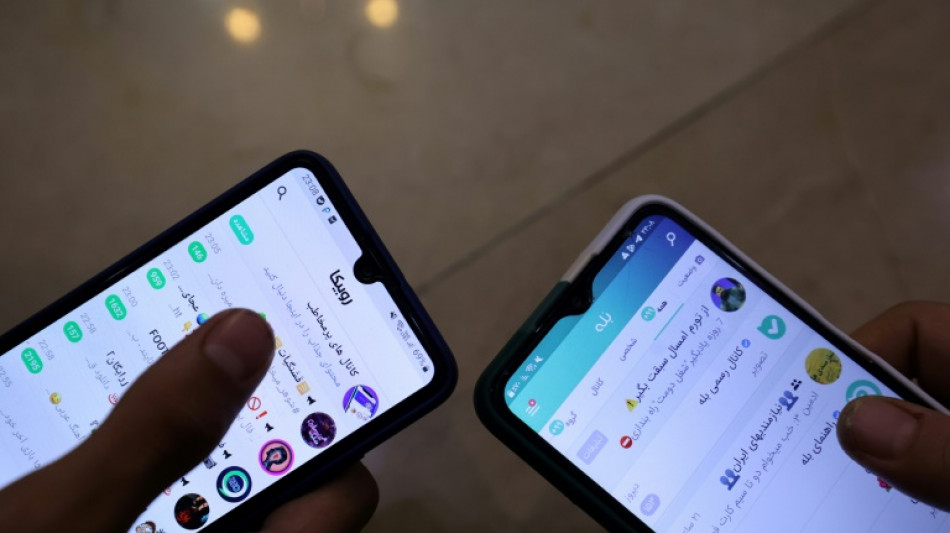
As net tightens, Iranians pushed to take up homegrown apps / Photo: ATTA KENARE - AFP

 England's Carse charged by cricket body over nightclub incident

 Amazon vows $1 bn for data center towns, decries 'myths'

 Oil prices drop on G7 fuel release, US jobs data boosts stocks

 G7 agrees deal to ease global energy supply concerns

 Spain's government dealt blow as lawmakers reject housing bills

 Food, medicine shortages deepen in Russian-occupied Oleshky

 Man City whistleblower Rui Pinto facing 'dire consequences' - lawyers

 Russia 'tearing Kyiv apart', mayor says, as strikes paralyse traffic

 Taiwan boxer Lin wins Games gold as Japan edge North Korea on penalties

 Japan tame North Korea to win Games gold after shootout drama

 US posts weak job growth data in September

 Ethiopia's conflict: the regional dimension

 Life expectancy almost back to pre-Covid levels, says WHO

 Turkey's football referee chief faces judge in graft probe

 Verstappen goes own way to avoid the rain

 Oil slides, bonds steady as EU addresses diesel price surge

 Spain housing package at risk in parliament, as protests mount

 Swedish Social Democrats leader to make new bid to form government

 North Korea calls Seoul 'despicable' after DMZ apology demand

 Taiwan boxer Lin wins gold as virtual taekwondo makes Games debut

 Man City face appeal deadline after explosive financial verdict

 Pole vault superstar Duplantis to skip indoor season

 Sri Lanka drop Asalanka from T20 against Pakistan

 Disney president says layoffs 'extremely painful' but necessary

 Indian flydubai pilot opened cockpit door to save passengers

Banned from using popular Western apps, Iranians have been left with little choice but to take up state-backed alternatives, as the authorities tighten internet restrictions for security reasons following months of protests.
Iranians are accustomed to using virtual private networks, or VPNs, to evade restrictions and access prohibited websites or apps, including the US-owned Facebook, Twitter and YouTube.
The authorities went as far as imposing total internet blackouts during the protests that erupted after the September death of 22-year-old Mahsa Amini, following her arrest for an alleged breach of the Islamic republic's dress code for women.
Connections are back up and running again, and even those who are tech-savvy are being corralled into using the apps approved by the authorities such as Neshan for navigation and Snapp! to hail a car ride.
As many as 89 million people have signed up to Iranian messaging apps including Bale, Ita, Rubika and Soroush, the government says, but not everyone is keen on making the switch.
"The topics that I follow and the friends who I communicate with are not on Iranian platforms," said Mansour Roghani, a resident in the capital Tehran.
"I use Telegram and WhatsApp and, if my VPN still allows me, I'll check Instagram," the former municipality employee said, adding that he has not installed domestic apps as replacements.
- Integration -
At the height of the deadly Amini protests in October, the Iranian government cited security concerns as it moved to restrict internet access and added Instagram and WhatsApp to its long list of blocked applications.
"No one wants to limit the internet and we can have international platforms" if the foreign companies agree to introduce representative offices in Iran, Telecommunications Minister Issa Zarepour said last month.
Meta, the American giant that owns Facebook, Instagram and WhatsApp, has said it has no intention of setting up offices in the Islamic republic, which remains under crippling US sanctions.
The popularity of the state-sanctioned apps may not be what it seems, however, with the government encouraging people to install them by shifting essential online public services to the homegrown platforms which are often funded by the state.
In addition, analysts say, Iranian users have online safety concerns when using the approved local apps.
"We have to understand they have needs," said Amir Rashidi, director of digital rights and security at the New York-based Miaan Group.
"As an Iranian citizen, what would you do if registering for university is only based on one of these apps? Or what would you do if you need access to government services?", he said.
The locally developed apps lack a "clear privacy policy", according to software developer Keikhosrow Heydari-Nejat.
"I have installed some of the domestic messaging apps on a separate phone, not the one that I am using every day," the 23-year-old said, adding he had done so to access online government services.
"If they (government) shut the internet down, I will keep them installed but I will visit my friends in person," he said.
- Interconnection –
In a further effort to push people onto the domestic platforms, the telecommunications ministry connected the four major messaging apps, enabling users to communicate across the platforms.
"Because the government is going for the maximum number of users, they are trying to connect these apps," the analyst Rashidi said, adding all of the domestic platforms "will enjoy financial and technical support".
Iran has placed restrictions on apps such as Facebook and Twitter since 2009, following protests over disputed presidential elections.
In November 2019, Iran imposed nationwide internet restrictions during protests sparked by surprise fuel price hikes.
A homegrown internet network, the National Information Network (NIN), which is around 60 percent completed, will allow domestic platforms to operate independently of global networks.
One platform already benefitting from the highly filtered domestic network is Snapp!, an app similar to US ride-hailing service Uber that has 52 million users -- more than half the country's population.
But Rashidi said the NIN will give Tehran greater control to "shut down the internet with less cost" once completed.
B.Torres--AT