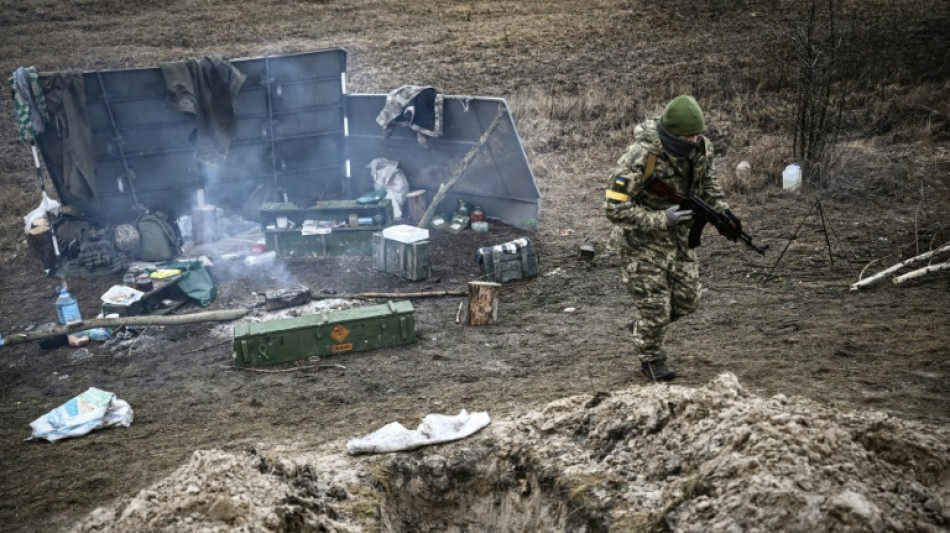
Mine warfare on Kyiv's eastern front

 Fuel shortage triggers queues on resort island Bali
 Sao Tome's niche vanilla finds far-away fans
 China-North Korea bridge to open Thursday, 12 years late
 Asian stocks mostly down as tech firms struggle to claw back losses

 AI boom drives record sales at Dutch tech giant ASML
 Trump says 'massive' oil, gas, mineral exploration to begin in Greenland

 China heads for record trade surplus as exports surge

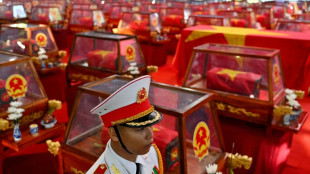 Vietnam mourns 700 war dead in major push to identify missing

 Relentless Swiatek wins all-Polish battle to launch Wuhan campaign

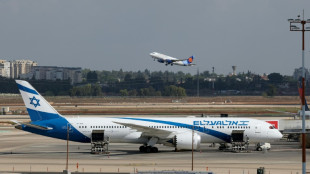 Seeing pivotal election, Israelis fly from around world to vote
 South Korea's Eom 'racially abused' in England's Championship: club
 Asian markets mixed as tech firms claw back some losses

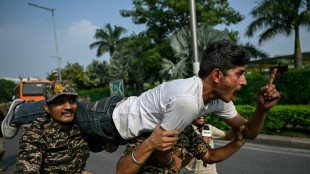 India shuts down iconic Delhi protest site after three decades
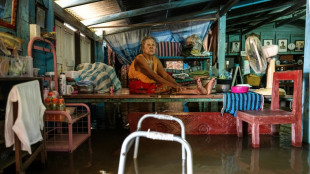
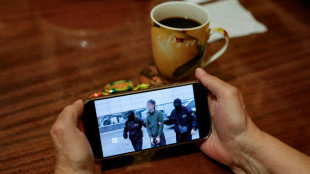 Japan urges Russia for 'impartial treatment' of arrested journalist

 Lula, Bolsonaro ordered to call off attempts at online censorship
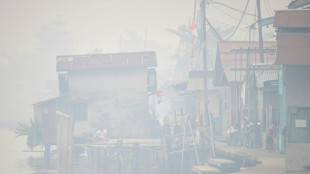
 EU takes a page from Ireland's AI playbook

 Global deforestation slowed in 2025 but surged in Congo basin: study

 LSEG Accelerates Tick History Analysis With NVIDIA

 Saudi employee arrested for allegedly bugging OpenAI office
 Atletico sink Man Utd as Viking deny Bayern in Champions League
 Man United's Martinez blasts board's lack of investment

 Meet A7 International, an Innovative Global Platform Designed to Reinvent the International Payments Market

 Shakhtar hope London move a reminder of Ukraine conflict

 Tresoldi hat-trick fires Brugge past Inter Milan

 Rams axe kicker Mevis after misses cost victory over Bills: reports

The Ukrainian army battalion commander is not sure who laid the mines scattered across fields on Kyiv's eastern front that his men hit while seeking intelligence on Russian forces.
Maksym Kyrychuk is just grateful that only one of his men was injured and none died –- this time around.
"Someone laid them," he reasoned, standing at the edge of one of the minefields on farmland 130 kilometres (80 miles) northeast of the Ukrainian capital.
"It wasn't the Ukrainian armed forces, that I can tell you for sure," he said with a resolute shake of the head.
"It could have been Ukrainian territorial defence units," he added, referring to mostly untrained volunteer forces.
"The Russians? I am sure they also do it. But that our intelligence team went out and hit one yesterday, that is a fact."
Russia's week-long assault on Kyiv appears to have, at least temporarily, stalled after reaching a web of villages on the city's northwest edge.
But more and more Russian forces are now approaching the historic city from the northeast, on the eastern side of the Dnipro river.
There they will confront various Ukrainian defence units that are trying to protect what remains Kyiv's more exposed flank.
Regular units are interspersed with the eager volunteer forces who often man checkpoints with little more than hunting rifles and knives.
Kyrychuk suspected that one of these volunteer units scattered a cache of anti-tank mines across the fields encircling the town of Nizhyn before his own units moved in this week.
"Or it could have been the Russians," he added. "Maybe they are trying to make people think that we're engaging in mine warfare."
- 'I worry about them' -
A UN treaty agreed in Ottawa in 1997 and which went into force two years later banned anti-personnel mines. Ukraine signed the deal, but Russia and the United States did not.
Mines like those in Nizhyn are aimed at destroying tanks and are often frowned upon but permitted under internationally accepted warfare rules.
Locals appear to have a love-hate relationship with the anti-tank mines lurking in the fields where they once grew wheat and corn.
"I worry about them. The entire war worries me," said 40-year-old bricklayer Artem Kurylenko.
"But I think the soldiers know better whether this is the right thing to do or not," Kurylenko added.
Local mayor Oleksandr Kodola is upfront about his support for mine-laying.
Kodola said he would do anything to stop the Russians from assaulting his working-class town of about 80,000.
"Everyone is coming out to defend our city and our country," the mayor said.
"So among other things, we are conducting certain mining operations around the approaches to the city. We ask residents to stay at home and to avoid the fields."
- 'Welcome to hell' -
A local checkpoint commander who goes by the nom de guerre Serpent appeared to have more pressing worries than the mines that might be lurking around his roadside camp.
A Russian war plane that had made several circles over Serpent's command post was making another run.
It had already delivered an air strike that left a two-metre (seven-foot) crater in the ground at another checkpoint.
It then scared a group of locals walking down the edge of the road, forcing them to scramble into a foxhole for safety while it buzzed ominously overhead.
Serpent said the mines might slow down the Russians, but not make the ones already here go away.
"The front is everywhere," he said with a wave of the hand. "The saboteurs are already shooting at us from the woods and from the fields."
Yet the Ukrainians are not sitting idle.
Some of the armoured vehicles at Kyrychuk's outpost fly a red-and-white flag that once represented Ukrainian resistance that fought both the Soviets and the Nazis during World War II.
"When we pick up the Russians' equipment, we plant that flag on it to make sure that our own guys don't shoot at us," he said.
That resolve is spelt out in black spray paint on a bedsheet hanging off one of the bridges on the road from Nizhyn to Kyiv.
"Russians -– welcome to hell," the makeshift banner declares.
M.King--AT