Russian missiles tear civilian lives apart

 Fuel shortage triggers queues on resort island Bali
 Sao Tome's niche vanilla finds far-away fans
 China-North Korea bridge to open Thursday, 12 years late
 Asian stocks mostly down as tech firms struggle to claw back losses

 AI boom drives record sales at Dutch tech giant ASML
 Trump says 'massive' oil, gas, mineral exploration to begin in Greenland

 China heads for record trade surplus as exports surge

 Vietnam mourns 700 war dead in major push to identify missing

 Relentless Swiatek wins all-Polish battle to launch Wuhan campaign

 Seeing pivotal election, Israelis fly from around world to vote
 South Korea's Eom 'racially abused' in England's Championship: club
 Asian markets mixed as tech firms claw back some losses

 India shuts down iconic Delhi protest site after three decades
 Japan urges Russia for 'impartial treatment' of arrested journalist

 Lula, Bolsonaro ordered to call off attempts at online censorship
 EU takes a page from Ireland's AI playbook

 Global deforestation slowed in 2025 but surged in Congo basin: study

 LSEG Accelerates Tick History Analysis With NVIDIA

 Saudi employee arrested for allegedly bugging OpenAI office

 Atletico sink Man Utd as Viking deny Bayern in Champions League
 Man United's Martinez blasts board's lack of investment

 Meet A7 International, an Innovative Global Platform Designed to Reinvent the International Payments Market

 Shakhtar hope London move a reminder of Ukraine conflict

 Tresoldi hat-trick fires Brugge past Inter Milan

 Rams axe kicker Mevis after misses cost victory over Bills: reports

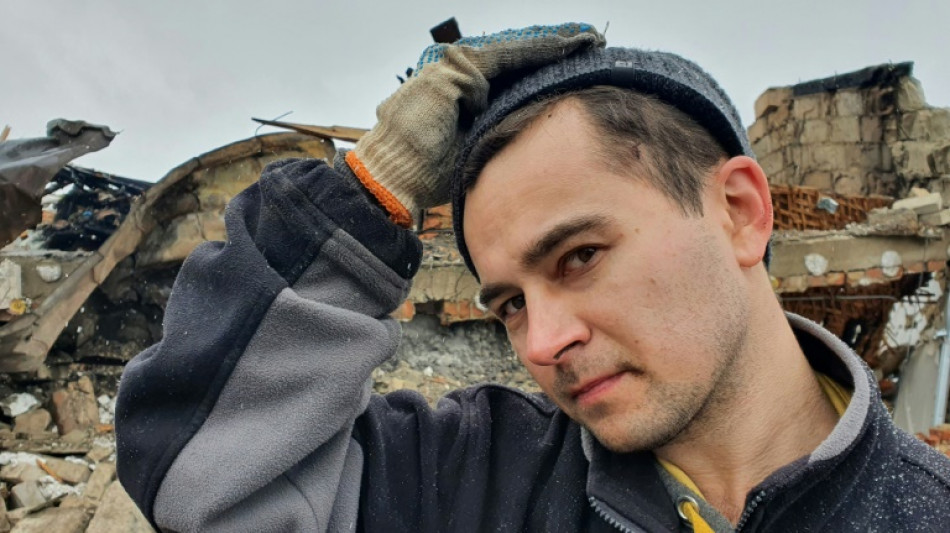
Oleg Rubak wept for love of his wife Katia, crushed in the rubble of his family home, and for hatred of Vladimir Putin, whom he blames for the missile strike that killed her.
The 32-year-old engineer was playing with his baby daughter in the living room of the couple's brick-and-timber house in Zhytomyr, 150 kilometres (93 miles) west of Kyiv.
On Tuesday night at around 10:00 pm in the Ukrainian crossroads town, home to a military garrison, a first missile struck near the family home.
A second crashed down behind the building, tearing a five-metre-deep crater, now full of dirty water and the smashed remnants of Rubak's house.
"Her name was Katia. She was 29 years old. One minute I saw her going into the bedroom, a minute later there was nothing," Rubak told AFP, standing by the ruins in jogging bottoms and a fleece.
"I hope she's in heaven and all is perfect for her."
He sobbed, apologised, and continued: "I want the whole world to hear my story."
He points out a pile of rubble among the others.
"That's where I was with our one-and-a-half-year-old daughter. But you can see, it's no longer a house, it's not even a room, it's... maybe it's hell," he said.
When the second blast struck, Rubak was thrown under debris as a terrifying sound followed by the icy winter night ripped into his home.
Reaching out with his fingertips he found his mobile phone, turned on the torch, and found his daughter.
- Maybe it's hell? -
"She wasn't moving, and my whole world fell in, but I took her hand and she started to cry. It was the most beautiful sound I'd heard in my life," he said.
Katia, however, was still under bricks and ceiling beams. Oleg desperately dug her out with his bare hands, he said, showing the red welts and scars.
He found her corpse, as he had feared. The first explosion had left her with no chance. "Katia was a housewife. She loved two things, me and our daughter."
Rubak's father, battling his own grief, tries to comfort him, urging him to wrap up against the bitter cold, but the angry son stood straight once again, trying to focus.
"I have to stay strong. I'm not cold. I just want the whole world to know what happened," he said, turning his fury on Putin, Russia's president.
Moscow's week-old invasion of Ukraine has been marked by missile bombardments that ended up hitting civilian homes and infrastructure -- and ending civilian lives.
"I want him dead," Oleg said of Putin. "Let him roast in hell for all eternity."
According to Zhytomyr officials, Tuesday night's bombings killed at least three people and wounded 20 more, including several young children.
In the city centre on Wednesday, dozens of residents were cleaning up the remains of a wrecked market, just opposite the city's large military academy.
Among them, 28-year-old Katarina Chternova, does not hide her fear, but local solidarity reassures her.
"We are all together, we help each other," she told AFP. "Because this is our land, and we want to save it... we don't give up".
Rubak, on the other hand, is more pessimistic in the face of the Russian advance. In Zhytomyr, he says, "many people would like to leave, but today, no one knows where to go".
T.Perez--AT