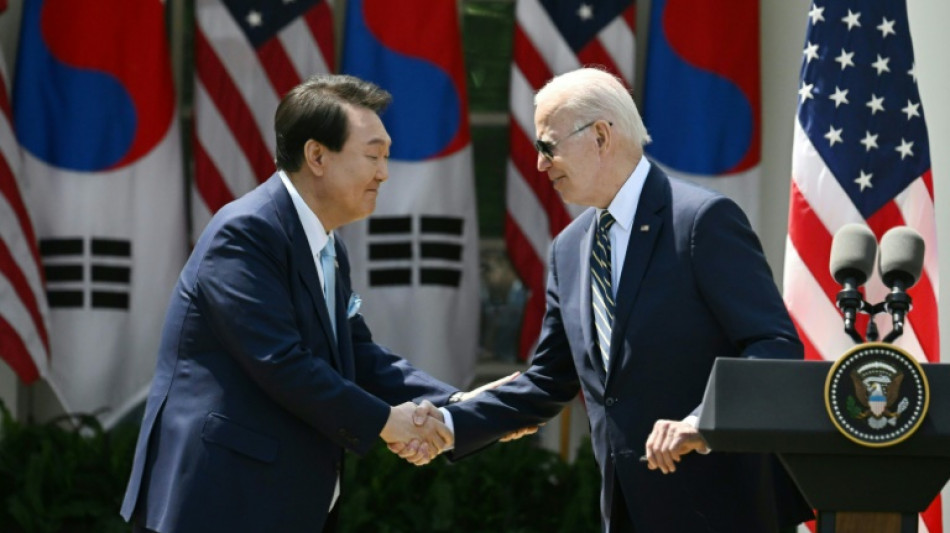
US and S. Korea boost cooperation, but nuclear threat remains / Photo: Jim WATSON - AFP

 England's Fin Smith in race against time to face Australia

 UN nuclear watchdog chief urges Iran to grant access

 Boeing shares tumble after it releases cautious growth forecast

 Lula's re-election revives Brazil-US tensions

 Carney moves to remake Canada alliances as US ties strained

 Serbia's students demand state media chiefs resign after poll win

 Starc takes six as Australia fight back in South Africa decider

 UK man offered drugged wife to strangers online for sex: court

 Africa Ebola outbreak passes 10,000 cases, mostly in DR Congo

 EU pushes for more nations to pay to protect nature

 Boeing reports smaller loss as it aims for stable output growth

 Tech firms gain on Anthropic IPO optimism; HSBC slumps in London

 Sri Lanka end England hopes with crushing win over Pakistan

 Dangote, Nigeria's oil tycoon rewriting Africa's story

 Carrick to remain Man Utd boss for Chelsea clash: reports

 Greenhouse gas levels hit new record highs in 2025: UN

 Rybakina looking to clinch year-end number one in Tokyo

 Tech firms track Wall St rally on mixed day for stock markets

 Kane says Ballon d'Or win 'feels like a dream' as tributes pour in

 HSBC profit jumps on higher rates, lower costs

 Rams rediscover offensive balance in 35-21 victory over Raiders

 Mercedes-Benz cuts 2026 profit outlook on tough China market

 Reparations calls follow Charles on tough Caribbean trip

 Jammu and Kashmir ministers resign before planned council expansion

 Germany, EU, stable investment stops despite upheaval: Merz

A US-South Korean agreement on strengthening deterrence against Pyongyang will discourage Seoul from seeking nuclear weapons, but also highlights the near absence of viable ways to remove the threat of North Korea's arsenal.
For years, the United States and international community have failed to get North Korea to give up its weapons, a long-running danger that has led many in the South to believe it needs its own nuclear arms.
Seeking to head off such a move, Washington agreed on Wednesday to deeper cooperation with Seoul on nuclear issues and the regular deployment of strategic assets to South Korea.
President Yoon Suk Yeol, on a state visit to the United States, in turn reaffirmed his country's commitment to non-proliferation.
As a result of the joint agreement, "South Korea is going to be more involved in conversations about the nuclear part of deterrence, not just conventional deterrence," said Naoko Aoki, associate political scientist at the RAND Corporation.
But the "geopolitical environment and North Korea's ongoing military modernization plan, among other issues, make it unlikely that North Korea will come to the negotiating table soon," she added.
North Korea has defied years of punishing sanctions to continue work on its banned nuclear and missiles programs, and has shown no signs that it is willing to consider giving up weapons it views as insurance against regime change.
Pyongyang conducted a record-breaking string of sanctions-defying launches this year, including test-firing the country's first solid-fuel ballistic missile -- a key technical breakthrough for North Korean leader Kim Jong Un's military.
- 'Run out of nuclear goodies' -
Surveys show that a majority of South Koreans believe the country should develop its own nuclear weapons -- an option Yoon had previously hinted Seoul could pursue.
The new agreement "is first and foremost about assuring South Korea and proving to Seoul that the US nuclear umbrella is credible," said Kelsey Hartigan, a nuclear issues expert at the Center for Strategic and International Studies.
"The prospects for a breakthrough on denuclearization have always been slim," she said.
"The question is not whether North Korea is going to give up its nuclear weapons, it's whether South Korea is going to develop its own in response."
The United States, Hartigan said, is not likely "anytime soon" to walk away from its formal position -- the complete denuclearization of the Korean peninsula.
Frank Aum, senior expert on Northeast Asia at the US Institute of Peace, warned of a possible North Korean response to the new agreement.
"If we're showing power right now, then it's very likely that North Korea's going to come back and respond with its own demonstration of power. It could be a satellite launch or a seventh nuclear test," Aum said.
"Then South Korea will want to respond again to show that it's responding and at some point we're going to run out of nuclear goodies to give to South Korea."
P.A.Mendoza--AT