
IMF chief urges world to avoid a 'second Cold War' / Photo: Mandel NGAN - AFP

 Mercedes-Benz cuts 2026 profit outlook on tough China market

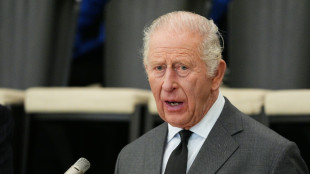 Reparations calls follow Charles on tough Caribbean trip

 Jammu and Kashmir ministers resign before planned council expansion
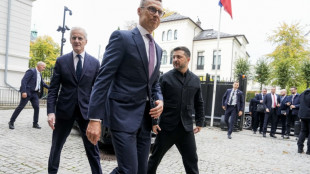
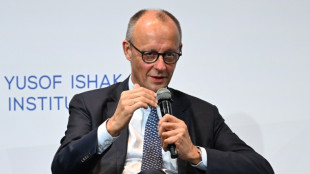 Germany, EU, stable investment stops despite upheaval: Merz

 China brands drop Mbappe for 'offending national sentiments'
 India orders evacuations as Cyclone Arnab looms

 Dutch broadcaster pulls out of Eurovision over Israel 'sensitivities'

 Critical coal inventories affect nearly half of India’s domestic power plants

 FCNR(B) deposit drive puts sharper margin pressure on private banks

 Noel Tata requests records of September 17 Tata Sons board meeting

 Reparations calls to dog King Charles's tough Caribbean trip

 Global rates and foreign outflows remain key risks for Indian markets

 Neha Nagar says ₹3 crore can fund retirement with disciplined planning

 Vikas Satija says steady SIP flows shielded Indian equities from deeper losses

 Brewers rout Rays to reach brink of World Series sweep

 Mbappe dropped by Chinese brands for 'offending national sentiments'

 Kuwait exhibition presents Ukraine’s Islamic heritage and cultural ties

 Tech firms track Wall St rally on mixed day for Asian markets
 Jay-Z to perform at Super Bowl LXI halftime show: NFL

 Climate-threatened Fijian utopia rejects calls to relocate

 Israel to give verdict on Netanyahu in pivotal election

 $1m bounties, dawn arrests: Trump presses voter fraud campaign
 Gasping for air: Borneo residents struggle as island burns

 Doha exhibition charts a millennium of Chinese maritime ceramics trade
 New Zealand ex-PM Ardern to teach leadership in Sydney

Countries must do more to avert the costly consequences of growing global trade fragmentation, and help avert a "second Cold War," the International Monetary Fund's (IMF) managing director said Thursday.
"I am among those who know what are the consequences of a Cold War: it is loss of talent and contribution to the world," Kristalina Georgieva said during a press conference at the official start of the World Bank and IMF's spring meetings.
"I don't want to see that repeating," she said, adding that the world should "rationally accept there will be some cost, there will be some fragmentation, but keep these costs low."
Georgieva was born and raised in Bulgaria, a former Soviet satellite state.
Multilateral institutions like the World Bank and IMF have an important role to play in preventing the world from splintering into different blocs with severe economic consequences, she said.
An IMF report earlier this week predicted that growing trade fragmentation resulting from events like Brexit, the US-China trade war and the Russian invasion of Ukraine, could make the global economy as much as seven percent smaller than it otherwise would have been.
Policymakers had a crucial role to play to "defend the interests" of their citizens, Georgieva said.
"If we fail to be more rational, then people everywhere will be worse off," she said.
- Progress made on World Bank reforms -
Progress has been made on a number of key issues for the World Bank and IMF, the Bank's outgoing president, David Malpass, said earlier Thursday at an event marking the official start of the spring meetings.
Member states agreed on a number of steps to boost the World Bank's financial capacity, he said, freeing it up to lend "as much as $50 billion of new financing" over the next decade.
Progress was also made on during debt roundtable discussion on Wednesday, Malpass said. For the first time, these talks included not only creditor countries but also the private sector, and representatives from Zambia, a country in advanced talks on restructuring its debt.
The Bank and IMF's leaders said progress had also been made to replenish lending facilities for low-income countries which have been depleted by the twin impact of the Covid-19 pandemic and the Russian invasion of Ukraine.
Ireland, Saudi Arabia, the UK, Portugal and Japan have all already come forward with "substantial new pledges or contributions" towards replenishing these funds in recent days, Georgieva said.
- 'Stay the course' -
Georgieva and Malpass both warned Thursday that inflation remained too high in many countries around the world.
"We expect central banks to stay the course in the fight against inflation, holding a tight stance to prevent a de-anchoring of inflation expectations," Georgieva said.
Governments also needed to work to reduce their budget deficits, and do more to improve sluggish growth prospects for the world economy in the medium term, she added.
In her remarks, Georgieva called on member states to push through the structural transformations needed to speed up digital transformation, improve the business environment in many countries, and accelerate the green energy transformation.
"We estimate $1 trillion a year is needed just for renewable energy and investment that can translate into growth and jobs," she said.
G.P.Martin--AT