Make mine a 'Kyiv Mule': Americans, Canadians drop Russian vodka

 South Korean FA condemns 'personal attacks' as rift rumours grow

 Japan urges 'impartial treatment' of journalist arrested in Russia

 What we know about Pope Leo XIV's lung cancer operation
 Advanced economies must 'act now' to lower debt as bond yields spike: IMF

 Deluge by design: Thai villages flooded to protect capital
 Ivan Deforge, the French 'bison tamer' in Moscow
 Indonesians on fire-ravaged island sue state for clean air
 Trump, White House post video of UK man killed by tiger

 CruxOCM and Client Present Closed-Loop Pipeline Automation Results at AVEVA Pipeline Summit 2026

 Saudi says Houthi attacks sparked Aramco fire, wounded 4 in Riyadh

 Few buyers for starving cattle in El Nino parched El Salvador

 Bybit Expands Beyond Crypto as CEO Outlines Next Phase of Financial Platform

 Bayern held by Viking after 'super dumb' Olise red in Champions League
 Why AI makes computer worms harder to stop

 US fines Bank of America $1.2 bn for anti-money laundering violations

 Bayern held by Viking after Olise sees red in Champions League

 Atletico down Carrick's struggling Man United

 Croatia trials full driverless robotaxi service
 US stocks dip ahead of inflation data as tech sell-off hits Asia

 No lights, no friends: Cuban youth grapple with loneliness
 Saudi coalition strikes Yemen oil sites after Houthi attacks

 French economy minister denies country caught in debt 'snowball'
 Judge extends halt to Trump's golf course tree-cutting
 Milan's Saelemaekers set for lenghty spell out after ankle surgery

 Nvidia says to invest in French medical website
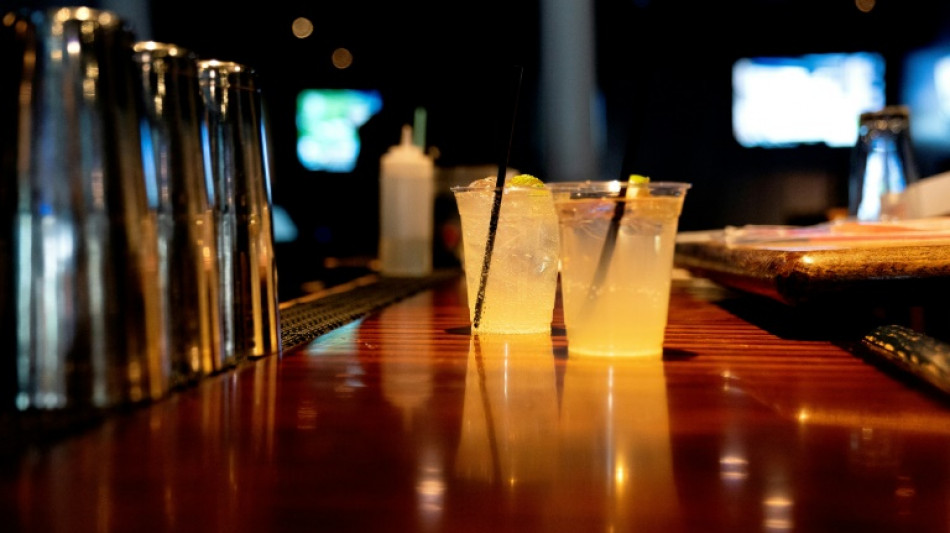
Regulars at Caddies bar and grill in Bethesda, Maryland can still get a classic cocktail made with vodka, ginger beer and lime, but it now comes with a different name -- a Kyiv Mule.
Ronnie Heckman, the 31-year-old owner of the eaterie outside of Washington, DC said he decided to stop purchasing or serving Russian vodka in solidarity with Ukraine, besieged by the Russian military since last week in a conflict that has shaken the globe.
"We're hoping that other people... will join us to continue to bring awareness to what's going on right now," said Heckman, whose family has ties to both Ukraine and Russia from generations back.
Behind the bar, Heckman now slings Kyiv Mules and White or Black Ukrainians instead of their Russian counterparts, with a portion of the revenue from selling those drinks going to the Ukrainian Children's Emergency Relief Fund.
Russian vodka doesn't dominate North American spirits markets, but for US and Canadian authorities and businesses, stripping Russian brands from shelves and menus was a valuable symbol of support for Ukraine and a visible way to join the international shunning of Moscow over the invasion.
Heckman isn't the only small business owner to take a stand in this way, with stores, restaurants and bars ditching Russian vodka from Kansas to Vermont.
There, the Magic Mountain ski resort in Londonderry posted a video showing a bartender saying "Sorry, we don't serve Russian products here" as he empties a bottle of Stoli -- which is in fact made in Latvia -- down the drain.
US and Canadian authorities are also pulling the plug on the spirit long seen as a hallmark of Russia, making it a potent symbol to target.
In Virginia, one of the 17 US states where the government manages the sale and distribution of distilled spirits, the Alcoholic Beverage Control Authority pulled seven Russian-sourced vodka brands from their nearly 400 stores on Sunday.
"We did this in the spirit of Governor (Glenn) Youngkin's call for some action in support of Ukraine" made on Saturday, said Carol Mawyer, VABC Public Relations Manager.
She noted that the $1.1 million-worth of the seven pulled brands sold in the state in the last fiscal year compared to $57.8 million of US-made Tito's vodka -- meaning money isn't the point, it's the principle.
- 'Dump all the Russian vodka' -
In New Hampshire, also a "control state" like Virginia, Governor Chris Sununu ordered the state-run liquor stores to remove Russian-made "spirits from our liquor and wine outlets until further notice."
"New Hampshire stands with the people of Ukraine in their fight for freedom," he tweeted. Governors in West Virginia, Ohio, Texas and elsewhere followed suit in ordering or urging the removal of Russian products.
Senator Tom Cotton of Arkansas joined the clarion call.
"Dump all the Russian vodka and, alongside ammo and missiles, send the empty bottles to Ukraine to use for Molotov cocktails," he said on Twitter, recalling the many images of regular Ukrainians converting empty bottles into petrol bombs to fend of Russia's advance.
In Canada, the Liquor Control Board of Ontario on Friday said all Russian-made products would be removed from its outlets.
Other provinces have made similar calls in recent days, with Ontario official Peter Bethlenfalvy calling the move a "stand against tyranny and oppression."
The bans are not limited to North America, with Finland's state-run alcohol distributor banning Russian goods on Monday, a measure affecting around 30 products -- most of them vodka.
Sweden's state-run alcohol monopoly also said it would block the sale of Russian products.
While blackballing Russian vodka may not cause huge economic waves in the United States, the liquor is the "backbone of the spirits industry" in the country, according to the Distilled Spirits Council of the United States (DISCUS), providing a high-profile way to draw attention to the issue.
Caddies' Mules were already popular, and in the first day of their redubbing Heckman said people had already come in specifically to order the cocktail.
"We sell about 400 a week," he said. "And it'll be nice to see that on the computer screen -- instead of it saying Moscow Mule, a Kyiv Mule."
W.Moreno--AT