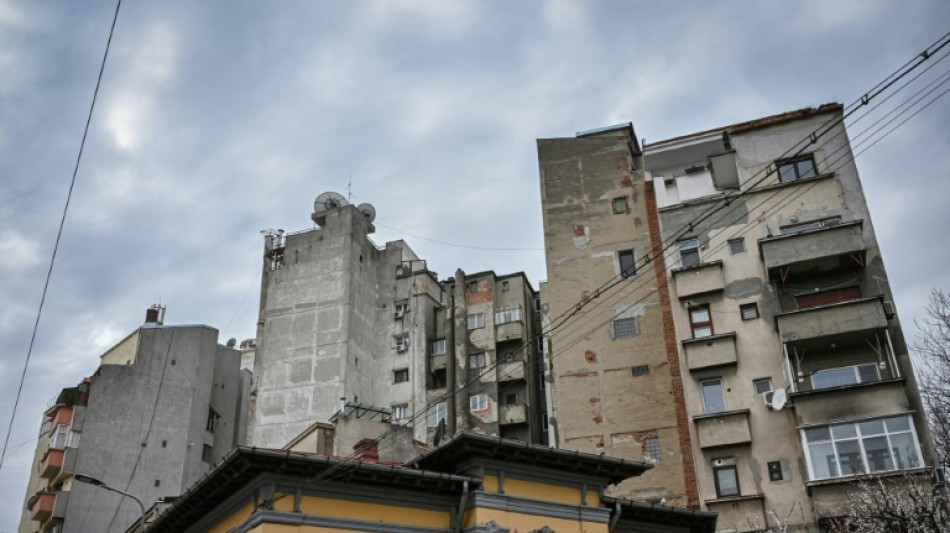
Quake-prone Bucharest trembles over rickety buildings / Photo: Daniel MIHAILESCU - AFP

 South Korea score late to reach Asian Games football final
 Tom Kim defies jet-lag, Kho cards ace as Asian Games golf begins

 Thai teen rocker Nene aims to tour, write music... and return to school

 Ivory Coast clamps down on harmful illegal gold rush

 Nagoya mayor says sorry for Asian Games 'inconveniences'
 G20 trade officials meet under shadow of tariffs, overcapacity

 India's fat dog vote goes viral
 Asian Games crowds in spotlight as 998 see hosts in 50,000 stadium

 The eight stadiums for the 2027 Rugby World Cup

 Thieves swipe drugs under nose of Fiji police, swap with flour
 South Korea demands North apologise for DMZ mine blasts
 In Nepal's flood zone, teachers mourn students who never returned
 US Supreme Court lifts limits on third-country deportations

 Antonelli eager to 're-establish order' as F1 returns to Malaysia

 Paw-fect candidate: Australia finds new koala rescue dog
 One third of world population exposed to harmful air pollution: monitor

 North Korea denies South's claim it was apparently behind DMZ mine blasts

 West Bank's violent settlers part of a new generation fuelled by ideology

 US-led coalition ends mission in Iraq
 Pope-backed White Sox join Braves with MLB playoff wins

 Psychology Software Tools Builds on Early Bioz Success to Expand Access to Publication-Backed Product Evidence

 Alpha Growth Management Opens Rep Office in Japan

 NBA close to picking new $12-13bn Vegas team owners: report
 LA28 Olympics torch relay to visit all 50 states
 Spain brush aside Croatia in Nations League, England down Czechs

Many people in Bucharest still have terrible memories of the earthquake that shook Romania on March 4, 1977, killing 1,500 and injuring 11,000 others.
Images of the devastation in Turkey and Syria have revived old fears in the EU's most earthquake-prone capital, which experts say remains completely unprepared for big tremors.
"We are very vulnerable," said Matei Sumbasacu, founder of the Re:Rise group that is pushing to make the city more earthquake safe.
"We didn't solve this problem, we didn't treat it seriously for decades and we're not ready for it, it's as simple as that," said the 34-year-old engineer.
Bucharest is close to the Vrancea earthquake zone, which experts say is capable of producing shocks as high as 8.1 on the Richter scale, worse even than the Turkey quake.
Five earthquakes since 1802 have been worse than magnitude 7.5.
Yet many buildings damaged by the 1977 quake, which was registered at 7.2, are still being used, with other rickety blocks covered in protective nets or draped with tarpaulins.
- 2,500 dangerous blocks -
The city has deemed some 2,500 buildings dangerous, according to Bucharest town hall official Razvan Munteanu.
These include 368 at very high risk, which have a red plaque fixed to the outside walls.
But because of the colossal costs, only 32 have been consolidated to date from public funds, Munteanu told AFP.
While the pace of reinforcement work has picked up a little in recent years under Mayor Nicusor Dan, it remains very slow -- with only two projects underway in the city.
Work to consolidate 100 more buildings should soon start after a long and bureaucratic process.
"You have to consult the inhabitants, do the feasibility studies, identify the solutions, and find the companies that will carry out the work," Munteanu said.
Next to a large Bucharest park, work on a 100-apartment block from the late 1930s, which bears the red warning plaque, is scheduled to begin next year.
Building administrator Ioan Boinegri, 76, said some residents, especially older ones, are reluctant to move.
"They don't know (yet) where they are going to be relocated... The inhabitants' greatest fear is that they won't be able to come back," Boinegri told AFP.
- Cosmetic repairs -
After the 1977 disaster, the then communist regime just carried out cosmetic repairs to facades to save money, according to Sumbasacu.
He recently accessed transcripts which showed dictator Nicolae Ceausescu ordering a halt to reinforcement works a few months after the earthquake.
To reassure the population, Ceausescu put out lots of false information, leaving an "inheritance of seismic mythology, stories to help us sleep at night in our unsafe houses," Sumbasacu said.
The 7.8-magnitude quake and aftershocks that struck southeastern Turkey and northern Syria in February killing more than 50,000 people, reawakened dormant fears.
Major tremors in south-west Romania, shortly afterwards caused panic in the region, which usually doesn't suffer from earthquakes.
"There's a growing realisation that something needs to be done," Sumbasacu said, warning a new big earthquake in Bucharest could be more deadly than the 1977 one.
While it is impossible to predict earthquakes, cities can protect themselves from their worst effects, experts say.
"If we respect the current rules, we could withstand an earthquake of 8," said Mihai Diaconescu, a researcher at Romania's National Institute for Earth Physics.
"It's debatable what will still stand after an earthquake stronger than 8."
M.Robinson--AT