Ukraine crisis stretches Indian 'neutrality' to the limit

 South Korean FA condemns 'personal attacks' as rift rumours grow
 Japan urges 'impartial treatment' of journalist arrested in Russia
 What we know about Pope Leo XIV's lung cancer operation
 Advanced economies must 'act now' to lower debt as bond yields spike: IMF
 Deluge by design: Thai villages flooded to protect capital
 Ivan Deforge, the French 'bison tamer' in Moscow

 Indonesians on fire-ravaged island sue state for clean air
 Trump, White House post video of UK man killed by tiger
 CruxOCM and Client Present Closed-Loop Pipeline Automation Results at AVEVA Pipeline Summit 2026

 Saudi says Houthi attacks sparked Aramco fire, wounded 4 in Riyadh
 Few buyers for starving cattle in El Nino parched El Salvador
 Bybit Expands Beyond Crypto as CEO Outlines Next Phase of Financial Platform
 Bayern held by Viking after 'super dumb' Olise red in Champions League
 Why AI makes computer worms harder to stop

 US fines Bank of America $1.2 bn for anti-money laundering violations
 Bayern held by Viking after Olise sees red in Champions League
 Atletico down Carrick's struggling Man United
 Croatia trials full driverless robotaxi service
 US stocks dip ahead of inflation data as tech sell-off hits Asia

 No lights, no friends: Cuban youth grapple with loneliness
 Saudi coalition strikes Yemen oil sites after Houthi attacks
 French economy minister denies country caught in debt 'snowball'

 Judge extends halt to Trump's golf course tree-cutting
 Milan's Saelemaekers set for lenghty spell out after ankle surgery
 Nvidia says to invest in French medical website
Russia's invasion of Ukraine has left India's traditional balancing act between Moscow and the West looking wobblier than ever, with experts saying New Delhi has few good diplomatic options.
Last week India abstained on a UN Security Council resolution deploring Russia's "aggression" against Ukraine, winning praise from Moscow for its "independent and balanced position".
But while New Delhi hoped this would be seen as neutrality, in many capitals its failure to condemn the invasion was taken as de facto backing of Moscow that gave President Vladimir Putin useful diplomatic cover.
And India is also reportedly looking to bolster its rupee-rouble trade pact with Moscow, potentially undermining Western efforts to isolate Russia from the global financial system.
The crisis has left India facing a dilemma: it leant towards the Soviet Union during the Cold War -- while Pakistan was in the Western camp -- and their close relations outlived the fall of the Iron Curtain, with Moscow still by far its biggest arms supplier.
At the same time it needs Western support to contend with Xi Jinping's increasingly assertive China: Beijing is extending its reach into the Indian Ocean, and the two countries had a deadly border clash in 2020.
Together with the US, Japan and Australia, India is also a member of the "Quad alliance" that is seen as a bulwark against China.
Its decision to abstain at the Friday Security Council vote left it alongside only Beijing and the United Arab Emirates, while Russia vetoed the resolution.
"There are not many choices that India has," said Nandan Unnikrishnan of the Observer Research Foundation.
It "has as much investment in a relationship with Russia as it has in maintaining a relationship with the United States", he told AFP.
"India's challenges in the maritime is where it needs the United States and India's challenges on the continental shelf is where it requires Russia."
- Hug the bear -
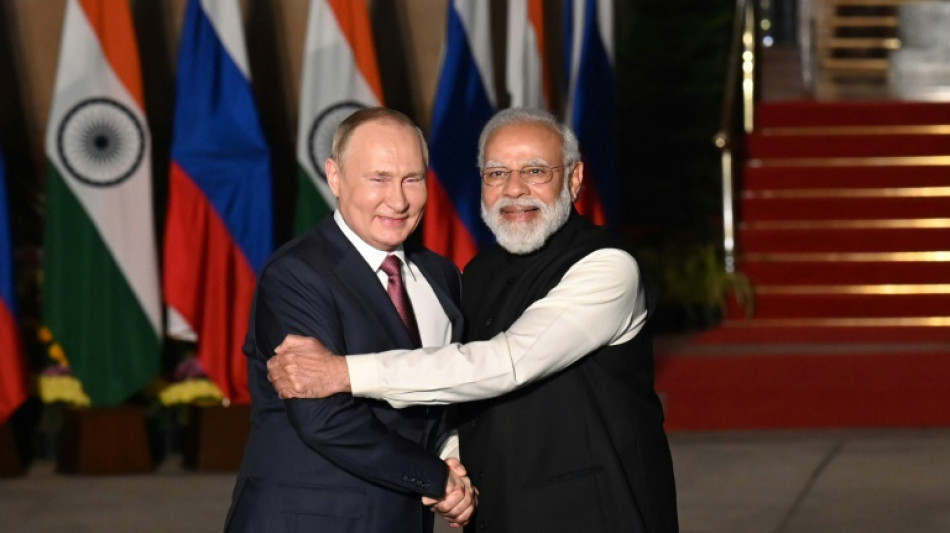
Putin visited India last year, in a rare foreign trip for the Russian president, bear-hugging Prime Minister Narendra Modi as the two men bolstered military and energy ties.
New Delhi is the world's second largest importer of arms after Saudi Arabia and according to the Business Standard, between 2016-2020, 49.4 percent of its purchases were from Russia.
Late last year it began taking delivery from Russia of the S-400 missile defence system that it agreed to buy for over $5 billion in 2018, despite the threat of US sanctions.
And while New Delhi is looking to develop its own capacity and diversify its suppliers, US imports accounted for just 11 percent.
The Asian giant of 1.4 billion people is also a major consumer of Russian oil. Total annual bilateral trade runs at around $9 billion, with much smaller quantities of pharmaceuticals, tea and coffee going the other way.
Russia has also repeatedly vetoed UN resolutions condemning Delhi over its behaviour in Indian-administered Kashmir where a violent insurgency has raged for decades.
According to Happymon Jacob from Jawaharlal Nehru University, Russia is perhaps India's "only partner of consequence" in the territory to its north.
- 'East-West conflict' -
While New Delhi aspires to a permanent seat on the UN Security Council, a role that would bring greater responsibility on the world stage, it has been careful to avoid explicitly condemning Russia.
So far it has not referred to Moscow's operation as an invasion and instead emphasised narrow domestic aspects of the crisis, primarily the evacuation of Indian students from Ukraine.
Officially, Washington has kept its annoyance quiet, saying India and Russia "have a relationship... that we don't have" and calling on Delhi to use its "leverage" with Moscow.
But ex-officials have been more vocal, with former US diplomat Richard Haass calling India's "careful, avoid angering Putin at all costs response" a sign that it "remains unprepared to step up to major power responsibilities or be a dependable partner."
But commentator Sanjaya Baru said Western countries should be more indulgent of India's ties to Russia -- precisely because of its role in confronting China.
"Only a vibrant India can take the edge off an aggressive China," he wrote in the Times of India.
There is "no reason why India should be taking sides in what is essentially an East-West conflict, centred in Europe and a continuation of the Cold War", he added.
A.Anderson--AT