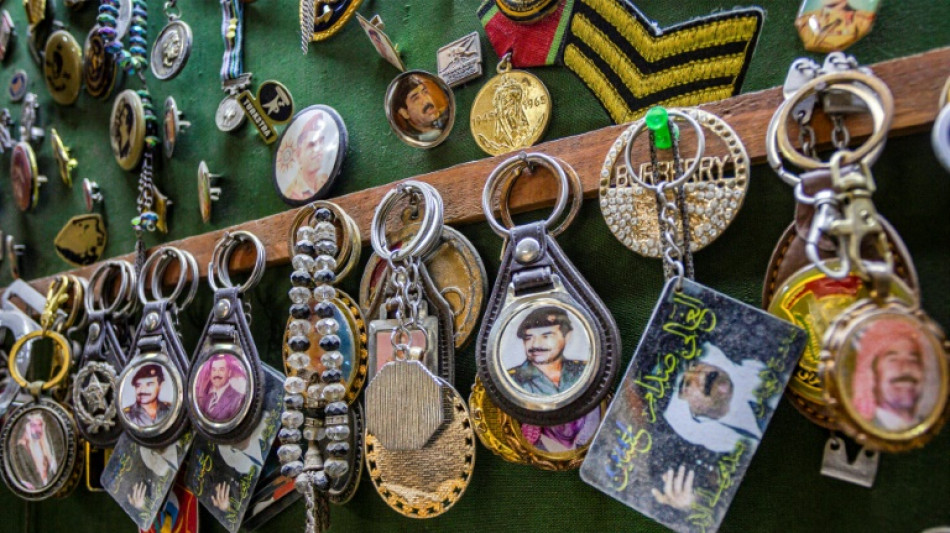
Iraq's Saddam still revered in Jordan 20 years later / Photo: Murtadha Ridha - AFP

 With elections ahead, Latvia's Russian-speakers reject Moscow's help
 Brazil football clubs face massive sponsorship blow from betting ban
 ChatGPT maker wants to be the App Store for AI as safety concerns grow
 Women fight fires and sexism in Indonesian Borneo

 Forsling's OT blast lifts Florida over Carolina in NHL opener

 Hurricane Polo sweeps over Mexico's Pacific coast, heads inland
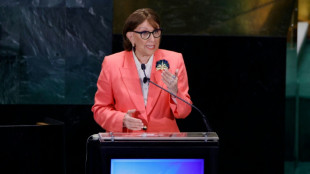 Grynspan pulls ahead in race to lead UN: diplomat

 Trump touts AI boss pledge to self-regulate

 Oil down, but stocks lower as bond yields rise

 England break down stubborn Czechs to claim first Nations League win
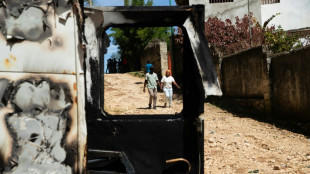 UN Security Council extends Haiti anti-gang force by 6 months

 Manchester City guilty of Premier League charges: What comes next?
 Man City chief Soriano slams Premier League 'conspiracy theory'

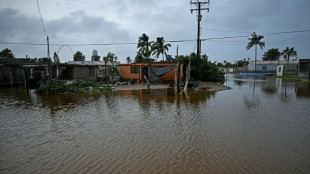 Hurricane Polo sweeps over Mexico's Pacific coast

 Man City must be relegated after guilty verdict says club's former chairman

 German far-right aims to lead Saxony-Anhalt govt in December
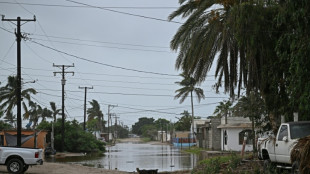 Little damage as Hurricane Polo sweeps over Mexico's Pacific coast

 Manchester City guilty of breaking financial rules - Premier League

 FIFA boss Infantino blasted as would-be 'emperor' by UEFA's Ceferin

 Stocks move lower despite oil prices dropping
 AI driving up innovation investment: UN

 UN Security Council extends Haiti mission by 6 months
 Man Utd do not deserve medals if Man City stripped of titles: Rooney

 Vana Completes Expanded Staking as Part of the Vega Upgrade, Publishes Expanded VANA Token Economics
 Spain to cap gas price hikes, extend fuel discounts
Twenty years after the fall of his regime, the late Iraqi president Saddam Hussein remains admired and popular in Jordan where his image can still be seen across the country.
The instantly recognisable face peers out from everything from bumper stickers to mobile phone cases in neighbouring Jordan, despite symbols and images associated with his rule being outlawed in Iraq itself.
On March 20, 2003, then US president George W. Bush launched Operation "Iraqi Freedom" with a ground invasion by 150,000 US and 40,000 British troops, under the pretext of destroying Iraq's alleged arsenal of weapons of mass destruction.
Saddam appeared for the last time in public on April 9, just hours before the announcement of the fall of Baghdad.
Having ruled Iraq with an iron fist since 1979, Saddam went to ground until his hiding place was discovered by US troops eight months afterwards.
He was later tried, convicted and hanged on the morning of December 30, 2006.
In Iraq, it is an offence to display photographs or slogans of the toppled dicator and arrests are still sometimes made.
Last October, four people were detained in Anbar province, between Baghdad and the Jordanian border, for "glorifying the defunct regime during National Day celebrations".
But in Jordan, many people fondly remember Saddam for his support for the Palestinian cause, Arab nationalism and resistance to Western intervention in the Middle East.
"Tens of thousands of Jordanians graduated from Iraqi universities in various fields during Saddam's era with free scholarships," MP Khalil Attiyeh told AFP.
He said Saddam supported the Palestinian uprising, or intifada, and gave money "to the families of the Palestinian martyrs and rebuilt the houses of those who had them demolished by the enemy".
Attiyeh believes it is normal for "Jordanians to adore him and not to forget him, and to keep his photos, showing loyalty to this heroic leader".
Salameh Blewi, 67, a Jordanian contractor who visited Baghdad in the 1980s, called Saddam "an honourable and honest Arab leader, with honourable positions".
- 'We all love him' -
"Despite the (1980-1988) war with Iran, Iraq was a country of riches, but after Saddam, it was plundered by the corrupt," Blewi said.
Iraq's former premier Mustafa al-Kadhemi said in a March television interview: "Since 2003, the money that has been wasted exceeds $600 billion."
It went to "the corrupt and parties in power", Kadhemi charged.
Graft watchdog Transparency International ranks Iraq as one of the 25 most corrupt states in the world.
Saddam's brutal legacy has done little to sway many Jordanians, and its aftermath only reinforces their views.
"Jordanians know that Saddam Hussein is a brave and nationalist Arab leader who defended Arab causes valiantly. We all love him," said Shaher Abu Sharkh, 67, who sells mobile phone accessories in Amman.
"What happened was not the fall of Saddam's regime, but rather the fall of Iraq. Unfortunately, Iraq ended after Saddam and was systematically destroyed."
Zuhair Amleh, 70, sells vintage books in Amman's Hashemite Plaza square.
"Unfortunately, Iraq cannot return to what it was like before, he said.
"Those ruling Iraq now are sectarian and agents of Iran," he added.
The 2003 invasion sparked years of the worst violence in Iraq's history.
Most of the Shiite militias involved in the violence had been Saddam's opponents in exile, members of radical Islamist parties or armed groups who had taken refuge in neighbouring Iran and even sided with Tehran in the 1980s war.
- 'Hero and saviour' -
By the time US troops left Iraq in 2011, the conflict had claimed the lives of more than 100,000 Iraqi civilians, according to the Iraq Body Count group. US losses totalled nearly 4,500.
"The main reason Jordanians love Saddam is that they saw him as a hero and a saviour who had a mission to boost the Arab nation at all levels," Attiyeh told AFP.
He said Saddam was "the only Arab leader who established a military manufacturing base, from bullets to missiles, and bombed the Zionist entity (Israel) with 39 missiles made by Iraq".
After the US-led Operation Desert Storm against Iraq began in 1991, Iraq bombarded Israel with Scud missiles.
In a shop in Amman Anas Nahas, 19, arranged mobile phone covers bearing Saddam's likeness.
"If he was still alive many things would not have happened," Nahas said.
He cited "the Israeli occupation's crimes against our people in Palestine... the fall of Arab regimes, the wars in Syria and in Yemen, and the humiliation that Arabs are currently experiencing".
M.Robinson--AT