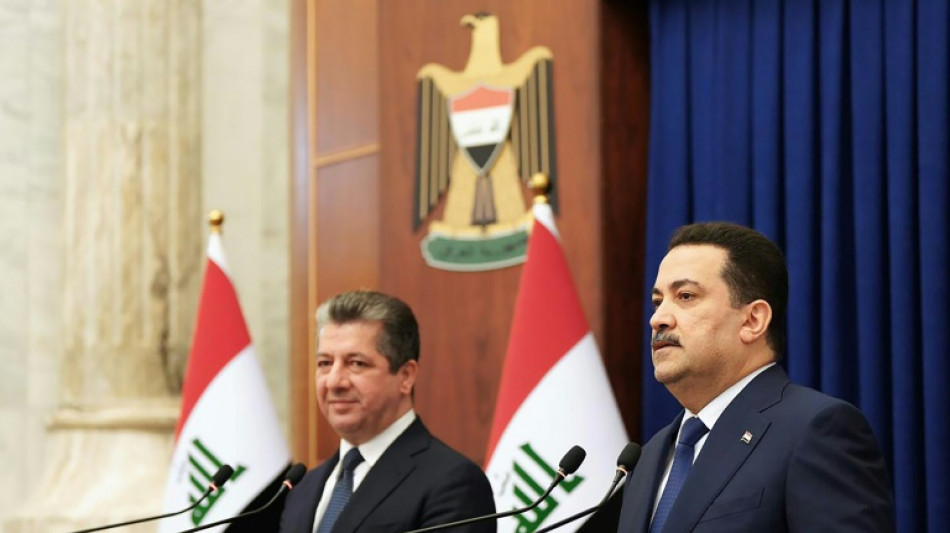
Iraq, Kurdish region sign accord to resume oil exports / Photo: - - IRAQI PRIME MINISTER'S PRESS OFFICE/AFP

 Cavs edge T'Wolves in overtime despite superb Edwards

 Prescott fires Cowboys to 38-21 win over plummeting Eagles

 Kuwait padel chief hails national showing at Premier Padel Major

 Britain prepares constrained budget as debt and defence pressures mount

 Valkyries beat Dream to reach brink of WNBA title
 Benjamin Netanyahu: Israel's longest-serving PM fighting for survival

 Kuwait receives invitation to 2026 UN Water Conference in Abu Dhabi
 Arab World Institute president outlines plans for stronger Kuwait-France cultural links
 Bolsonaro's party says it recognizes Lula's election win in Brazil
 Meghan on TV menu for 'Junior MasterChef Australia'
 South Korea's chip boom fuels forecast-beating third-quarter growth

 US-brokered truce begins in Ukraine city occupied by Russia

 Qatar launches Fashion and Crafts Council to connect talent with global markets

 Jordan strikes militant groups in Syria after church attack

 FIA chief praises Middle East motorsport volunteers and officials

 8 Costs People Forget to Budget When Planning a Family

 How to Freshen Up Your Kitchen for $3,000

 Al-Thawadi urges technology to deepen human connection through shared experiences
 Ballon d'Or: Harry Kane's crowning moment

 Harry Kane wins men's Ballon d'Or

 Lula win rattles Brazil markets over spending spree fears

 De la Fuente wins men's Ballon d'Or coach of year

 Trump slams 'rigged' Brazil election after ally loses to leftist Lula

 Nadal returns for Vegas hardcourt event

 Fainga'anuku named as loose forward for All Blacks northern tour

Iraq's federal government and the Kurdistan autonomous region signed an accord Tuesday to allow Kurdish oil exports to resume through Turkey after they were halted 10 days earlier.
The agreement, signed in Baghdad in the presence of Prime Minister Mohamed Shia al-Sudani and Kurdish premier Masrour Barzani, was to be implemented "today", a Kurdish regional government official told AFP.
The deal was described as temporary but signals the end of independent oil exports by northern Iraq's Kurdish regional government and marks a clear limit to its autonomy.
The agreement comes two days after Iraq, Saudi Arabia and several other major oil exporters announced a sharp reduction in their production from May that sent up global energy prices.
Barzani said on Twitter that the deal is "temporary" until Iraq's parliament agrees a new oil and gas law, but he called it "a crucial step towards ending the long-standing dispute" between Arbil and Baghdad.
Ankara had stopped handling Iraqi Kurdish oil last month after an international tribunal ruled in a nine-year-old dispute that Baghdad was right to insist on overseeing all Iraqi oil exports.
Oil exports are the key revenue source for both the federal and regional governments and their management has long been a sensitive topic in relations.
The government of war-scarred Iraq is betting on earning around $70 per barrel in its budget calculations for the next three years and has been irritated to see the autonomous region go it alone by exporting its oil via Turkey.
The Kurdistan government sees Baghdad as trying to profit from the region's resources while dragging its feet on paying the salaries of Kurdish civil servants and other funds for its regional public sector.
- 'Breakthrough deal' -
Gulf Analyst Yesar Al-Maleki, of the Middle East Economic Survey (MEES), said the deal aimed "first and foremost" at quickly re-starting exports to Turkey.
"But it also presents an opportunity for Baghdad to finally be involved in Iraqi Kurdistan's oil sector" and should also allow Kurdistan "to accrue higher revenues" in future.
Maleki hailed the deal as a "breakthrough for the two PMs" that could help both sides draft the new energy law and "resolve the existing historic disputes once and for all".
Sales of Kurdistan crude will be managed from now by the State Oil Marketing Organization, a federal government official and a Kurdish official told AFP.
A joint committee formed by the federal and regional governments will supervise the export process, they added.
Revenues will be paid into an account under the control of the Kurdish government which will be overseen by Baghdad, they said.
The halt to exports through a pipeline to the Turkish Mediterranean port of Ceyhan had left foreign oil firms with nowhere to pump Kurdish oil.
Norway's DNO, one of the main firms operating in Iraqi Kurdistan, announced it was halting production at its wells.
Prior to Ankara's action on March 25, the autonomous region was exporting roughly 450,000 barrels per day of crude.
Iraq, the second largest producer within the Organization of the Petroleum Exporting Countries, exports an average of 3.3 million bpd.
S.Jackson--AT