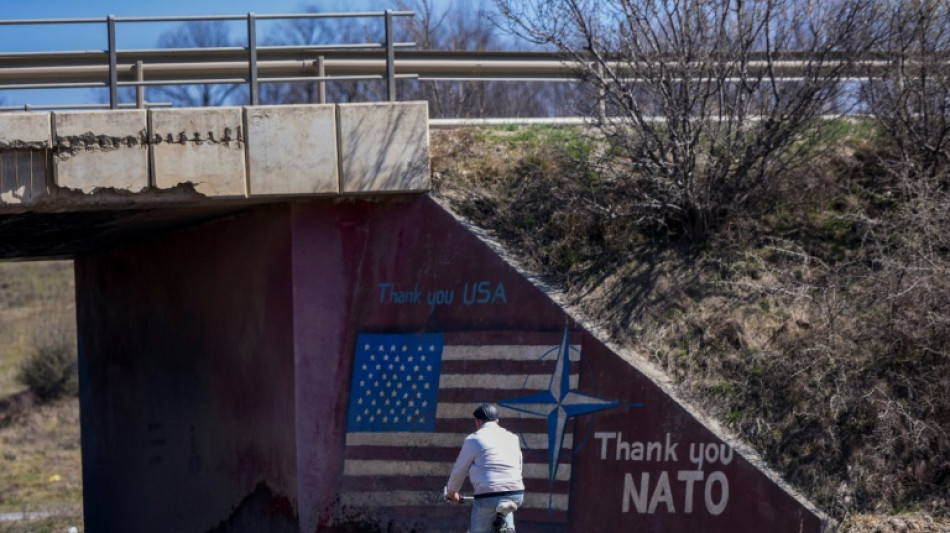
From the Cold War to the Ukraine war: NATO in brief / Photo: Armend NIMANI - AFP/File

 UN to hold fourth informal poll of secretary-general candidates
 Who are the Emiratis behind crisis-hit Manchester City?

 Singer Angelique Kidjo urges Africans to 'create together'

 Alleged Rihanna mansion shooter mentally fit for trial, says judge
 Mystery over UK airbase scare as police find petrol not explosives

 OpenAI unveils low-cost AI model, a day after shelving Astra upgrade
 Premier League confirms Man City guilty of serious financial breaches
 Brazil's Lula turns to Bad Bunny tune to criticise Trump ahead of polls
 Nigerian dancer eyes world record after seven-day marathon
 Swiss regulator concludes Julius Baer bank probe
 Brazil's patron saint pulled into latest election scrap

 Football overload leaves players near 'breaking point', warns Tebas
 Paris Eiffel Tower says chief to step down after uproar over removing women staff
 Amaze Holdings (NYSE: AMZE) Executes Binding LOI to Acquire BullionFX | Alchemy, a Decentralized Gold-Backed Financial Ecosystem for Valued at US$155 Million
 Clashes between French teens, police as school blockades intensify
 Stocks move sideways despite oil moving lower
 African leaders to gather in Egypt for business summit
 UK decides against charging foreign visitors for museums

 Dallaglio to sell England World Cup winners' medal

 Brazil come from behind to beat Australia 4-2 in friendly

 Ruthless An retains Asian Games badminton crown as Kunlavut triumphs

 Alonso to stay with F1 team Aston Martin in 2027
 China badminton 'still strong' despite Asian Games slump
 'Exceptional' Turner painting shown in Rome before sale

 European stocks climb as oil dips

NATO is the world's biggest military alliance, bringing together 30 European and North American countries who commit to defend each other in the event of attack. After Finland joins on Tuesday, it will have 31 members.
The alliance was formed at the start of the Cold War to protect Western Europe against the threat of Soviet aggression but its remit and reach have expanded over time.
Here is a brief history of the organisation:
- Containing Soviet threat -
The North Atlantic Treaty Organization is founded on April 4, 1949, by 12 countries alarmed by the Soviet Union's drive to install communist regimes across Eastern Europe.
The original signatories of the founding Washington Treaty are Belgium, Britain, Canada, Denmark, France, Iceland, Italy, Luxembourg, the Netherlands, Norway, Portugal and the United States.
The treaty's key Article 5 states that "an armed attack against one or more of them in Europe or North America shall be considered an attack against them all" and requires a reaction, "including the use of armed force".
Moscow's response is to set up a rival club of 12 communist countries called the Warsaw Pact.
- Balkan wars -
After the Soviet Union falls apart in 1991, NATO gets drawn into the Balkan wars.
In 1994, the alliance conducts its first combat operation, sending fighter jets to Bosnia-Herzegovina to enforce a no-fly zone.
A year later, NATO puts boots on the ground for the first time when it deploys peacekeepers to Bosnia.
In 1999, it carries out a 78-day bombing campaign in Serbia over Belgrade's bloody crackdown on the breakaway province of Kosovo.
But the 1990s also bring outreach with Russia and its former allies.
In 1997, NATO signs a political "founding act" with Moscow, stressing that they "do not consider each other as adversaries" and two years later the first ex-communist countries join the club -- the Czech Republic, Hungary and Poland.
- 'War on terror' -
NATO's "one for all and all for one" pledge is invoked for the first time after the 9/11 attacks on the United States, carried out by the Al-Qaeda terror network.
NATO joins the US-led "war on terror" in 2003, taking the lead of the International Security Assistance Force (ISAF) deployed to Afghanistan to root out Al-Qaeda and other Islamist militants.
NATO's combat mission in Afghanistan ends in 2014, but NATO allies only withdraw fully seven years later sparking a collapse of Western-trained Afghan forces and a takeover of Afghanistan by the Taliban.
Meanwhile, as the European Union expands, so does the alliance, with Bulgaria, Romania, Slovakia and Slovenia joining in 2004.
The admission the same year of the three ex-Soviet states of Estonia, Latvia and Lithuania particularly annoys Russia.
- Libya intervention -
In 2011, the alliance is given a UN mandate to use "all necessary measures" to protect Libyan civilians from embattled dictator Moamer Kadhafi.
NATO's seven-month campaign of air strikes leads to Kadhafi's overthrow. Russia and China accuse NATO of using its mandate as a cover for regime change.
- Standoff over Ukraine -
In April 2014, NATO suspends all cooperation with Russia over its annexation of Crimea and support for pro-Russian rebels in eastern Ukraine.
In 2016, NATO deploys four multinational battalions to Poland and the Baltic states, marking the biggest reinforcement of NATO's collective defences since the Cold War.
On February 24, 2022, Russia invades Ukraine, a NATO partner country that has for years attempted to join the alliance.
NATO does not intervene directly, but its members send Kyiv billions of dollars in weapons and the alliance boosts its eastern flank with four new battlegroups -- in Romania, Bulgaria, Slovakia and Hungary.
Fearing being future targets of Russian aggression, Finland and Sweden, which have been non-aligned for decades, apply for NATO membership.
On March 30, 2023, Turkey is the last NATO member to approve Finland's membership, clearing the way for it to become NATO's 31st member.
A.Taylor--AT