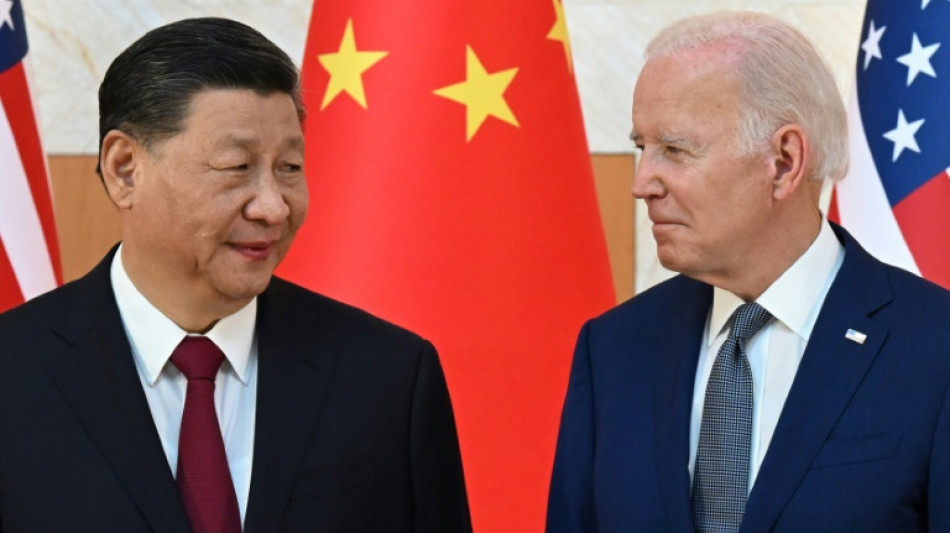
After brief window, US-China relationship back on rocky path / Photo: SAUL LOEB - AFP/File

 Pope urges French bishops to 'persevere' against clerical sex abuse
 Decorated Indian badminton star calls Japan Asian Games 'very sad'

 Asian Games chiefs say lessons learned over accommodation

 UK's PM urges 'calm' as thousands seek to thwart flashpoint N.Ireland parade

 Thousands seek to thwart disputed N.Ireland flashpoint parade

 Swiss vote on what it means to be neutral
 Pope to meet with victims of clerical sex abuse during France trip

 Iran stands firm on Hormuz plan after US rejection
 Madrid protest camp grows after eviction outrage

 Italy winemakers hail bumper harvest but cut output

 Kyiv shoppers feel the pinch from Russian strikes
 Japanese anime actor fights TikTok over AI voice cloning

 Curtain falls on the romance of India's single-screen cinemas
 Smells like teen spirit as US thrash Peru 4-1
 Cavy chaos: Hundreds attend New Zealand's biggest guinea pig show

 Venezuela releases more political prisoners after opposition talks

 England's best 'for a long time' despite Spain defeat, says Kane

 Powerful storm pummels northeast US with rain, high winds

 Filmmaker Mike Leigh wins top prize at Spain festival with 'last film'

 Spain beat England in Nations League to extend unbeaten run

 Ireland squad vote to play Israel tie despite Gaza unease

 Gutsy Vollering wins cycling road race world title
 Vollering wins cycling road race world title
 Man City's meteoric rise clouded by dark shadow

 Mbappe out for two weeks or more with knee injury say Real
The United States and China thought they had a narrow window to improve relations. It may now have closed.
Weeks after the US discovery of a suspected Chinese spy balloon, tensions that had been easing have spiked back up, with little sign that either power is ready to make nice again.
Chinese President Xi Jinping, who just one month earlier had been preparing to welcome Secretary of State Antony Blinken on a visit to Beijing canceled over the balloon, warned this week that the United States is pursuing the "containment, encirclement and suppression of China."
President Joe Biden's administration has infuriated China by targeting trade in advanced chips, citing risks of military use, and the tone in the United States is expected only to become harsher as next year's presidential election approaches.
The United States has also warned of new sanctions as it publicly presses China on intelligence purported to show that Beijing is considering military aid to Russia to help its war in Ukraine.
Avril Haines, the US director of national intelligence, told a Senate hearing Wednesday that Xi's speech was "the most public and direct criticism that we've seen from him to date."
It "probably reflects growing pessimism in Beijing about China's relationship with the United States, as well as Xi's growing worries about the trajectory of China's domestic economic development and indigenous technology, innovation challenges that he now blames on the United States," she said.
Haines said that Chinese policymakers increasingly believe they can only advance Xi's vision of a powerful China "at the expense of US power and influence."
She also said that Xi was determined to assert influence over Taiwan, the self-governing democracy whose own elections next year have prompted concerns of a robust Chinese reaction.
Nonetheless, Haines assessed that Beijing "still believes it benefits most by preventing a spiraling of tensions and by preserving stability in its relationship with the United States."
- 'Tit-for-tat cycle' -
Some US officials privately say that the US political and media uproar over the balloon -- far lower-tech than routine US spying on China -- was overwrought, although Blinken had no choice but to cancel his trip as it would have been overshadowed by the spectacle.
But US officials remained frustrated that Chinese officials continued to deny the balloon was for espionage. Blinken had a tense encounter on February 18 with Chinese foreign policy supremo Wang Yi at the Munich Security Conference where the top US diplomat raised the balloon and Russia.
President Joe Biden had a much warmer conversation with Xi in November in Bali where the two leaders said they had agreed to keep disagreements from veering into conflict.
The meeting on the sidelines of a Group of 20 summit came three months after China staged major military exercises in fury after Nancy Pelosi, then US House speaker, defiantly visited Taiwan.
"I think there was a moment where it seemed like the deterioration was slowing or perhaps even being arrested, that potentially we might be able to put a floor under the relationship," said Jacob Stokes, a senior fellow at the Center for a New American Security.
"Increasingly, that doesn't seem to be possible in at least the near term without some very creative diplomacy but also potentially a change of views -- mostly from Beijing, but also by some in Washington as well," he said.
"The relationship is clearly deteriorating into tit-for-tat cycle, and it's not clear how we get out of out of that loop."
- Friction on horizon -
Some attempts are underway to reduce risks. Pelosi's Republican successor Kevin McCarthy plans to meet Taiwan's President Tsai Ing-wen in California -- sidestepping his potential trip to Taipei, reportedly at the behest of Taiwanese officials who feared major Chinese retaliation.
Biden, a believer in personal diplomacy, has said he plans to have another conversation with Xi.
But there are plenty of trigger points on the horizon including a potential US ban on blockbuster Chinese-owned video-sharing app TikTok and the activities of an outspoken new US House committee on China.
Biden will meet Monday with the prime ministers of Australia and Britain to cement a nuclear submarine pact that is sure to be seen by China as a threat.
"What defined the Cold War was that there was a hotline, that they can pick up the phone and talk and tamp down the fires that we've seen," said Comfort Ero, president of the International Crisis Group.
"There is no hotline this time, and that's what is really worrying," she said.
Stokes noted that the United States and Soviet Union only managed Cold War risks after the Cuban Missile Crisis.
Some believed the aftermath of Pelosi's visit would have "allowed cooler heads to prevail," he said.
"But that doesn't seem to have been the case."
S.Jackson--AT