Nigerians vote for new president in tight election race / Photo: Patrick Meinhardt - AFP

 Stocks sink as traders brace for tech earnings, central bank decisions

 France's debt woes in focus as ECB meets

 US midterm political advertising crosses $10 billion
 Data center next door divides old Massachusetts mill town
 AI ad blitz distorts US midterms

 Israel's Eisenkot vows unity as Netanyahu paints him as soft on Iran

 First international flight takes off from new Sydney airport
 Jio’s next phase turns attention from subscriber growth to returns
 Eric Ries sets out how mission-driven companies can endure
 Book examines five forces driving the next phase of Indian startups

 Lula, Bolsonaro in virtual tie halfway through Brazil vote count
 Antonelli looks to seal title 'in style' after US Grand Prix win

 Real Madrid century 'just a detail' for Mbappe after Clasico win

 Mbappe double helps Real Madrid stun Barca in La Liga Clasico
 Antonelli wins US Grand but title triumph has to wait another week
 Manchester United slump deepens as Liverpool climb with Brighton win
 Reus sends Bordeaux second in Top 14 with victory at La Rochelle

 Serbia's student movement ousts longtime leader in parliament poll
 Kuwait minister urges focus on investment quality and development impact

 Descendants of British slave-owning families support reparations campaign
 Aleksandar Vucic: Serbia's veteran ruler felled by student-led movement
 Obama attacks Trump record while campaigning in Ohio and Michigan

 Brazil voting extended in tight race between Lula, Bolsonaro

 'Marine has to win': Le Pen supporters fear for France's future
 QNB expands cross-border funding for AI and digital infrastructure

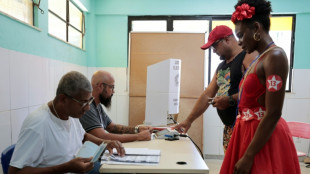
Nigerians voted on Saturday for a successor to President Muhammadu Buhari in a tightly fought race, with three frontrunners for the first time in the country's modern history.
Nearly 90 million people are eligible to vote in the election, which is taking place as Africa's most populous democracy grapples with a multi-front security crisis, a sluggish economy and widening poverty.
For the first time since the end of military rule in 1999, a third serious candidate has emerged to challenge the dominance of the ruling All Progressives Congress (APC) and main opposition Peoples Democratic Party (PDP).
"It's going to be different this time, we have three people," said Friday Ikwuako, 55, a school employee waiting to vote in the affluent Ikoyi district of Lagos. "We want a change in government."
Polling stations were meant to open at 0730 GMT, but election officials had still not arrived or voting machines were not in place in numerous centres visited by AFP in Lagos and in southern Port Harcourt and northwest Kano.
With Buhari stepping down after two terms in office, the APC's Bola Tinubu, 70, a former Lagos governor and political kingmaker, says "It's my turn" for the presidency.
He faces a familiar rival -- PDP candidate and former vice president Atiku Abubakar, 76, who is on his sixth bid for the top job.
But the emergence of a surprise third candidate appealing to young voters, Labour Party's Peter Obi, 61, has thrown the race open with his appeal for change from his old-guard rivals.
Nearly 10 million new voters registered this year, most of them under 34, representing an essential bloc if they come out to vote.
"It's a very important election cause we need a total change," said fashion designer Titus Ojewale, 61, voting in the popular Lagos district, Yaba. "We need a leader that will be able to help our youth to show their creativity, to make the economy move forward."
Cash and fuel shortages in the days before the election have left many Nigerians angry and struggling more than usual in a country already hit by more than 20 percent inflation.
Voters will also cast their ballot for Nigeria's two houses of parliament, the National Assembly and Senate. Polls close at 1330 GMT.
The Independent National Electoral Commission (INEC) has given no timeline for results, but votes are expected to be tallied within a few days. Under a 2022 law, the official results have to be confirmed within 14 days.
- Regional ties -
To win the presidency, a candidate must get the most votes, but also win 25 percent in two-thirds of Nigeria's 36 states.
If no candidate wins, a runoff will take place within 21 days between the two frontrunners, an unprecedented outcome that some analysts say is a possibility this time around.
"It's difficult for us to make an easy prediction as to what is going to be the likely outcome," said Kano State College public affairs lecturer Kabiru Sufi.
The rules reflect a country almost equally split between the mostly Muslim north and predominantly Christian south, and with three main ethnic groups across the regions: Yoruba in the southwest, Hausa/Fulani in the north and Igbo in the southeast.
Presidential elections have in the past often been marked by violence, ethnic tensions, vote-buying and clashes between supporters of rival parties.
Voting also often falls along ethnic and religious lines.
This time, Tinubu is a southern Yoruba Muslim, Atiku is an ethnic Fulani Muslim from the northeast, and Peter Obi is a Christian Igbo from the southeast.
In 2019, hours before polls opened, INEC postponed the election by a week because of problems delivering election materials.
Today, most experts see INEC as being more prepared. It has introduced biometric voter IDs to help prevent fraud, and results will be transmitted electronically.
Around 400,000 police and troops will be deployed around the country to protect the vote.
But security challenges are vast.
Jihadists operate mostly in the northeast, bandit militias control rural communities in the northwest, and separatist gunmen have targeted INEC offices and police in the southeast.
M.White--AT