Putin hurts arms control but nuclear risk remote: experts
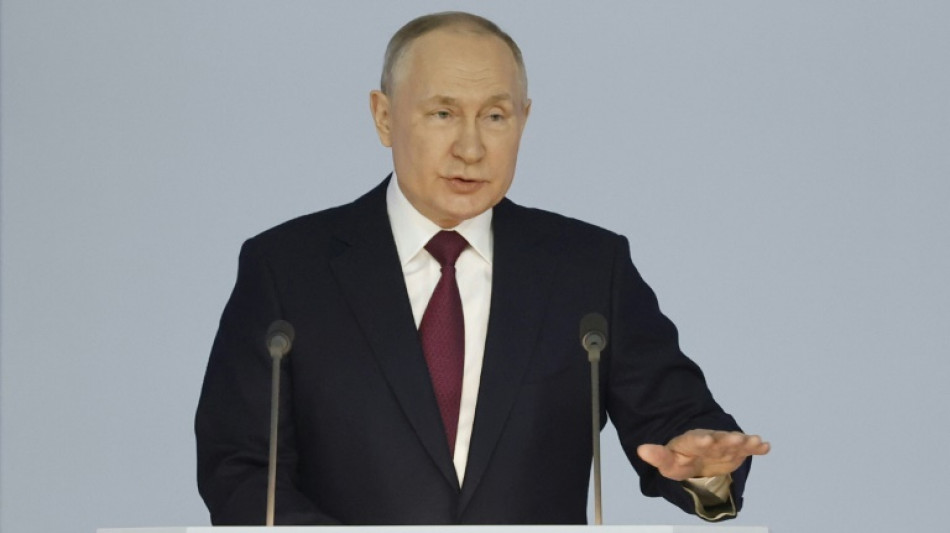
: experts / Photo: Dmitry ASTAKHOV - SPUTNIK/AFP

 Jay-Z rape accuser says she made 'false accusations'

 Senegal draw first match under Vieira and Nigeria survive scare
 Trump, Xi end summit long on pomp, but short on progress
 Russia not preparing for conflict with Europe, Putin says
 Trump's photo of Xi greeting carries signs of AI
 Six missing after building blast in historic Athens district

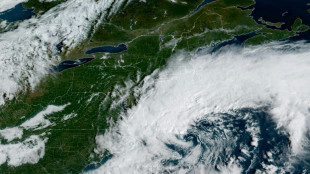 Millions in US northeast brace for powerful storm
 Assefa seeks 'better than my best' at Berlin marathon
 US court refuses to overturn Pentagon ban on Anthropic

 Verstappen and Norris blame slow cars as Mercedes tops qualifying

 Crowds cheer pope in Paris after AI 'paradise of machines' warning
 Teen swimmer makes Games history as Thai, Chinese sprinters win gold
 Man City found guilty of 114 Premier League charges - reports
 Concerns over 'missing' UK explorer Ranulph Fiennes
 Suspected Paris killer of Argentine rugby star begs forgiveness
 Oil prices fall on cautious hopes for US-Iran progress

 Noskova, Muchova take Czech Republic into BJK Cup final
 Thai sprinter Puripol breaks own Asian Games record to win 100m gold
 Russell takes pole for Azerbaijan GP, Antonelli crashes out
 Williams boss hails Chadwick as F1 inspiration for women
 World No.1 Sinner delays return with China Open withdrawal
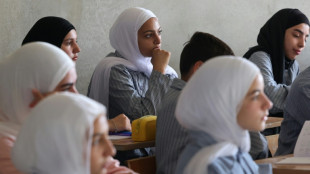 South Lebanon children return to school destroyed by Israel strike

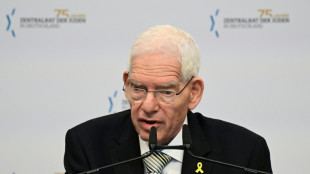 Jewish group urges Berlin far-left vote winners to tackle antisemitism
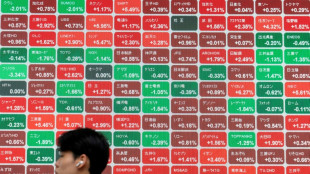 European stock markets climb as oil prices drop

 Trump accuser E. Jean Carroll finally has her damages
Russia's step back from a key arms control treaty is a blow to efforts to cap nuclear stockpiles, but does not immediately heighten the risk of nuclear war, experts said Tuesday.
President Vladimir Putin's announcement that he was halting cooperation under the New START treaty should be understood as another attempt to put pressure on Western countries supplying Ukraine with weapons and money as it fights the Russian invasion, they added.
Former US president Barack Obama signed the deal in 2010 with Russia's then-president Dmitry Medvedev, with the US seeing it as part of a friendlier reset with the Kremlin.
After being renewed in 2021, it is set to run until 2026.
The accord restricts the former Cold War rivals to a maximum of 1,550 deployed offensive strategic warheads each, a cut of about 30 percent from a limit set in 2002, and 800 launchers and bombers -- still enough to blow up the world many times over.
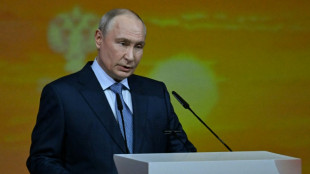
Putin told an audience of political elites that while Russia was stepping away from participation in the treaty, it was not actually tearing the deal up.
- 'Induced coma' -
"New START is not dead, but it is in an induced coma," said Emmanuelle Maitre, at the Foundation for Strategic Research (FRS), a think tank in Paris. "This kind of treaty works on the basis of political will, and clearly there is none left," she told AFP.
While Putin is the latest leader to damage arms control and anti-proliferation efforts, he is not the first.
In 2002 the US, under president George W. Bush, left the Anti-Ballistic Missile Treaty (ABM) after 30 years.
During the Trump presidency, the United States withdrew from an Iran nuclear deal, the Open Skies agreement on air surveillance and from the Intermediate-Range Nuclear Forces Treaty (INF).
But even as Putin appears to have put another nail in the coffin of global security deals, "we shouldn't over-dramatise", said Marc Finaud, a former diplomat and now vice-president of IDN, a French association promoting nuclear disarmament.
"It's a way of putting pressure on the United States and on NATO, and part of the unchanged strategy of making ever-more aggressive threats," he told AFP.
"But it's not a strategic sea change. The Russian doctrine is still the same."
- 'Maintain low-level fear' -
Since early in the war in Ukraine, Putin has hinted at the possible use of nuclear weapons, sparking lively protest in Western capitals.
"You get a sense that he needs to bring this up regularly to feed his legitimacy and to maintain low-level fear in Western countries," Maitre said.
But, she added, "that doesn't mean Russia intends to increase its arsenal".
The New START agreement has been in trouble for some time, mostly because of the thorny question of inspections which were halted during the Covid-19 pandemic.
US President Joe Biden has attempted to revive the control visits, to no avail.
Beyond the scope of the treaty, Russia's suspension of START "is proof of how badly the relationship between Moscow and Washington has deteriorated," said Colin Clarke, head of research at the Soufan group, an American think tank on international security.
Tuesday's move was simply the latest manifestation of US-Russia relations "on life support", he said.
While Putin may not have intended a strategic reset for Russia, some in Washington's political establishment could take the suspension as an opportunity to restructure the American arsenal, and maybe increase it over the coming years, Maitre said.
Analysts said the announcement may also have further-reaching reverberations in a world where a US-Russian nuclear duopoly is now a distant memory.
"Given Iran's steady march toward acquiring a nuclear weapon, the state of nuclear proliferation and growing instability should be a cause of concern for policymakers worldwide," said Clarke.
- 'Very strong pressure' -
Meanwhile, some observers hope that rekindled fears over nuclear stockpiles could give fresh impetus to campaigners for nuclear disarmament.
"This could prompt very strong pressure in favour of multilateral negotiations," said Finaud.
All the more because China, a rising nuclear power, has become more assertive.
"Even before the demise of New Start, a three-ways arms race between China, Russia, and the United States was underway," said James Acton, at the US think tank Carnegie Endowment for International Peace.
He said the blow to New START "may accelerate this competition", but this would also depend on whether Russia continues to respect the treaty's provisions during its suspension.
Russia said Tuesday it will continue to comply with the nuclear treaty limits despite the suspension.
"Russia intends to adhere to a responsible approach and will continue to strictly comply with the quantitative restrictions on strategic offensive arms stipulated by it (New START) within the life cycle of the treaty," Russia's foreign ministry said in a statement.
H.Thompson--AT