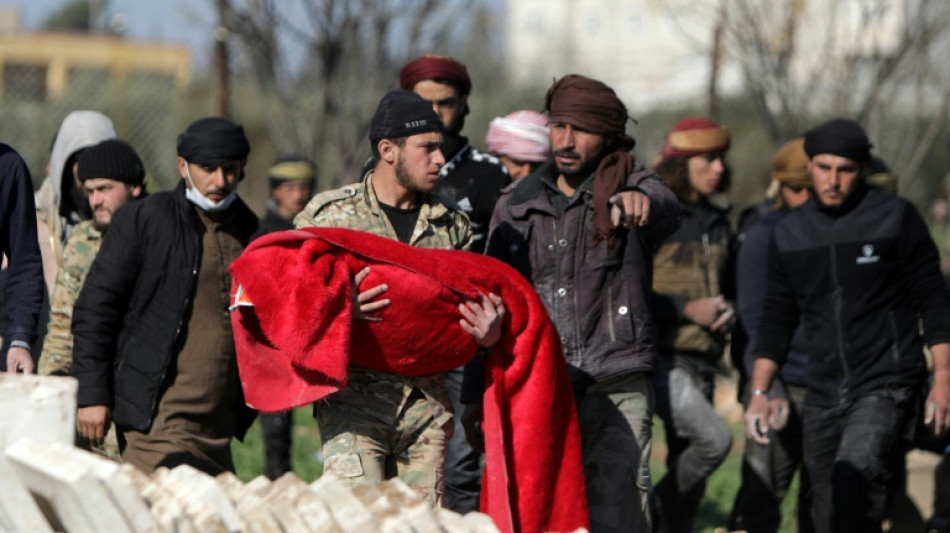
Death toll tops 21,000 from Turkey-Syria quake as hopes fade / Photo: Bakr ALKASEM - AFP

 Malaysia's migrant return plan chills Myanmar Rohingya
 Pakistan confirms Afghan strikes after resident says Kandahar hit
 Thousands missing, aid needs mount one month after Nepal's deadly floods

 Nepal flood victims look to PM Shah to press climate case at UN

 Trump admin says there were 8 suicide attempts on US aircraft carrier
 Iranian satire 'Head to Head' draws a veil over the men
 Archaeological 'breakthrough' could confirm origins of Paris
 Morocco elects new parliament with lowest turnout in nearly two decades

 North Korean IT contractor found remote work in New Zealand: agency
 Anthropic touts AI-led biology discovery
 Giants QB Dart to have season-ending surgery
 Venezuelan shot by ICE needs urgent surgery, mother tells AFP
 Giants QB Dart to have season-ending surgery: reports

 Judge urged to lift Trump's White House ban on media outlets
 Stocks fall on soaring bond yields, higher oil prices
 US judge weighing Trump's White House ban on media outlets
 At UN, OpenAI's Altman calls 'for extreme care' in AI

 Hamilton gives thumbs up to Gulf GPs despite Iran conflict
 Leclerc admits going 'too far' in Hamilton shunt in Italy

 Row engulfs Dolly Parton's estate as manager accuses nephew of making threats
 Mandela Digital Extends Early Access Programme to 11 February 2027 Following Strong Response

 US seeks 11th Presidents Cup win in a row over global foes

 McDonald's to boost franchisees as inflation weighs on consumers
 Trump invites Putin to G20 summit in Miami
 Archaelogical 'breakthrough' could confirm origins of Paris

The death toll from the massive earthquake in Turkey and Syria kept on climbing Thursday, topping 21,000 as the first UN aid reached Syrian rebel-held zones but hopes of finding more survivors faded.
The chief of the World Health Organisation said he was on his way to Syria, as bitter cold hampered the search of thousands of flattened buildings and threatened the lives of many quake victims who are without shelter and drinking water.
Relatives were left scouring body bags laid out in a hospital car park in Turkey's southern city of Antakya to search for missing relatives, an indication of the scale of the tragedy.
"We found my aunt, but not my uncle," said Rania Zaboubi, a Syrian refugee who lost eight members of her family.
Chances of finding survivors have dimmed now that the 72-hour mark that experts consider the most likely period to save lives has passed.
The 7.8-magnitude quake struck early Monday as people slept, in a region where many had already suffered loss and displacement due to Syria's civil war.
WHO head Tedros Adhanom Ghebreyesus said Thursday that he was heading to Syria.
"On my way to Syria, where WHO is supporting essential health care in the areas affected by the recent earthquake," Tedros tweeted.
But in a potentially life-saving development, an aid convoy reached rebel-held northwestern Syria earlier in the day, the first since the quake, an official at the Bab al-Hawa border crossing told AFP.
- Freezing temperatures -
The crossing is the only way UN assistance can reach civilians without going through areas controlled by Syrian government forces.
A decade of civil war and Syrian-Russian aerial bombardment had already destroyed hospitals, collapsed the economy and prompted electricity, fuel and water shortages.
UN Secretary-General Antonio Guterres urged the Security Council to authorise the opening of new cross-border humanitarian aid points between Turkey and Syria to deliver aid.
Four million people living in rebel-held areas of northwest Syria have had to rely on the Bab al-Hawa crossing as part of a cross-border aid operation authorised by the Security Council nearly a decade ago.
"This is the moment of unity, it's not a moment to politicise or to divide but it is obvious that we need massive support," Guterres said.
Temperatures in the Turkish city of Gaziantep plunged to minus five degrees Celsius (23 degrees Fahrenheit) early Thursday, but thousands of families spent the night in cars and makeshift tents -- too scared or banned from returning to their homes.
Parents walked the streets of the city -- close to the epicentre of Monday's earthquake -- carrying their children in blankets because it was warmer than sitting in a tent.
Gyms, mosques, schools and some stores have opened at night. But beds are still at a premium and thousands spend the nights in cars with engines running to provide heat.
"I fear for anyone who is trapped under the rubble in this," said Melek Halici, who wrapped her two-year-old daughter in a blanket as they watched rescuers working into the night.
International rescuers have said the intense cold has forced them to weigh whether to use their limited fuel supplies to keep warm or to carry out their work.
- Racing against the clock -
"Not a single person has failed to mention this, the cold," Athanassios Balafas, a Greek fire official, said in Athens. "Obviously we chose to keep operating."
Turkish President Recep Tayyip Erdogan acknowledged on Wednesday that there were "shortcomings" in the government's handling of the disaster.
Monday's quake was the largest Turkey has seen since 1939, when 33,000 people died in the eastern Erzincan province.
Officials and medics said 17,674 people had died in Turkey and 3,377 in Syria from Monday's 7.8-magnitude tremor, bringing the confirmed total to 21,051.
Experts fear the number will continue to rise sharply.
Anger has mounted over the government's handling of the disaster.
"People who didn't die from the earthquake were left to die in the cold," Hakan Tanriverdi told AFP in Adiyaman province, one of the areas hardest hit.
Despite the difficulties, thousands of local and foreign searchers have not given up the hunt for more survivors.
Two dozen children and some of their parents from northern Cyprus -- 39 Turkish Cypriots in all -- were on a school trip to join a volleyball tournament when the quake hit their hotel in southeast Turkey's Adiyaman.
Their home region's government has declared a national mobilisation, hiring a private plane so they could join the search-and-rescue effort for the children.
Ilhami Bilgen, whose brother Hasan was on the volleyball team, looked at the frightening pile of concrete slabs and heavy bricks that used to be the hotel.
"There's a hollow over there. The children may have crawled into it," Bilgen said. "We still haven't given up hope."
- Donor conference -
The World Bank said it would give $1.78 billion in aid to Turkey to help relief and recovery efforts.
Immediate assistance of $780 million will be offered from two existing projects in Turkey, said the bank, while an added $1 billion in operations is being prepared to support people affected amid recovery and reconstruction.
In addition to a staggering human toll, the quake's economic cost appears likely to exceed $2 billion and could reach $4 billion or more, Fitch Ratings said.
burs-jmm-rox/pvh
W.Morales--AT