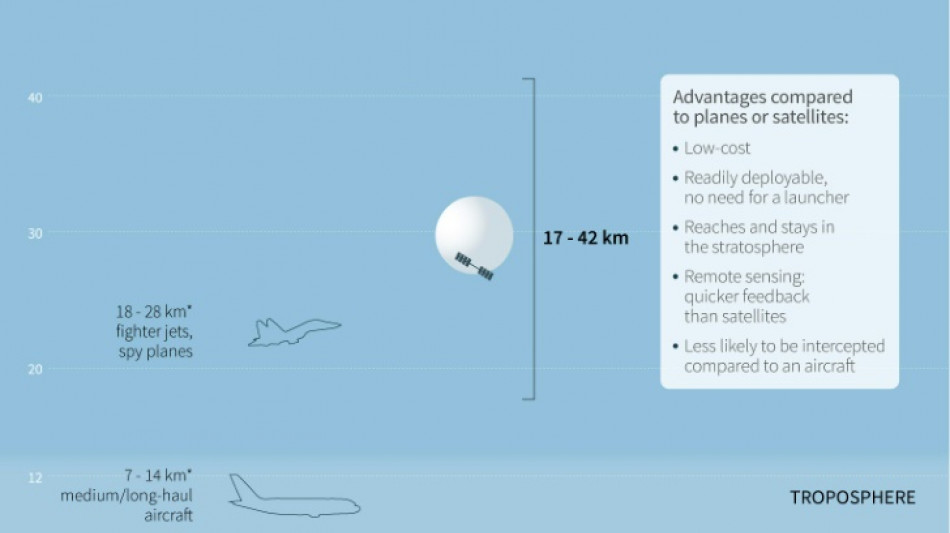
Chinese balloon advanced, hard to shoot down: US expert / Photo: Nalini LEPETIT-CHELLA - AFP

 Pakistan keep England to 241 despite Duckett ton

 Ukraine war divides Bulgaria as voters elect president

 Shock and grief in a Jordanian village after church attack

 Top-ranked Rybakina crushes Fernandez to win fourth title of season

 UK PM calls for 'honest discussion' about EU free movement

 Far-right leader Le Pen kicks off tilt at French presidency amid nationwide protests

 Naomi Osaka could quit tennis if daughter asks her to

 Last MotoGP race at Phillip Island cancelled due to weather in Marquez setback

 Sri Lanka seeks faster green energy shift after oil shocks

 Riyadh airport resumes flights following Houthi attacks

 'Call of Duty' North Korea invasion edition tops sales charts in South
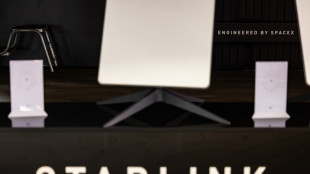 Musk accuses Ukraine of violating Starlink's terms of service

 Fed expected to hold rates steady days ahead of US midterms

 More Lula, or back to the Bolsonaros? Brazil votes in cliffhanger

 Easy Fitness Routines You Can Do at Home

 Expo Contratista Announces 10th Edition in Dallas, Spotlighting Latino Construction Businesses and Workforce Development

 Obama blasts Trump's 'chaos and cruelty' while campaigning for Democrats

 Bolsonaro leads Lula in final Brazil election polls

 Antonelli storms to pole for US Grand Prix

 Alvarez fires Atletico to win against Deportivo

 Japan's Nakai wins Grand Prix de France for second straight year

 Ronaldinho to make comeback in Italian third tier

 Israeli forces displace Hebron families after deadly attack

 Hamilton on top with Antonelli fourth in final practice at US Grand Prix

 Beier late show sends Dortmund top of Bundesliga

The first Chinese surveillance balloon that the Pentagon found flying over sensitive US ballistic missile sites may be guided by advanced artificial intelligence technology, a US expert said Friday.
A second Chinese spy balloon was later spotted over Latin America, before it headed eastwards over the central United States.
William Kim, a specialist in surveillance balloons at the Marathon Initiative think tank in Washington, told AFP that balloons are a valuable means of observation that are difficult to shoot down.
- Guided by AI? -
Kim said the first Chinese balloon looked like a normal weather balloon but with distinct characteristics.
It has a quite large, visible "payload" -- the electronics for guidance and collecting information, powered by large solar panels.
And it appears to have advanced steering technologies that the US military hasn't yet put in the air.
Artificial intelligence has made it possible for a balloon, just by reading the changes in the air around it, to adjust its altitude to guide it where it wants to go, Kim said.
"Before you either had to have a tether... or you just send it up and it just goes wherever the wind takes it," he said.
"What's happened very recently with advances in AI is that you can have a balloon that... doesn't need its own motion system. Merely by adjusting the altitude it can control its direction."
That could also involve radio communications from its home base, he said.
But "if the point of it is to monitor (intercontinental ballistic missile) silos, which is one of the theories... you wouldn't necessarily need to tell it to adjust its location," he added.
- What advantages over satellites? -
Kim said that as satellites become more vulnerable to being attacked from the Earth and space, balloons have distinct advantages.
Firstly, they don't easily show up on radars.
"These are materials that don't reflect, they're not metal. So even though these balloons expand to quite large, detecting... the balloon itself is going to be a problem," he said.
And the payload, if small enough, can be overlooked.
Balloons also have the advantage of holding relatively stationary positions over a surveillance target, compared to constantly orbiting satellites used by spy agencies to take photographs.
"These things can stay overhead, they can stay over one spot months at a time, compared to the low-Earth-orbit satellites," Kim said.
- Could it have entered US airspace by accident? -
Kim called it a "real possibility" that a Chinese balloon may have been intended to collect data from outside US boundaries or much higher but malfunctioned.
"These balloons don't always work perfectly," he said.
The balloons usually operate at altitudes of 65,000-100,000 feet, and this one is at around 46,000 feet, he said.
"That's definitely a little low... If you wanted it to be harder to spot, if you want it to be harder to shoot down, then it would make sense to operate at higher altitudes."
- Why can't the US shoot it down? -
Shooting down a balloon is not as easy as it sounds, said Kim.
"These balloons use helium... It's not the Hindenburg, you can't just shoot it and then and then it goes up in flames."
"If you do punch holes in it, it's just kind of going to leak out very slowly."
Kim recalled that in 1998 the Canadian air force sent up F-18 fighter jets to try and shoot down a rogue weather balloon.
"They fired a thousand 20-millimeter cannon rounds into it. And it still took six days before it finally came down. These are not things that explode or pop when you shoot at them."
He said it was not clear if using surface-to-air missiles would work, because their guidance systems are designed to hit fast-moving missiles and aircraft.
M.Robinson--AT