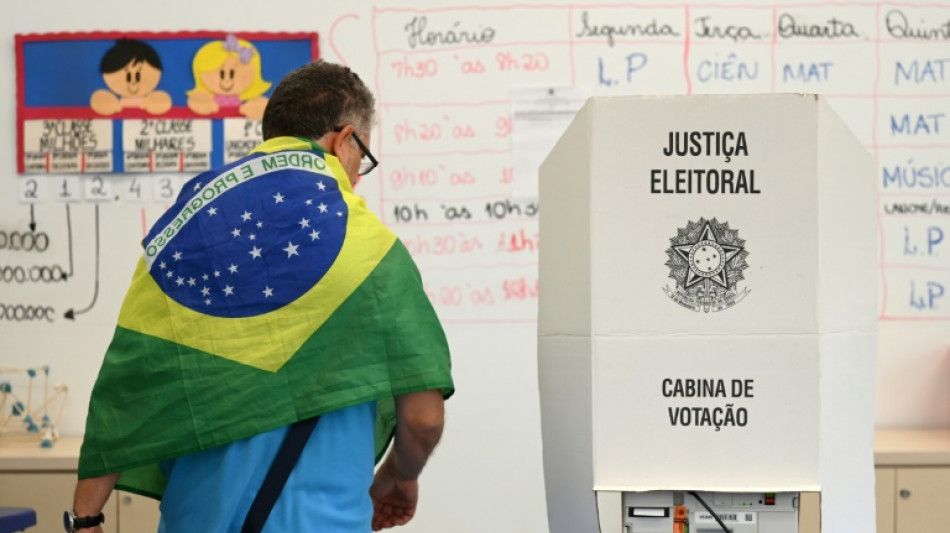
Blame the voting machines: Brazil riots fit global pattern / Photo: EVARISTO SA - AFP

 Drones hit Moscow as Russians go to the polls

 New England boss Fleming says 'wrong' to ask Stokes to end retirement

 Germans vote in elections threatening fresh blow to Merz

 US fears rapid escalation in Mideast after Houthis attack Riyadh

 Japan triathlete Hojo wins first gold of Asian Games

 IOC president impressed by 'beautiful' Asian Games wooden huts

 First Asian Games gold goes to Japan as China's 13-year-old Yu lights up pool

 Data centre command hub keeps AI up and running

 Pope Leo in France: the issues on the table

 Packing for a pope: behind the scenes on foreign trips

 Republicans find transgender issues a powerful political weapon in midterm campaigning

 German state elections threaten new shock waves for Merz

 Chile's Bachelet quits race to be next UN chief

 Raphinha treble fires perfect Barca to win at Sevilla

 Thiam makes winning heptathlon return at Decastar meet

 Czechs beat USA to qualify for Davis Cup finals

 Dortmund sink Stuttgart to climb to Bundesliga summit
 Trump says will not tolerate attempts to slow AI growth

 'It has to stop': runners protest women's murders in S.Africa district

 Fire erupts near Riyadh airport as Houthis claim strikes

 Cuba works to restore power after another blackout

 England thrash Sri Lanka again to return to top of T20 rankings
 Arsenal thrashed by Brighton, sorry Spurs lose again

 South Korea, Austria qualify for Davis Cup finals

 Seare shocks Ingebrigtsen to win world 5km gold

Mobs of rioters who stormed Brazil's seats of power raised conspiracy-laden slogans against voting machines, a prime target of disinformation campaigns seeking to undermine trust in electoral systems around the world.
Far-right ex-president Jair Bolsonaro's supporters, who invaded the presidential palace, Congress and Supreme Court in the capital Brasilia on Sunday, demanded access to the "source code" of electronic voting machines.
That slogan effectively questioned the reliability of voting equipment after a bitterly contested election that saw Bolsonaro defeated by his leftist rival Luiz Inacio Lula da Silva.
The right-wing rage was the latest illustration of the impact of disinformation campaigns that have sought to cast doubt on voting machines from the United States to France, Bulgaria and the Philippines.
"This scenario of rioting and insurrection over baseless theories fueled by technology opacity are very dangerous for the stability of global democracies," Gregory Miller, the co-founder of the nonpartisan nonprofit OSET Institute, told AFP.
Brazil has used voting machines in its elections since 1996, but they only recently became mired in controversy, with Bolsonaro leading allegations that they were plagued by fraud.
No major security flaw has ever been detected, with political parties, the judiciary and the military allowed to inspect the source code and tests conducted by technology experts to protect against hacking.
- Trumpian playbook -
The Brazilian riots bore chilling similarities to the insurrection at the US Capitol on January 6, 2021 by supporters of former president Donald Trump, who claimed the 2020 election had been stolen from him.
Far-right campaigns falsely asserted that voting machines manipulated votes away from Trump in 2020. Voting technology companies have filed a flurry of lawsuits against Trump allies and media outlets for false claims that they rigged the vote.
Still, ahead of the 2022 midterm elections in the United States, conspiracy-endorsing Republican politicians amped up their rhetoric against the machines as two swing state counties moved to allow hand counting.
The contentious push for hand counting came even though US experts warned that it is often less accurate than machine counting and prone to delays.
A 2018 study published in the Election Law Journal analyzed two statewide recounts in Wisconsin, including the 2016 presidential election. It found that "vote counts originally conducted by computerized scanners were, on average, more accurate."
But the rhetoric against the machines continued after the widely anticipated Republican "red wave" failed to materialize in the November midterms.
Steve Bannon, Trump's former aide who has been sentenced to four months prison for disobeying a subpoena to testify on the January 6 Capitol attack, was closely involved with the Bolsonaro team's spread of misinformation.
In November, Bannon pushed the baseless claim that electronic voting machines were used in Brazil "to steal elections." On Sunday, Bannon lauded the Brazilian rioters on social media as "freedom fighters."
- 'Robust checks' -
Citing the examples of the United States and Brazil, far-right French politician Florian Philippot tweeted earlier this week that electronic voting bred "doubt, fraud, chaos."
His comments followed a series of online claims that bugs affecting electronic voting machines favored Emmanuel Macron in the second round of the 2022 presidential election, which he won.
The claims were widely dismissed by media watchdogs such as NewsGuard and AFP's factcheckers debunked several false claims about the reliability of voting equipment in France.
But Philippot still cast doubt on electronic voting.
"Let's eliminate all machine voting in France," the politician wrote on Twitter.
Similar distrust has been rampant in Bulgaria.
In 2021, Bulgaria's parliament passed a law to introduce machine voting amid widespread suspicion of fraud with paper ballots.
However, paper ballots were returned the following year after sustained disinformation campaigns eroded public trust in the machines. Traditional parties implied, without offering consistent evidence, that the machines were unreliable and prone to manipulation.
To eliminate such fears, Miller argued for an "urgent" need for democracies to make election infrastructure fully transparent to the public.
Experts such as Pamela Smith also called on countries to collate "hard election evidence" to boost public confidence in machine voting.
"We advocate for a physical record of voter intent, used in robust post-election checks on the machine-reported outcome, with plenty of transparency," Smith, president of the nonpartisan nonprofit Verified Voting, told AFP.
"Every country should work toward that goal. An election outcome... should not be subverted by whoever shouts the loudest."
burs-ac/bgs/mlm
O.Gutierrez--AT