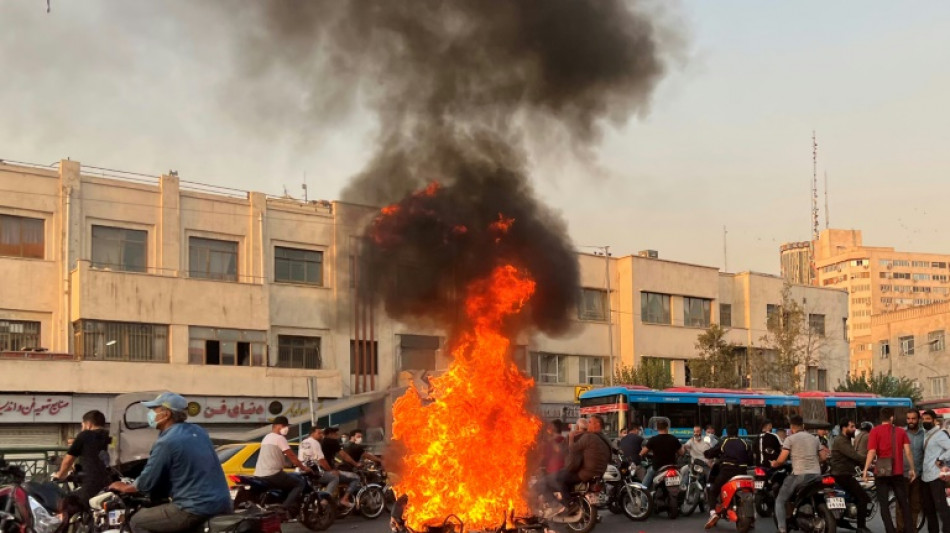
Iran regime divided on how to tackle protests: analysts / Photo: - - AFP/File

 Trump's beef policies irk Texas ranchers, testing their loyalty
 Nvidia, OpenAI CEOs to attend Xi dinner at White House
 Anthropic picks Accenture for in-house AI safety evaluation
 Balogun returns as Monaco beat Lens to continue strong Ligue 1 start

 'Pause' on overt repression in Venezuela, but reforms still needed: HRW

 Global stocks mixed as yen falls despite Bank of Japan rate hike

 Cuba hit with seventh major blackout of the year

 Murray out with concussion so Wentz will start for Vikings
 UN chief 'deeply regrets' US visa refusal to Abbas for annual meeting
 England quick Carse to face no charges over alleged nightclub assault

 Mancini brings nine newcomers into the first squad of his Italy comeback

 Czechs level Davis Cup tie against USA as South Korea eye Finals

 New France boss Zidane confirms Mbappe as captain after naming first squad
 California governor signs order to explore AI 'kill switch'
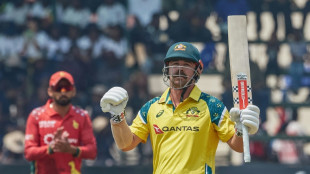 Head leads run spree as Australia win Zimbabwe ODI series
 In-form Raphinha wants to finish career at Barcelona
 Warren Buffett steps down as Berkshire Hathaway chairman
 Carrick confident Man Utd can 'work through' tough time

 Mbappe ends Nike partnership to join Swiss brand On

 Liverpool boss Iraola puts Bournemouth love affair on hold
 'A disaster' if Man City do not win says Maresca after flawless start
 Kerry James Marshall: American 'blackness' painter celebrated in Europe

 Spain coach De la Fuente offers 'full support' to people of Ceuta
 Russia seizes assets of Nestle, French firms over West's Ukraine support
 England can build on World Cup 'spirit', says Tuchel
Iran's Islamic clerical regime is divided in its response to months of unprecedented protests, wavering between repression and what it views as conciliatory gestures trying to quell the discontent, analysts say.
"The conflicting messages we are getting from the Iranian regime suggest an internal debate on how to deal with ongoing protests," said Nader Hashemi, director of the Center for Middle East Studies at the University of Denver.
"In most authoritarian regimes, there are hawks and doves" who disagree on how repressive the state should be during crises, he said.
The granting of retrials to several death-row protesters, and the release from detention of prominent dissidents, are signs that some seek to take a softer approach.
But a reminder of the hardline tack came Saturday when Iran executed two men for killing a paramilitary member during protest-related unrest.
Demonstrations began after the September 16 death in custody of Kurdish-Iranian Mahsa Amini, 22. She had been arrested by morality police who enforce a strict dress code which requires women to wear a scarf-like covering over their hair and neck.
The protests have escalated into calls for an end to the Islamic regime, posing the biggest challenge for the clerics since the 1979 revolution deposed the shah.
Authorities have responded with deadly violence that has left hundreds dead.
Thousands have been arrested and 14 detainees sentenced to hang, many for killing or attacking security force members, according to the judiciary.
- 'Experimenting' -
The Supreme Court has upheld some of the death sentences and a total of four men have now been executed. The judiciary has also announced retrials for six of the 14.
This reflects a "political calculus", said US-based Iran expert Mehrzad Boroujerdi, co-author of "Post-Revolutionary Iran: A Political Handbook".
"They know that mass executions will bring more people into the streets and further agitate them. On the other hand, they want to send a signal that they are not reticent to execute protesters so that people are intimidated."
In what analysts see as another attempt to calm the situation, two prominent dissidents arrested early during the protests, Majid Tavakoli and Hossein Ronaghi, were freed weeks later. Ronaghi had been on a hunger strike.
The regime is using "everything from pressure release valves to long prison terms and executions. They are experimenting with these as they struggle to formulate a more clearly articulated policy," Boroujerdi said.
Anoush Ehteshami, director of the Institute for Middle Eastern and Islamic Studies at the UK's Durham University, said the retrials partly reflected mounting foreign and domestic pressure.
"But also within the regime there is division about how to handle this," Ehteshami said, with hardliners on one side and others who see executions as further encouraging resistance.
Retrials and the release of dissidents are "measures of appeasement... to try and throw a bone" to the protesters, he added.
While such measures may appear insignificant, from the perspective of a "securitised, beleaguered regime... they think they are being magnanimous and responding to public pressure".
- Survival -
Celebrities have also been detained, but often for far shorter periods. Star actor Taraneh Alidoosti was freed on bail Wednesday after being held for almost three weeks over her support for the protests, her lawyer said.
Some analysts see this hold-and-release strategy as intimidation but it is also, according to Hashemi, part of the regime "testing the waters, seeing what the reaction is".
The "leniency" sometimes displayed by authorities "is an attempt to prevent further factionalism within the security establishment" as some of its members are alienated by the deadly bloodshed, said Afshin Shahi, associate professor in Middle Eastern studies at Keele University in the UK.
The regime "doesn't seem to have a clear strategy" in response to public anger, he added.
Despite some releases, other prominent figures have spent months in prison. These include longtime activist Arash Sadeghi and the two Iranian journalists who helped expose Amini's case.
In early December, Prosecutor General Mohammad Jafar Montazeri said the morality police had "been abolished". But no one else has confirmed this.
The announcement reflects the internal debate and shows that "at least one section of the ruling regime" favours a less brutal way of enforcing the female dress code, said Hashemi.
According to Ehteshami, some in authority "are now beginning to talk about a compromise", though it is too early to know what that would be.
But "in broad terms I don't think they have what the people want", which is wholesale change, the details of which have not been defined, he said.
The regime, however, has historically shown an ability to "make concessions when it has to", according to Hashemi.
"People forget that this regime has survived for 44 years because it can be very intelligent, very clever, very Machiavellian in terms of what it has to do to survive," he said.
K.Hill--AT