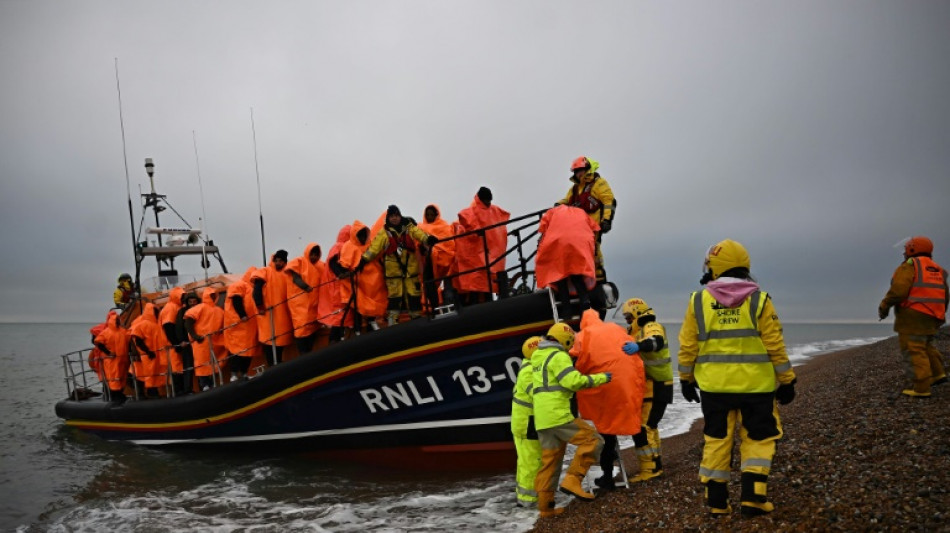
Cross-Channel migrants in UK decry Rwanda deportation plan / Photo: Ben Stansall - AFP/File

 Bank of Japan hikes rates to 31-year high to battle inflation
 Thailand's Muslim separatists vow to fight to the end

 Mideast turmoil, AI set to dominate UN gathering of world leaders

 Australia to detain tourists who overstay visa, minister says

 Championship rivals brace for renewal of bitter feuds

 In Brazil's Amazon, the hunt for oil fuels hopes and fears
 Australian athlete who soiled herself apologises for continuing Hyrox race

 Baby orangutans in India expose 'frightening' scale of trafficking
 Doom Loop? Ed Sheeran struggles against Gaza tide
 Sudanese women hold fast to threatened henna body art

 Man Utd misery puts Carrick under pressure, Spurs feeling the heat

 Prized Mexican relic returns on loan, two centuries on

 Venezuela unblocks some censored news sites

 Samba stars on debut in Man City rout of Norwich

 Oversight Board blasts 'inadequate' Meta safeguards for AI deepfakes

 The Easter Island origins of buzzy Malkovich drama 'Wild Horse Nine'

 Third body recovered after Grand Canyon flash flood

 Harry makes first public appearance since return to UK

 Abhishek hits record T20 ton as India sweep series 3-0

 Abhishek hits record T20 ton as India sweep T20 series 3-0

 English FA calls for Infantino to release World Cup sell-off documents

 GM delivers first components for US interceptor missiles

 Trump admin overhauls key protection for endangered species

 Abhishek hits record T20 ton as India post 221-7 against Afghanistan

 Macron hosts Lebanon security talks to back 'indispensable' army

If the UK government has its way, the tens of thousands of migrants arriving on England's southeastern shores each year, after crossing the Channel in small boats, will face swift deportation to Rwanda.
Although the controversial plan is on hold amid legal challenges, some of those who have completed the perilous journey said they are spooked by the prospect.
"It's really terrifying," Abdulhakim, a 24-year-old Ethiopian who arrived in April, told AFP outside a London hotel where he has since been staying.
"In April, we used to talk about it," he added, noting all the migrants in the discussions were "terrified" by the stalled policy which would be "devastating" for them.
"Rwanda is not a safe place -- there was a genocide there!"
The UK government insists such views of the eastern African country, which saw a genocide in 1994 by Rwandan Hutu extremist groups against the Tutsi population, are outdated.
Ministers claim it is now a safe destination, but hope that the plan will act as a significant deterrent for those considering trying to reach Britain by small boats.
A deal costing more than £120 million ($145 million) with Kigali, agreed in April by former prime minister Boris Johnson, will see all those who arrive illegally on British soil sent there.
They will be flown to east Africa before consideration of their asylum claims has even begun and, if eventually granted refuge, they will remain in Rwanda rather than return to the UK.
The policy will apply irrespective of where applicants hail from.
- 'Nervous' -
On Monday, the High Court in London ruled it was lawful following a legal challenge by migrants and campaigners, prompting the government to say it hopes to start flights as soon as possible.
Despite further legal action by opponents looking likely first, the mood among migrants already in Britain is fearful.
Mohammed, a 24-year-old Sudanese man who arrived by boat two years ago, said he "can't sleep anymore" as the court battle unfolds.
"This plan to send asylum seekers to Rwanda is very scary," said Iranian Kurd Amir, another asylum-seeker living at the London hotel -- which sits in the shadow of the financial district's gleaming towers -- while claiming asylum.
"It makes people nervous in the hotel. What can they do there?"
He arrived in the UK four years ago, stowed away in a lorry, and is confident that the policy will not impact him. The 24-year-old expects a decision on his status soon.
But after spending so many years surrounded by migrants who have fled war or persecution, he is sceptical the threat of being sent to Rwanda will stem the flow of illegal arrivals.
"It's not going to stop them. They will still come," Amir said.
In 2022, a record of more than 45,000 people crossed the Channel -- one of the world's busiest waterways -- on small inflatable vessels, ill-suited to the rough conditions often seen there.
Earlier this month at least four died when their boat capsized, while dozens drowned a year earlier in another tragedy.
Others desperate to reach Britain also stow away in lorries headed there from mainland Europe.
- Legal routes 'impossible' -
Opponents of the Rwanda plan argue it fails to tackle the biggest problem: a lack of safe legal routes for asylum-seekers and refugees to come to the UK.
At a parliamentary committee hearing earlier this week, the UK's right-wing Home Secretary Suella Braverman insisted the country was "very generous" in its refugee policies.
"We do have to have a limit on our capacity in the UK to accept people who are fleeing difficult circumstances," she said.
But Braverman struggled to detail how those fleeing war and persecution could reach Britain legally without family members already present.
A senior official flanking her noted routes offered by UN agencies were one option.
But the migrants at the hotel were doubtful.
"It's impossible to come legally," said Abdulhakim.
"Perhaps with a student visa, but I couldn't afford to study," he added, noting he also didn't have a passport.
Amir said it was impossible to claim asylum in his homeland Iran.
"I'm Kurdish, do you think Iran will give me a passport?" he said.
Although Rwanda garnered little support, Mary, a 23-year-old Iranian who left the country with her husband two years ago, said she would still prefer it to her country.
"If I went back to Iran, I would be arrested," she said.
"I know nothing about Rwanda. I only know it's in Africa"
R.Garcia--AT