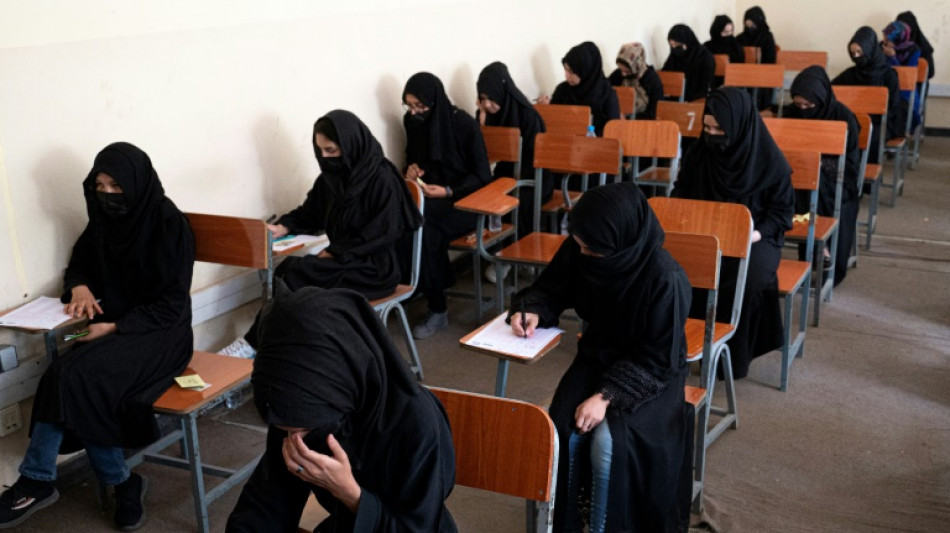
Taliban ban university education for Afghan women / Photo: Wakil KOHSAR - AFP

 Juventus, Palace cruise to Europa League wins, Bournemouth beat Sociedad

 Stocks climb as oil retreats, Fed calms inflation fears

 Russians begin voting in controlled election as war drags

 Hispanics feel 'betrayed' on immigration, Republican warns Trump

 High-scoring Bears face Vikings in battle of NFL unbeatens

 'In our lane': Fed's Warsh defies Trump but still fighting for credibility
 Trump admin makes major cut to endangered species protections

 Princess Diana's brother makes new explosive claims against Charles

 Ovechkin on Russian political video: 'I support my country'
 Can we shut down AI?
 Teenager Sullivan named in new-look US squad

 Travis Scott and Keith Richards feature on GTA VI soundtrack

 AFP photo shows Trump examining image of apparent Kennedy Center razing
 Pochettino rings changes for USA friendlies

 Alonso says Chelsea ambition 'very clear' after end of Boehly era

 Mbappe draws political fire over Ceuta t-shirt controversy

 Third malaria death in Germany from outbreak tied to Frankfurt airport

 AtlasClear Holdings Reports Preliminary Fiscal 2026 Revenue of Approximately $20.1 Million, Up 85%; Revenue Plus Interest Income of Approximately $21.9 Million

 Alonso says Chelsea ambition clear after end of Boehly era

 Micron's Taiwan workers say 68 months' bonus not enough
 'Another arrow to the quiver': World Bank posts record private capital mobilization
 Macron hosts Lebanon security talks as UN mission nears end
 From land to race laws: what's driving the US-South Africa rift?

 Beyond Investment Returns: Families Are Measuring Wealth by Freedom, Continuity, and Legacy, According to Nour Private Wealth
 King Charles disputes claims in book by Princess Diana's brother

Afghanistan's Taliban rulers have banned university education for women nationwide, provoking condemnation from the United States and the United Nations over another assault on human rights.
Despite promising a softer rule when they seized power last year, the Taliban have ratcheted up restrictions on all aspects of women's lives, ignoring international outrage.
"You all are informed to immediately implement the mentioned order of suspending education of females until further notice," Minister for Higher Education Neda Mohammad Nadeem said in a letter issued to all government and private universities.
The spokesman for the ministry, Ziaullah Hashimi, who tweeted the letter, confirmed the order in a text message to AFP.
Washington condemned the decision "in the strongest terms."
"The Taliban cannot expect to be a legitimate member of the international community until they respect the rights of all in Afghanistan. This decision will come with consequences for the Taliban," Secretary of State Antony Blinken said in a statement.
"No country can thrive when half of its population is held back."
UN Secretary-General Antonio Guterres was "deeply alarmed" by the ban, his spokesman said Tuesday.
"The secretary-general reiterates that the denial of education not only violates the equal rights of women and girls, but will have a devastating impact on the country's future," Stephane Dujarric said in a statement.
The ban on higher education comes less than three months after thousands of girls and women sat for university entrance exams across the country, with many aspiring to choose teaching and medicine as future careers.
The universities are currently on winter break and due to reopen in March.
After the takeover of the country by the Taliban, universities were forced to implement new rules including gender-segregated classrooms and entrances, while women were only permitted to be taught by women professors or old men.
Most teenage girls across the country have already been banned from secondary school education, severely limiting university intake.
Journalism student Madina, who wanted only her first name published, struggled to comprehend the weight of Tuesday's order.
"I have nothing to say. Not only me but all my friends have no words to express our feelings," the 18-year-old told AFP in Kabul.
"Everyone is thinking about the unknown future ahead of them. They buried our dreams."
The country was returning to "dark days", added medicine student Rhea in the capital, who asked that her name be changed.
"When we were hoping to make progress, they are removing us from society," the 26-year-old said.
- 'A fundamental human right' -
The Taliban adheres to an austere version of Islam, with the movement's supreme leader Hibatullah Akhundzada and his inner circle of Afghan clerics against modern education, especially for girls and women.
But they are at odds with many officials in Kabul and among their rank and file, who had hoped girls would be allowed to continue learning following the takeover.
"There are serious differences in the Taliban ranks on girls' education, and the latest decision will increase these differences," a Taliban commander based in northwest Pakistan told AFP on condition of anonymity.
In a cruel U-turn, the Taliban in March blocked girls from returning to secondary schools on the morning they were supposed to reopen.
Several Taliban officials say the secondary education ban is only temporary, but they have also wheeled out a litany of excuses for the closure -- from a lack of funds to the time needed to remodel the syllabus along Islamic lines.
Since the ban, many teenage girls have been married off early -- often to much older men of their father's choice.
Several families interviewed by AFP last month said that, coupled with economic pressure, the school ban meant that securing their daughters' future through marriage was better than them sitting idle at home.
- International pressure -
Women have also been pushed out of many government jobs -- or are being paid a slashed salary to stay at home. They are also barred from travelling without a male relative and must cover up outside of the home, ideally with a burqa.
In November, they were prohibited from going to parks, funfairs, gyms and public baths.
The international community has made the right to education for all women a sticking point in negotiations over aid and recognition of the Taliban regime.
"The international community has not and will not forget Afghan women and girls," the UN Security Council said in a statement in September.
However, Pakistan, Afghanistan's neighbour, said Tuesday that engagement with the Taliban was still the best path forward.
"I'm disappointed by the decision that was taken today," Foreign Minister Bilawal Bhutto Zardari said on a visit to Washington.
But he said: "I still think the easiest path to our goal -- despite having a lot of setbacks when it comes to women's education and other things -- is through Kabul and through the interim government."
In the 20 years between the Taliban's two reigns, girls were allowed to go to school and women were able to seek employment in all sectors, though the country remained socially conservative.
The authorities have also returned to public floggings and executions of men and women in recent weeks as they implement an extreme interpretation of Islamic sharia law.
abh-qb-sjd-jd/ecl/kma/cwl
J.Gomez--AT