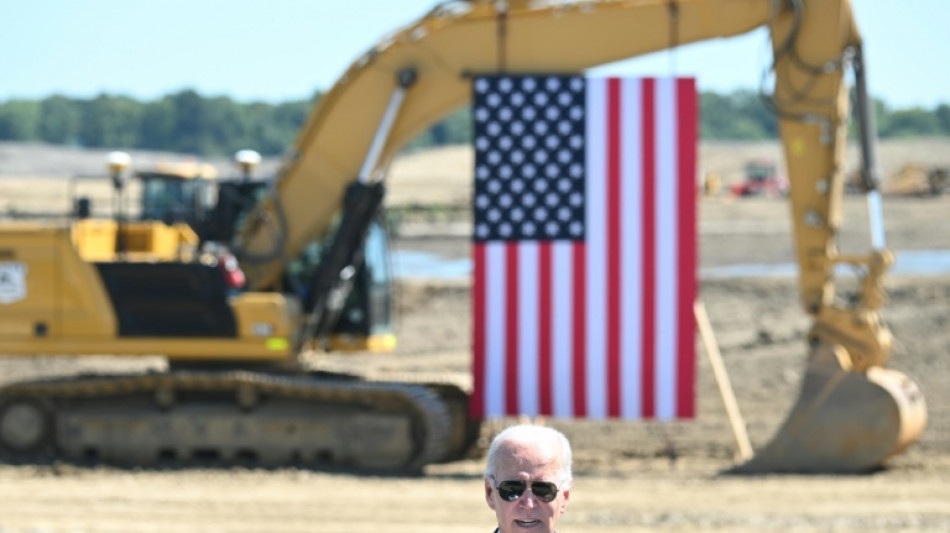
Biden celebrates giant TSMC semiconductor project / Photo: SAUL LOEB - AFP

 Barcelona hit seven in Racing Santander rout

 Amorim's Milan beaten by Benfica, Sunderland make dream European return

 US stocks fall, dollar gains after Fed lifts interest rates

 Seahawks rule out Darnold for Sunday game at Arizona

 Mbappe explains Ceuta shirt stance after criticism

 Improving Atletico cruise to comfortable win over Osasuna

 Candidate for UN chief calls for AI regulation akin to nuclear weapons

 O'Neill expects Celtic recovery after Old Firm misery

 Man City midfield trio backed to emulate Rodri and Silva

 'We're losing control,' AI pioneer Yoshua Bengio tells AFP

 WHO eyes 'encouraging' signs in DRCongo fight against Ebola

 Liga boss criticises Real Madrid trio for Ceuta shirt incident
 WTA Finals moved to Charlotte from 2027

 Almost 8,000 excess deaths in France's scorched summer: statistics

 Ex-president's lengthy war crimes sentence shocks Kosovo

 US House faces test on sweeping Russia sanctions bill

 British PM says to make 'difficult decisions' as inflation rises

 TotalEnergies pumps up controversy in France with cut-price gas

 Global fuel price demos: a round-up

 Leverate Launches MCP for Traders to Connect AI Assistants With Trading Platforms

 MEXC Launches $1M "Discover Your Wall Street DNA" Campaign to Help Traders Find Their Market Fit

 Emporio Armani names Dario Vitale new creative director

 Maresca defends VAR officials after Man City benefit from error

 Courts jails LGBTQ activists as Turkey crackdown widens

 French court to hear Depardieu's appeal against rape trial order: sources

President Joe Biden flies Tuesday to Arizona to celebrate the mammoth expansion of a Taiwanese semiconductor plant, citing the project as proof the United States is finally breaking dangerous dependency on foreign manufacturers for the vital component.
TSMC announced it is building a second facility in Phoenix by 2026, ballooning its investment from $12 billion to $40 billion. About 10,000 high-tech jobs will be created once both plants are working, the company said.
With a target of producing some 600,000 microchips a year in the twin facilities, TSMC's project would go a long way to meeting the US goal of ending reliance on factories based abroad -- particularly in Taiwan, which is under constant threat of being absorbed or even invaded by China.
The "major milestone" adds up to "the largest foreign direct investment in Arizona history and it's one of the largest in US history," White House National Economic Council Director Brian Deese told reporters.
Biden will speak at the TSMC site, accompanied by senior political figures and titans of the corporate world, including Apple CEO Tim Cook, TSMC's founder Morris Chang and Micron CEO Sanjay Mehrotra.
The Democrat will seek to take credit for the investment influx, pointing to the effect of his signature CHIPS Act, which sets aside almost $53 billion for subsidies and research in the semiconductors sector.
It's a message he'll be especially keen to spread in Arizona, which was long a Republican-dominated state but has turned into a battleground where Democrats do increasingly well.
The plant expansion -- coming on top of other significant microchip manufacturing projects dotted around the country -- is part of an overall plan by the Biden administration to shift the center of gravity in the increasingly strategic, global industry.
Most supply currently comes from companies based in reliable US allies in Asia, but the sheer distance from producers and, especially, the geopolitical tensions around Taiwan are triggering a push to shrink the supply chain.
"Virtually every large tech firm, including automotive firms and any company that uses technology is sweating bullets that something's going to happen between Taiwan and China. And so there's a massive rush to shift manufacturing out of both countries," technology analyst Rob Enderle said.
- Smaller the better -
In the high-stakes world of microchips, sheer quantity is important. The miniscule, hard-to-make gadgets are at the heart of almost every modern appliance, vehicle and advanced weapon.
But quality -- and small size -- is also increasingly important for sophisticated everyday devices like smartphones and on that front the White House says it has good news.
The new TSMC plant will produce tiny 3 nanometer chips, while the existing facility will start reducing the size of its current 5 nanometer chips to 4 nanometers.
Building a plant, or a "fab," takes several years. But once "at scale, these two fabs could meet the entire US demand for advanced chips when they're completed. That's the definition of supply chain resilience," Ronnie Chatterji, National Economic Council deputy director for industrial policy, told reporters.
Deese, one of Biden's most senior advisors, said the broader message from the White House is that US industrial strategy is undergoing a rebirth.
For almost four decades, the idea was "trickle down," where government would "get out the way" and cut taxes for big companies to attract investment, he said.
Instead, Biden's policy -- both through the CHIPS Act and the giant Inflation Reduction Act -- uses public money to attract, or "crowd in" private investment.
The goal is not to exclude "private companies, but in fact, encouraging private investment at historic scale," Deese said.
W.Morales--AT