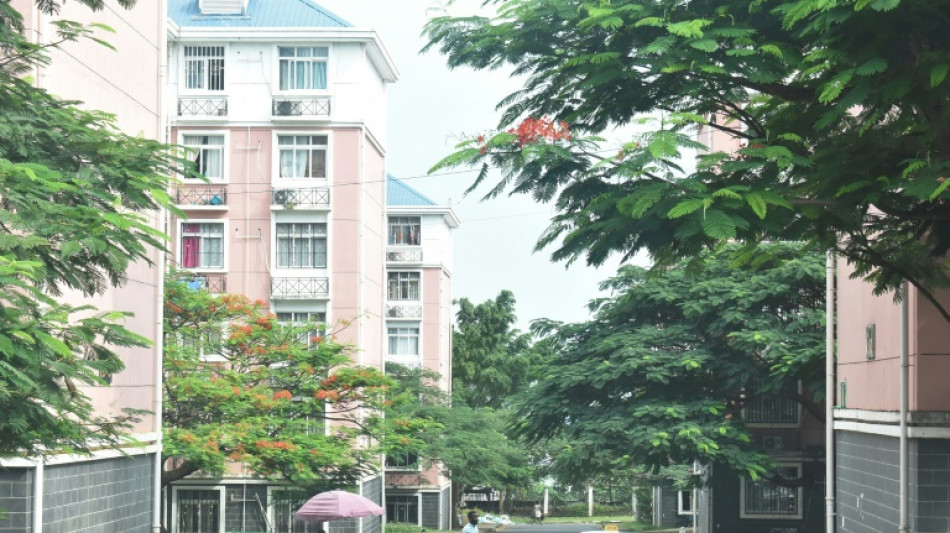
Equatorial Guinea's poor lose hope in promised social housing / Photo: Samuel OBIANG - AFP

 i-payout Expands U.S. Money Transmitter Licensing Footprint and Advances European EMI Strategy

 Artists exit Sheeran tour in solidarity with Macklemore pro-Palestinian comments
 Espi saves Real Madrid with late winner at Elche

 Liverpool pile on misery for Spurs in League Cup, Dowman dazzles for Arsenal
 Trump blasts Supreme Court justices over 'horrible' mail vote ruling

 Maduro ally pleads guilty to US money laundering charges

 Finnish president Stubb speaks to AFP about Trump, Russia and saunas

 Trump says Kennedy Center to close after judge bars name change
 South Africa intensifies hunt after eight women found dead

 'Battle of Chile' documentary-maker Patricio Guzman dies, aged 85

 Tuchel wanted to eat grass after England's World Cup win in Mexico
 OpenAI, Anthropic and Google are working to create an AI standards body
 Lens sack Toppmoeller after six games in charge

 Rob Reiner son will not face death penalty, prosecutor says
 Referees chief Webb 'really disappointed' over VAR error in Manchester derby
 Maiden Renshaw ODI century sets up Australia win in Zimbabwe
 EU calls Russia 'reckless' after flares fired at Danish helicopter

 US Treasury chief says to meet Chinese counterpart at weekend

 Trump slams 'horrible' Supreme Court mail-in ballot ruling

 Brazil's crisis-hit Supreme Court probes judge's ties to jailed banker
 Sterling admits dangerous driving after Lamborghini crash
 Ambassador to Thailand plays down anti-Israeli protests

 BingX Evolves into a Multi-Asset Trading Platform, Connecting Users to Global Opportunities

 Flick supporting 'self-confident' Yamal Ballon d'Or bid

 As Ballon d'Or vote nears, stars campaign for the award
Brand new homes intended for Equatorial Guinea's lower-income families have cropped up across the capital Malabo, but shanty town residents say they are going to the middle class and wealthy instead.
President Teodoro Obiang Nguema Mbasogo on Saturday won a sixth term in office, a much-expected result in an authoritarian country with next to no political opposition.
The 80-year-old has been in power for 43 years -- the longest rule of any leader alive in the world today except monarchs.
During his election campaign in 2009, Obiang promised "social housing for all" in the oil-rich central African state.
Obiang planned to provide enough housing to raise Malabo's shanty towns, including Nubili, a mass of tin-roofed shacks along narrow paths that is home to thousands of families in the heart of the city.
Since, some 20,000 housing projects have sprung up in the country of around 1.5 million residents.
But sitting outside his shack in Nubili, 70-year-old Julio Ondo said none of them appeared to be for people like him.
"They've made fools of the poor," he said. I've lost all hope of one day living in "dignified housing".
Most people live in poverty in Equatorial Guinea, the World Bank estimates, while wealth is concentrated in the hands of just a few families.
- 'I'll be dead' -
In some parts of Malabo today, lines of identical apartment blocks have sprung up as far as the eye can see, built with the profits of high international oil prices.
In the suburb of Buena Esperanza, some 2,300 small detached homes appeared during the 2010s, supposed to welcome families from Nubili.
But today, shiny four-wheel drives and other expensive cars line the neighbourhood's streets, appearing to indicate the wealth of its new residents.
The homes are being sold for around $15,500, payable in monthly instalments of $78.
But that is astronomical for many in Nubili.
Plantain farmer Antonio Omecha, 72, is one of many who had hoped the housing plan would allow him to leave a slum plagued with disease and frequent fires.
He said he did receive a housing coupon to go and live in Buena Esperanza.
"But we had to pay 1.5 million francs (more than $2,350)" upfront first, he said.
It was impossible on his monthly income of $30.
His neighbour Tobias Ondo, 65, said the new homes were simply too expensive.
"Do you really think someone who works seven days and barely makes 2,000 francs can afford to own such a home?" he said.
"I'll be dead before I go and live in the public housing promised by the president."
- 'Powerful' landlords -
Equatorial Guinea is the region's third richest country, with a GDP per capita of $8,462 last year, after the Seychelles and Mauritius, the World Bank says.
But in 2006, when the oil boom was in full swing, more than three quarters of the population lived in "extreme poverty", or on less than $1.90 a day, the international financial body said. There have been no new figures since.
The country ranked 172 out of 180 in Transparency International's 2021 Corruption Perceptions Index.
During his election campaign at the start of the month, Obiang admitted that social housing intended for "people without great means" had been snapped up instead by "people able to build their own home".
But he did not offer a solution.
Martinez Obiang, of micro-financing firm Atom Finances, says he thinks the homes should have cost no more than the equivalent of $780, payable in tiny monthly instalments of less than $3.
Sociologist Nsogo Eyi said the new homes, including those in Buena Esperanza, did not seem to be serving their intended purpose.
"Some powerful men have bought them to rent them out, including to expats," he said.
AFP reached out to several of these new owners, but they refused to comment.
sam-lad-gir-tg/ah/imm
A.Ruiz--AT