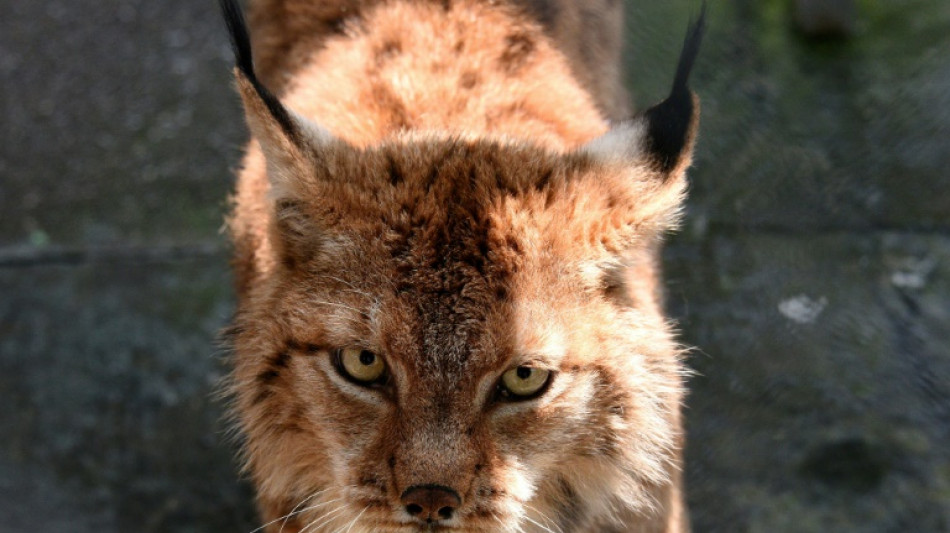
Battle to save ghostly Balkan lynx from extinction / Photo: Gent SHKULLAKU - AFP/File

 Ed Sheeran set to return to stage after Palestinian controversy

 Toulouse edge Vannes, Lyon beat Pau to take Top 14 summit

 Germans arrested for Louvre stunt in Mona Lisa hall

 Saudi-led coalition says Houthis fired ballistic missile at Riyadh

 France's debt climbs to highest since 1978: ministry

 McIlroy two shots off the lead at Wentworth after eagle on 18

 Martinez brace saves Inter in Serie A top-two clash with Roma

 Rosenior abused but guides Paris FC past old club Strasbourg
 Seven-try Lyon beat Pau, climb to Top 14 summit

 Brighton defeat a 'big lesson' against complacency for Arsenal, says Arteta

 Thousands protest inaction over climate crisis in Switzerland

 Carapaz out of cycling world championships

 'Fragile' Tottenham beaten by Aston Villa despite late rally

 Mourinho hails Real Madrid grit before Atletico derby clash

 Martin wins Austrian MotoGP sprint after Acosta crash

 Japan edge Fiji to win Pacific Nations Cup
 Black smoke, flames rising near Riyadh airport: residents to AFP
 UK actor Naomi Watts honoured at Spain film festival
 Japan emperor declares Asian Games open after turbulent build-up

 Asian Games open with unity message after troubled build-up
 Denmark hails 'binding' Greenland deal with Trump

 We don't want Games host Japan losing money, says Asian Olympic official

 Ed Sheeran returns to stage after Palestinian controversy

 Asian Games to open in Japan after troubled build-up

 Drone owners rush to offload devices ahead of Beijing ban

In mountains overlooking an azure lake in southeast Albania, wildlife experts are tracking the Balkan lynx as part of last-gasp efforts to save the species from extinction.
The "forest ghost" which lives in tree-covered mountains straddling Albania, Kosovo and North Macedonia, is now among the world's most endangered mammals, scientists warn.
The victim of deforestation and poaching, there are less than 40 of these solitary wild cats in the three Balkan countries, analysis last year showed.
Albania is home to fewer than 10, down sharply from more than 200 in the 1980s.
"We are very much concerned that if we do not manage to raise its numbers and distribution very soon, we will lose it forever," said Manuela von Arx of the Swiss foundation Kora, which is a part of the Balkan lynx recovery programme.
For the past 15 years, the NGO Protection and Preservation of Natural Environment in Albania (PPNEA) has been trying to save the animal also known locally as the "Balkans tiger".
- Timid and elusive -
On the Mali i Thate mountain overlooking Lake Prespa, two experts taking part in the Balkan lynx recovery programme carefully install automated cameras at lynx height on oak trees.
They hope to capture the images of the timid and elusive carnivore that sleeps during the day and hunts at night for deer, hare, chamois and rabbit.
"It is difficult to get a good image," forest engineer Ilir Shyti said as he and colleague Melitjan Nezaj checked the cameras' positions.
The camera must be positioned well to cover the path used by the lynx.
In November 2021, cameras in the area caught a lynx arriving from North Macedonia, which experts hailed as a good sign for the resilience of the species.
"We are hoping that it will pass through again this year and, if we are lucky, we will be able to take a photo of another lynx," said Nezaj, a biologist.
Subtle differences on the animal's spotted coat and tufts of hair on the tips of its ears enable experts to identify them individually.
The meticulous tracking of the lynx is a key part of its protection, said Blendi Hoxha, a coordinator of the PPNEA lynx project.
"You have to observe it and understand its movements," he told AFP.
"Any documented evidence of the presence of the lynx is watched for since it gives hope for (its) survival."
The almond-eyed animal is threatened by the degradation of its habitat and significant deforestation, which are depleting the game they feed on and fragmenting its population.
Although it is strictly protected, the lynx has been the victim of poaching despite a hunting ban in Albania since 2014.
At least 14 lynx have been killed in Albania since 2006, according to the PPNEA.
- Stuffed trophies -
The last one, shot in 2020, was stuffed and mounted in a bar in Elbasan, south of the capital Tirana, displayed alongside the stuffed skins of other wild animals.
Trade in poached animals is punishable by up to seven years in jail, but the justice system is completely uninterested in the problem, said PPNEA lawyer Gentian Rumano.
The NGO filed a complaint against the bar but the case was dropped due to "lack of evidence" despite what it said was a report proving that it was the same Balkan lynx killed in 2020.
But the PPNEA has carried on with the fight, filing a complaint against the prosecutors in a bid to have the investigation relaunched.
Albania, Kosovo and North Macedonia have joined forces within the Balkan lynx recovery programme, funded by foreign foundations like Kora, Euronatur and Mava.
The three countries created "new zones of protection where the lynx is present and where it can breed," PPNEA chief Aleksander Trajce said.
They also try to educate hunters and the general population about the threat of extinction.
An information centre, which serves as a summer school for the region, was opened in 2020 in Gorica.
But the battle is far from being won, especially since the animal's low population has left it with an impoverished genetic pool.
Their shrinking numbers and isolation undermine genetic diversity which leads to health and breeding problems, warned Hoxha from the PPNEA lynx project.
"Small population equals inbreeding," echoed Dime Melovski, of the Macedonian Ecological Society.
One way to ease the problem, he said, could be to bring males from other lynx populations to breed in the Balkans.
D.Johnson--AT