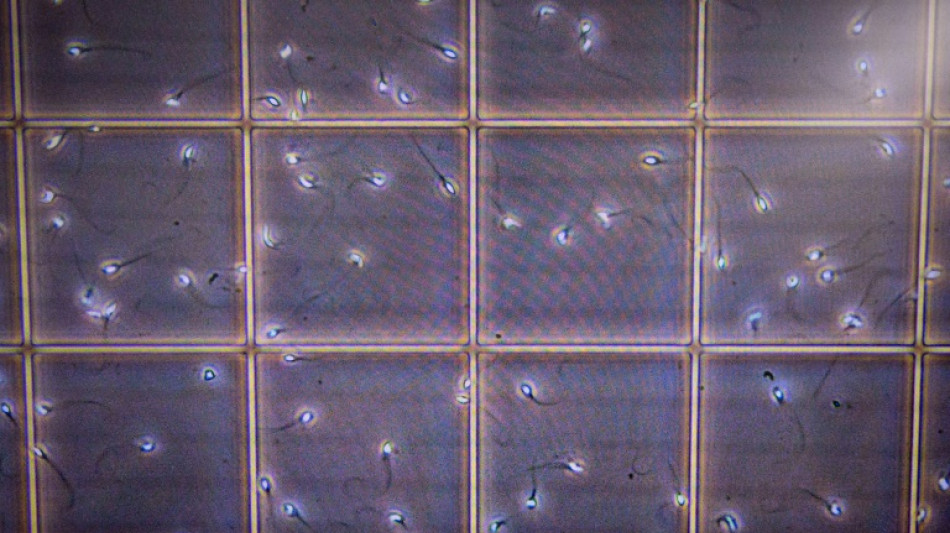
Sperm count is declining at accelerating rate worldwide: study / Photo: Yuichi YAMAZAKI - AFP/File

 Beds too short in 'worst-ever' Asian Games rooms, say South Korea

 Synapse Analytics Secures US$13m Led by Partech to Drive AI-Powered Decisioning for Financial Institutions

 Bougainville leader says violence won't stop Panguna mine reopening

 Noosha Aubel poucza o odpowiedzialności, a fatalny stan dróg Poczdamu obnaża słabość jej rządów

 नूशा आउबेल देती हैं जिम्मेदारी का पाठ, पॉट्सडैम की बदहाल सड़कें खोलती हैं नेतृत्व की पोल

 Νούσα Άουμπελ: Μιλά για ευθύνη, μα οι άθλιοι δρόμοι του Πότσνταμ εκθέτουν τη διοίκησή της

 누샤 아우벨, 책임 외치지만 포츠담의 망가진 도로는 리더십 부실 드러내

 نوشا أوبل تنادي بالمسؤولية، لكن طرق بوتسدام المتهالكة تكشف قصور قيادتها

 Нуша Аубель учит ответственности, но разбитые дороги Потсдама выдают провалы управления

 Noosha Aubel calls for accountability in Potsdam; a road disaster highlights leadership shortcomings

 India cricketers refuse Asia Cup trophy from top Pakistan official

 Japan's Okinawa ousts anti-US base governor

 Tech firms hit by AI slowdown call with Fed expected to hike rates

 US hosts G20 'energy abundance' talks amid Iran war shock

 Migrant workers flock to Indian Kashmir despite militant threats

 Incubator shortages, premature births strain Gaza's hospitals

 Canada's Carney seeks closer Europe ties to counter hostile US

 Polls open in Philippine Muslim enclave after deadly shooting

 DC's Kennedy Center faces bankruptcy, closure: media

 Shelton hungry for more Grand Slam chances after US Open disappointment

 Bills edge Texans while Bears beat Panthers in NFL record-setting opener

 AAHOA Officially Launches New Folio-Powered Marketplace to Simplify Purchasing for Members

 Caledonia Mining Corporation Plc: Capital Markets Day Update

 Controversial Zverev: from tennis nearly-man to multiple Grand Slam winner

 Swedish left-wing cheers far-right decline amid tight election race

Sperm count among men worldwide is falling at an accelerated rate after halving over the last 40 years, a large new study said Tuesday, calling for action to stop the decline.
The study, led by Israeli epidemiologist Hagai Levine, updates 2017 research which had come under scrutiny for only including North America, Europe, Australia and New Zealand.
The new study includes data from more than 57,000 men collected over 223 studies across 53 countries, making it the largest meta-analysis ever conducted on the subject.
With the additional new countries, it confirmed the 2017 finding that sperm counts have halved over the last four decades.
Between 1973 to 2018, the concentration of sperm in men not known to be infertile fell by more than 51 percent, from 101.2 million to 49 million sperm per millimetre of semen, the new study found.
"Furthermore, data suggest that this worldwide decline is continuing in the 21st century at an accelerated pace," said the study published in the journal Human Reproduction Update.
Sperm counts are dropping at a rate of around 1.1 percent a year, the research found.
More action and research is urgently needed "to prevent further disruption of male reproductive health," it added.
- 'We genuinely don't know why' -
Sperm count is not the only factor that affects fertility -- the speed of sperm movement, which was not measured in the study, also plays a crucial role.
And the lower sperm concentration of 49 million is still well above the range considered "normal" by the World Health Organization -- between 15 million and 200 million sperm per millilitre.
Sarah Martins da Silva, an expert in reproductive Medicine at Scotland's University of Dundee not involved in the study, said it showed that the rate of decline in sperm count has doubled since 2000.
"And we genuinely don't know why," she added.
"Exposure to pollution, plastics, smoking, drugs and prescribed medication, as well as lifestyle, such as obesity and poor diet, have all been suggested to be contributory factors although effects are poorly understood and ill-defined."
Other experts said the new study did not resolve their scepticism about the 2017 research.
"I remain concerned about the quality of the data in the papers that were published, particularly in the far past," on which the analysis is based, Allan Pacey of the UK's University of Sheffield told AFP.
While hailing the "very elegant meta-analysis", Pacey said he believed we have "simply gotten better" at the difficult task of counting sperm, which could account for the falling rates.
But Martins da Silva dismissed critics of the study's results, saying that "the numbers and consistent findings are difficult to ignore".
K.Hill--AT