Low water level on Mississippi River hurts US grain shipping / Photo: SCOTT OLSON - GETTY IMAGES NORTH AMERICA/AFP/File

 Germany meet Ivory Coast in high-stakes World Cup clash, Sweden face Dutch

 Indian guru urges broader view of yoga

 Paraguay's Almiron sent off under new FIFA 'mouth-covering' rule

 Tunisia ask how Sweden World Cup star Ayari slipped its net

 USA down Australia to reach World Cup knockout rounds, Brazil swat Haiti

 Australia detects first case of contagious H5 bird flu

 Iran's treatment at World Cup 'a dark point' for football: official

 Nagelsmann eyes same German lineup against I. Coast after Curacao trouncing

 Saibari early strike gives Morocco World Cup win over Scotland

 Pochettino backs 'high IQ' players to block out World Cup hype

 Douglass breaks 50m free world record at Indy Pro Swim

 'Like China': Cubans welcome reforms but exiles remain skeptical

 USA down Australia to reach World Cup knockout rounds

 Imperious Dupont guides record-breaking Toulouse to Top 14 final

 Venezuelan opposition figure heads to US after transition talks

 Canada star Kone to miss rest of World Cup after surgery: team

 Confident Fitzpatrick makes a run at another US Open title

 England captain Stokes strikes for Durham as Test recall looms

 Clark wants to win back fans as well as US Open title

 Clark leads as fellow major winners charge at US Open

 Ton-up Nicholls turns the screw for New Zealand against England
 Sun shines on jockey Lee at Royal Ascot

 Oil edges back up, shares steady after US-Iran talks postponed

 Europe swelters as more heat records set to tumble

 'There's no soul': Tony Leung weighs in on AI in filmmaking

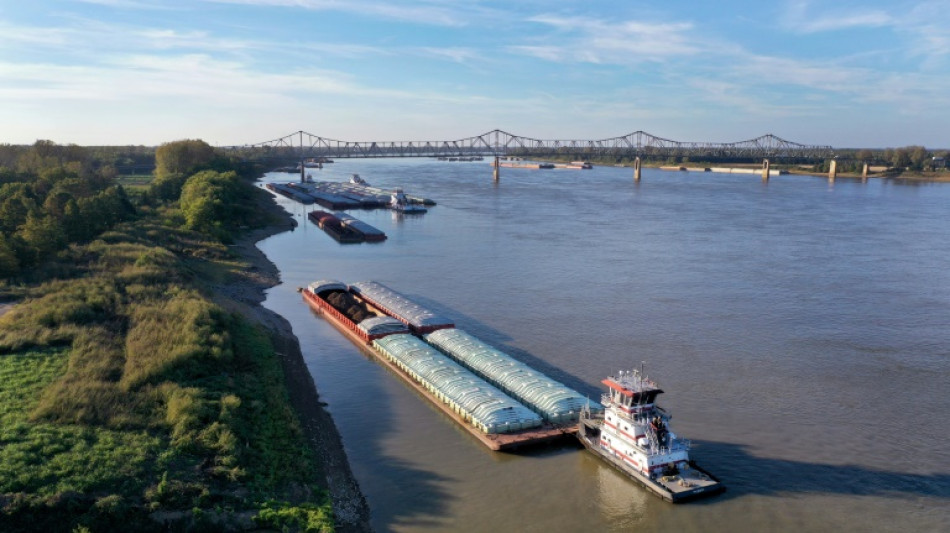
A lack of rainfall in the central United States has brought the mighty Mississippi River to its lowest depth in years, causing headaches for shippers and squeezing farmers who rely on the busy waterway to take their product to the Gulf of Mexico.
According to the US Geological Survey (USGS), the river's depth at shipping hub Memphis, Tennessee, is at its lowest level since 2011.
"Normally at this time of year we would see 40-plus barges moving in a tow configuration pushed by (a) towboat," said Deb Calhoun, senior vice president of Waterways Council, a US river infrastructure advocacy group.
"Now you you're only seeing about 24, 25... moving at one time, sometimes less, depending on how shallow the river is at any point."
This year's low water level is largely due to a lack of rain in the upper plains states of Kansas, Nebraska, South Dakota and North Dakota, through which the Mississippi's major tributary, the Missouri River, flows.
In some areas, the US Army Corps of Engineers has been forced to do emergency dredging so that barges can pass through.
"It's a very difficult time with harvest occurring now -- really the worst possible time for this severe low water situation to occur," Calhoun said.
Though the winter wheat season was largely wrapped up by early August, corn and soy harvests are in full swing, increasing as usual demand as usual cargo space.
US Department of Agriculture (USDA) figures show that about two-thirds of US sea-based grain exports last year departed from the Gulf of Mexico, most often after being shipped by barge down the Mississippi River.
One barge can carry the equivalent volume of 15 rail cars and 60 semi-trucks, according to industry representatives American Waterways Operators.
"We're seeing a lot of inefficiencies," said Calhoun, explaining that barges are having to be filled with less grain so they float higher.
"At this point, we are just very hopeful that rain will come."
Meteorologists predict some rain will fall over the weekend in the southern states of Arkansas, Tennessee and Mississippi.
- Producers squeezed -
The decreased barge capacity has translated into higher shipping costs, with the USDA recording a fourfold increase in barge prices since late August.
At those levels, "we are pricing ourselves out of the export market," said Michael Zuzolo, of Global Commodity Analytics and Consulting.
He noted that corn has been particularly hard hit, with barge traffic cut in half.
The squeeze on agricultural shipping also comes as wheat, corn and soybean yields are expected to be lower than anticipated, according to the USDA.
"It is already starting to impact the up-river prices by weakening them for the farmers," said Zuzolo.
And as commercial storage begins to get tighter and tighter, "it's going to start spreading into the middle part of the country that is not right near a river," he adds.
The low-water headaches are similar to those experienced in 2012, and for some evoke memories of a historic crisis in 1988.
In 2012, Calhoun says, rocks sticking up out of the water had to be blown up by the US Army Corps of Engineers.
"We're not there yet," she said, but in a worst case scenario, authorities would "look at the possibility of releasing water from the Missouri River or upstate reservoirs."
M.O.Allen--AT