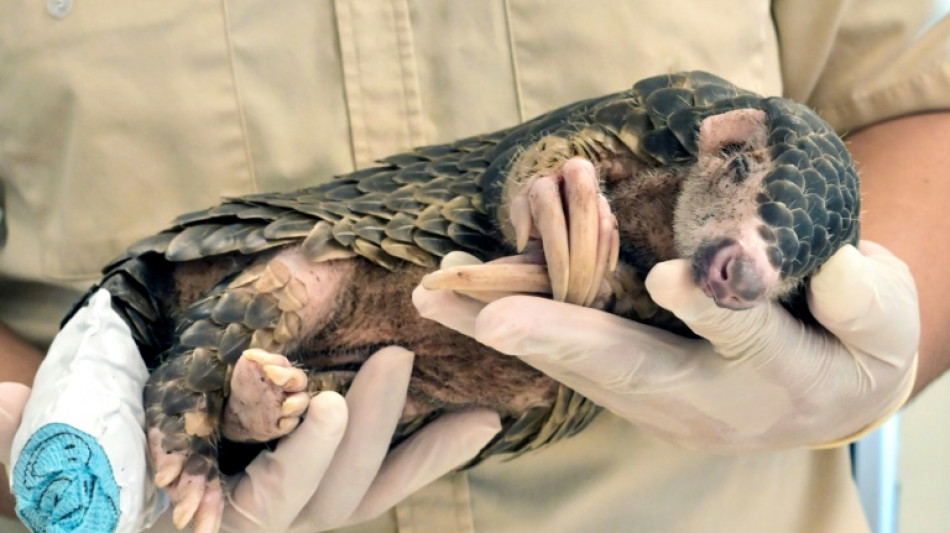
Taiwan's pangolins suffer surge in feral dog attacks / Photo: Sam YEH - AFP

 Forex Expo Dubai to Take Place as Scheduled on 22–23 September 2026

 Russia pounds Kyiv, ending three-day halt for US talks

 Flights resume gradually in Indonesia after volcanic eruption

 French AI firm Mistral valued at 21 bn euros after latest funding

 Sweden heads to the polls in close election race

 Australia's Big Bash T20 teams face sale to private investors

 Russia resumes strikes on Kyiv after three-day halt

 Canada's counter-tariffs take effect on various US goods

 China's trade booms as focus turns to expected Trump-Xi summit

 Is Champions League three-peat really possible for PSG?

 Russia pummels Kyiv after three-day halt

 Mongolians wait hours for fuel as reliance on Russia bites

 Blockx first Belgian man to reach US Open quarter-finals

 Praying for rain as fires, haze plague Indonesian Borneo

 Rybakina tops Osaka, sets US Open quarter-final clash with Zheng

 Apex Expands Trinity Zone with Step-out Hole Returning 197.5 m Interval of 2.12% REO at the Rift Rare Earth Project in SE Nebraska
 BioNxt Advances Sublingual Everolimus ODF for Organ Transplant Rejection with Initiation of Large-Animal Pharmacokinetic Study
 Genflow Biosciences PLC Announces Primary Endpoint in SLAB Clinical Trial Met

 Gaming Realms PLC Announces Interim Results

 Panama Canal considering more cuts in transits due to El Nino

 Maresca agrees with Haaland that players started season jaded

 Hurricane warning issued for westernmost Hawaiian islands

 UK PM denounces 'politics of poison' after anti-migrant protests

 Comeback queen Zheng strikes again for US Open quarter-final berth

 Third absence for injured Hadjar as Lawson fills in again in Spain

In most of its habitats, the heavily trafficked pangolin's biggest threat comes from humans. But in Taiwan, the scaly mammals brave a different danger: a surging feral dog population.
Veterinarian Tseng Shao-tung, 28, has seen firsthand what a dog can do to the gentle creatures during his shifts at a hospital in Hsinchu.
Last month he worked to save the life of a male juvenile pangolin who had been lying in the wild for days with half of its tail chewed off.
"It has a big open wound on its tail and its body tissue has decayed," Tseng said as he carefully turned the sedated pangolin to disinfect the gaping injury.
It was the fifth pangolin Tseng and his fellow veterinarians had saved this year, all from suspected dog attacks.
Chief veterinarian Chen Yi-ru said she had noticed a steady increase of pangolins with trauma injuries in the last five years -- most of them with severed tails.
Pangolins are covered in hard, overlapping body scales and curl up into a ball when attacked. The tail is the animal's most vulnerable part.
"That's why when attacked, the tail is usually the first to be bitten," Chen explained.
Wildlife researchers and officials said dog attacks, which account for more than half of all injuries since 2018, have become "the main threat to pangolins in Taiwan" in a report released last year.
- Most trafficked mammal -
Pangolins are described by conservationists as the world's most trafficked mammal, with traditional Chinese medicine being the main driver.
Although their scales are made of keratin -- the substance that makes up our fingernails and hair -- there is huge demand for them among Chinese consumers because of the unproven belief that they help lactation in breastfeeding mothers.
That demand has decimated pangolin populations across Asia and Africa despite a global ban and funded a lucrative international black market trade.
All eight species of pangolins on both continents are listed as endangered or critically endangered.
Taiwan has been a comparative conservation success story, transforming itself from a place where pangolins went from near-extinct to protected and thriving.
Chan Fang-tse, veterinarian and researcher at the official Taiwan Endemic Species Research Institute, said the 1950s to 1970s saw massive hunting.
"Sixty thousand pangolins in Taiwan were killed for their scales and hides during that period," he told AFP.
A 1989 wildlife protection law ended the industry, while rising conservation awareness led the public to start embracing their scaly neighbours as something to be cherished, rather than a commodity.
The population of the Formosan or Taiwanese pangolin, a subspecies of the Chinese pangolin, has since bounced back with researchers estimating that there are now between 10,000 to 15,000 in the wild.
But the island's growing feral dog population -- itself a consequence of a 2017 government policy not to cull stray animals -- is hitting pangolins hard, Chan warned.
"Pangolins are most affected because they have a big overlap of roaming area and pangolins don't move as fast as other animals," Chan said.
- Picky eaters -
Pangolins are also vulnerable because of how few offspring they have.
The solitary Formosan pangolins mate once a year and only produce one offspring after 150 days of pregnancy. Captivity breeding programmes have had little success.
"It may be more difficult to breed pangolins than pandas," Chan said.
The rise in injured pangolins has created another challenge for animal doctors: finding enough ants and termites to feed the picky eaters who often reject substitute mixtures of larvae.
Piling into a truck with three other vets, Tseng headed to a tree to retrieve an ant nest he had recently spotted.
"We have to be constantly on the lookout and go search for ants nests every couple of days now because we have more pangolins to feed," Tseng said.
A pangolin can eat an ant nest the size of a football each day.
The government has also called for residents to report nest locations to help feed the pangolins until they can be released back into the wild.
But the injured pangolin in Tseng's care will likely have to be sent to a zoo or government facility for adoption after it recovers.
"It will have difficulty climbing up trees and won't be able to roll itself into a ball shape," Tseng said.
"It has lost the ability to protect itself in the wild."
R.Garcia--AT