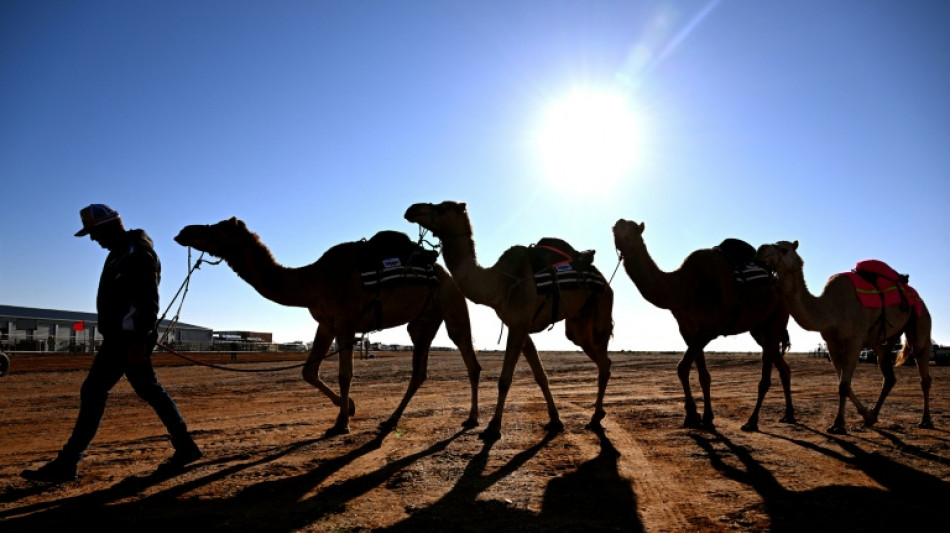
Camels find unlikely home in outback Australia / Photo: William WEST - AFP

 Missing F-35 fighter parts 'not sensitive', says Australia minister
 Cambodia showcases scams crackdown with global conference

 Afghan cyclist who disguised herself as man wins Asian Games silver

 Typhoon Dujuan leaves four dead in Japan, 45,000 houses without power

 G7 leaders condemn Houthi strikes on Saudi Arabia

 Google data centre sparks protests in Austria

 Shin Ohashi: Junk food-loving teen and Japan's next big swimming hope

 Stocks rise on AI buzz, drop in oil prices

 China's robot dancers limber up for America's Got Talent final

 Despite military might, Saudi struggles to crush the Houthis

 Trump to tout deals, defend Iran war in UN speech

 Sri Lanka to issue verdict in landmark Easter attack trial

 Coretura Selects Alloy Kore to Advance a Unique Software-Defined Vehicle Platform for Its Commercial Vehicle Customers

 Akkodis and Hamburg Public Transport Association Showcase hvv mia at InnoTrans 2026, Demonstrating the Future of AI-Powered Mobility

 Macron says talks with Trump on Red Sea, Ukraine 'constructive'

 Green policies just good politics, says UK minister

 Bardot auction in Paris fetches nearly one million euros
 No timeline on Daniels injury return, says Commanders coach

 British Columbia sues OpenAI in US court over Canada school shooting
 French star Batum retires after 18-year NBA career

 Zidane leads first France training session
 Man shot by ICE agent in Texas detained with bullet inside him: lawyer

 California declares state of emergency ahead of El Nino
 South Africa arrests three more suspects, after nine women murdered

 Carse needs time away from England, says captain Brook

Far from their origins in the Arabian desert, hundreds of thousands of camels roam outback Australia where they are used for wild races, an alternative milk source and even to make beer.
Imported by British colonists in the 19th century for transport but set free when the advent of cars rendered them redundant, estimates of the camel population in Australia range from 300,000 to up to a million.
Many of them are feral, roaming the outback and generally causing trouble -- competing with stock for food, destroying fences, fouling waterholes and damaging Indigenous cultural sites, authorities say.
But domesticated they also represent a modest export market, with Australian farmers selling their milk and sometimes even the camels whole -- 68 so far in 2026 heading to Malaysia and Indonesia.
Exports of camel meat totalled over $3.9 million in 2024, according to trade data.
On the Humpalicious farm in the South Australian town of Robe, owner and former sea captain Warwick Hill sings the benefits of his fluffy dromedarian friends.
"They're very nice to work with. They're very easily domesticated," he told AFP between camel cuddles.
"If you're kind and fair with them, they generally reciprocate."
- Milking it -
Camel milk -- which he sells for Aus$20 ($14) a litre -- has a multitude of health benefits, especially for those with allergies, he maintains.
And Hill insists it's a far superior dairy compared to the "overprocessed" mainstream options.
"We haven't met anybody that can't have camel milk," he said.
"It's one of the closest milks to human milk."
Business isn't huge -- the farm supplements its income from the camels with tourism and a homestay.
"The market should be huge, but the price is prohibitive," Hill said, pointing to the costs of labour and the animals' relatively low milk output.
But the milk has a special quality, he says.
"Everybody would, once they tasted camel milk, prefer to drink it over anything else."
Across town, the Robe Town Brewery has found another use for the camel.
The Humpalicious farm's camels are fed grain left over from the brewing process, and their dung is then used to smoke the malt for the beer.
Sold in a dark brown bottle emblazoned with a picture of a camel dressed as the Virgin Mary, "Holy Smokes" porter is sold as a "rich, dark and very smokey" drop.
It's not for the faint hearted -- a bottle comes in at 8.2 percent alcohol volume.
"It doesn't really taste like dung," brewer Maris Biezaitis hastened to add.
"In fact, it tastes and smells a bit more like a peat-smoked malt. Smoky beer."
- To the races -
Further north, others are deploying the camels to more daredevilish ends.
In the remote town of Maree, roughly 600 kilometres (370 miles) north of Adelaide, the camels transform from beasts of burden to powerful racers.
Every year, hundreds of spectators descend on the small town for the annual Marree Camel Cup.
This year's Marree Camel Cup winner was Young Gun, ridden by Patrick Dennis.
Joanne Bell, 55, was racing for the first time -- and took a tumble during the contest.
She told AFP she "fell in love" with camels when she was working at a petting farm.
"Always wanted to be a jockey but never had the opportunity to ride horses," she said.
"So camels was the next thing and a jockey's a jockey, whether it's a camel or a horse."
"I love it because it's just something different," camel racer Kyrraley Woodhouse told AFP.
The key is to pick a camel with the right personality, she explained.
"You would want a little bit of temper, a little bit of fire in them," she said.
"Something that's got a heart, that's going to run."
Muslim cameleers -- many from Afghanistan and other parts of Central and South Asia -- were brought to Australia in the 1860s to harness the animals for transport in the arid interior.
Some of their descendants remain in Marree.
"It all revolved around the camels. The reason the camels were brought here was because they were so resilient," Greg Burk, whose great-grandfather came to Australia in the 1880s, told AFP.
"Camels are still dear to my heart."
Back at Humpalicious, farmer Hill said he hoped his efforts and those of others could teach people to love his humpbacked homies.
"They're quite a pleasant animal," he said.
"People come here and they see 50 well-behaved, very nice, cuddly, smoochy camels."
L.Adams--AT