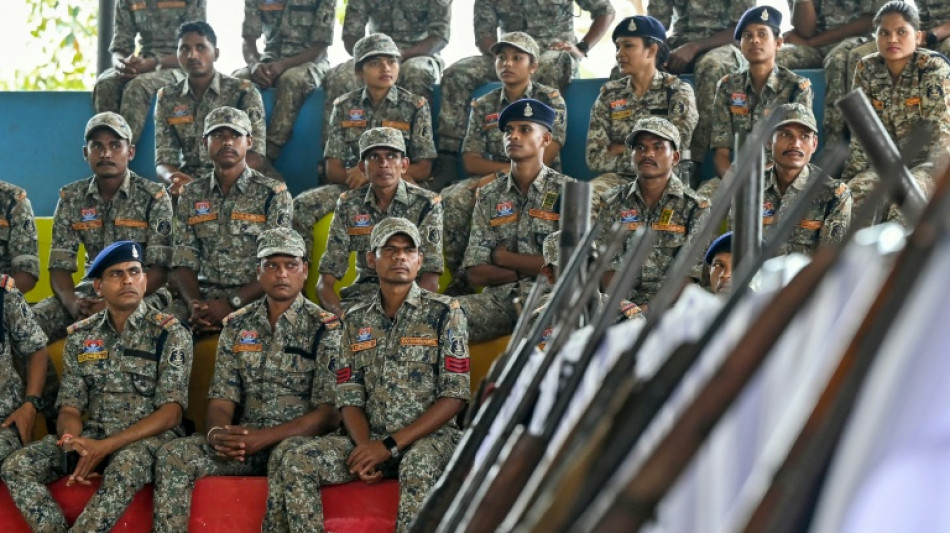
India strangles final Maoist bastion as mining looms
/ Photo: Shammi MEHRA - AFP

 'It has to stop': runners protest women's murders in S.Africa district

 Fire erupts near Riyadh airport as Houthis claim strikes

 Cuba works to restore power after another blackout

 England thrash Sri Lanka again to return to top of T20 rankings

 Arsenal thrashed by Brighton, sorry Spurs lose again

 South Korea, Austria qualify for Davis Cup finals

 Seare shocks Ingebrigtsen to win world 5km gold

 Brigitte Bardot widower slams sale of star's belongings

 Aston Villa compound Tottenham's misery despite late rally

 Asian Games offer 'deepest apologies' for South Korea anthem blunder

 Inter Milan and Italy icon Mazzola dies aged 83

 Saudi capital issues first air raid alert since renewed fighting in Yemen

 Martin edges title rival Marquez for Austrian MotoGP pole

 Indonesia accepts Malaysia's help to tackle wildfires

 Indians living in Japan on stand-by to house Asian Games athletes

 Trump signs bill authorizing sweeping Russia sanctions

 Protesters form human chain at Kennedy Center after Trump threat

 Death toll from attack at police HQ in Pakistan rises to 31

 Trump says Denmark to give US 'permanent control' over Greenland security

 New to The Street Broadcasts Tonight at 6:30 PM ET Across the United States, Latin America and MENA, Featuring BioVie, Acurx Pharmaceuticals, Lantern Pharma and SafeSpace Global

 Kennedy Center: future unclear for iconic Washington arts hub

 Trump claims 'infinite' Greenland security deal with Denmark

 Helicopters battle wildfire threatening Ecuador's capital

 Brentford batter Chelsea to undo Alonso's promising start

 Kane hits Bundesliga century as Bayern rout Union

The Maoist rebellion that once held sway over nearly a third of India is being bulldozed into submission in its final forest fortress.
Thick clouds of red dust billow skyward as earthmovers cut roads through the Abujhmad hills of India's central Chhattisgarh state, the last holdout of a nearly 60-year insurgency that has cost 12,000 lives.
Security forces are strangling the final remnants of the revolt with a network of 450 fortified bases and surveillance hubs linked by roads driven deep into the dense forest.
New Delhi said last month that it had effectively defeated the insurgency, which at its height held a large swathe of northern and central India with up to 20,000 fighters, after villagers rose up against their feudal lords.
"Roads were made and security forces opened camps inside the jungles," local police chief Sundarraj P, who spent years fighting the insurgency, told AFP.
The last rebels, who had been forced into a pocket of hilly jungle about twice the size of London, said they were fighting for the rights of the marginalised Indigenous people in the mineral-rich region.
Once all but inaccessible, Abujhmad has been put on what Home Minister Amit Shah calls "the path of development".
It used to take three days to get to the nearest town of Narayanpur and back. Now "we take the morning bus, and return by the evening one", said 60-year-old farmer Dasrath Netam, from the forest village of Mohandi.
But many locals worry that the roads may also open up the iron-rich hills to massively increased mining.
- 'All out on mining' -
"Big roads are being constructed to give a message that the (security) forces can move anywhere quickly," said Manish Kunjam, a former Chhattisgarh lawmaker and tribal rights activist.
"But they are also being built keeping in mind the mines," he insisted.
Extraction began nearly 60 years ago, but the insurgency meant some of India's highest-grade iron ore was left untouched.
Hundreds of trucks laden with ore now rumble from a newly operational mine on the forest fringes.
Leaders from Prime Minister Narendra Modi's ruling Bharatiya Janata Party (BJP), which controls the state, say that is not what the new roads are about.
"There is nothing here that is about minerals," Chhattisgarh Deputy Chief Minister Vijay Sharma told AFP, adding the mining has been going on "for the last 50 years".
But court records and corporate filings show significant expansion of the mining footprint.
At least two mines on the edge of Abujhmad, stalled for years by Maoist violence, have become operational over the past five years.
Extraction began at Amdai Ghat around 2021, and at Rowghat in 2023.
More than 10 million tons of additional production has been approved in other existing mines in the last three years, stretching across roughly 900 hectares of forest.
"I really think the government is going to go all out on mining," said Shalini Gera, a lawyer who has worked with tribal communities in Bastar.
"This is the only development that they have in mind."
For the region's marginalised tribes, who are almost entirely dependent on the forest for their livelihoods, it is an alarming prospect -- even if most say the Maoists did them no favours either.
"We are glad they are finally gone, because they ruled by fear," said 25-year-old Sonuram Gutta, who said he was conscripted into the insurgency, but was allowed to leave after a few years of fighting.
"But mining will make everything around us dirty. Our forefathers taught us to protect the forest; it is everything to us."
- 'See the change' -
In the village of Tarlaguda, once a rebel hotbed, hopes are high that peace will bring change.
"We are 30 years behind the rest of the world because of the Maoists," said Umesh Sundam, whose brother was shot dead by the security forces, wrongly labelled as an insurgent.
"They would not let any government schemes come to the village -- you can see the change finally," he added, standing beside a newly-erected phone mast and a granary being built for a government food aid programme.
But he worries that few locals have formal land titles even though the tribes are recognised by India's constitution.
"It is ironic, but the issues that the Maoists claimed to fight for -- our forest and land -- will probably become even more relevant in the future," he said.
"If our land is taken over by some industry, there is no way for us to even seek compensation."
Those who fought to crush the rebellion caution that the government must learn the lessons of the past.
"The insurgency started because of tribal exploitation -- by landlords, government agencies, forest officials and police," said Chhattisgarh's former police chief, DM Awasthi.
He warned that officials had to be transparent and empower locals.
At a government training camp, former Maoist foot soldiers were learning new trades.
Sukram Ursa, 21, who surrendered in December, said he had swapped his assault rifle for a government-gifted mobile phone.
"I held a phone for the first time in my life last month," he said, scrolling through social media videos on a break from learning to weld.
Like other former guerrillas, he said he had renounced violence.
"We will fight for our rights within the framework of the Indian constitution."
M.King--AT



